Home
Why The Princess and the Pea Is More Than Just a Bedtime Story
The Princess and the Pea is a classic fairy tale by Hans Christian Andersen, first published in 1835 . The story follows a prince who travels the world to find a "real" princess. One stormy night, a bedraggled girl arrives at his castle claiming to be royalty. To test her, the Queen places a single pea under 20 mattresses and 20 eider-down beds . The girl's inability to sleep due to the discomfort proves her "sensitivity," which the story equates with true nobility. Today, it ranks among the top literary examples of class satire and sensory awareness.
A Stormy Night and a Surprising Test of Royalty
The narrative begins with a sense of longing. A prince is in search of a "real" princess, but despite his extensive travels, he cannot find a candidate who meets his exacting standards. Every woman he meets has some flaw that makes him doubt her royal lineage. This setup establishes the central theme of the story: the difficulty of identifying true quality beneath a surface appearance.
The atmosphere shifts dramatically when a fearful storm breaks over the kingdom. According to the original Hans Christian Andersen text , the thunder crashed and the rain poured down in torrents. It was a truly terrifying night. Amidst this chaos, a knocking is heard at the town gate, and the old King goes to open it.
Standing there is a girl in a wretched state. The water streamed down from her hair and her clothes; it ran in at the toes of her shoes and out at the heels. Despite her bedraggled appearance, she makes a bold claim: she is a real princess. While the King is skeptical, the old Queen Mother decides to say nothing and instead prepares a secret test to uncover the truth. This moment is a significant advancement in fairy tale logic, moving away from magical transformations toward a psychological and physical test of character.
Read the Original 1835 Story by Hans Christian Andersen
Hans Christian Andersen wrote this tale in Copenhagen, and it was published on May 8, 1835. Interestingly, it is one of his shortest works, yet it remains one of the strongest to date in terms of cultural recognition. The story is classified as ATU 704 in the Aarne–Thompson–Uther Index, a category specifically dedicated to "The Princess on the Pea."
The Full Text of the Classic Tale
Once upon a time there was a prince who wanted to marry a princess; but she would have to be a real princess. He travelled all over the world to find one, but nowhere could he get what he wanted. There were princesses enough, but it was difficult to find out whether they were real ones. There was always something about them that was not as it should be. So he came home again and was sad, for he would have liked very much to have a real princess.
One evening a fearful storm blew up; it thundered and lightened, and the rain poured down in torrents. It was a terrifying night. Suddenly a knocking was heard at the castle gate, and the old king went to open it.
It was a princess standing out there in front of the gate. But, good heavens, what a sight the rain and the wind had made her look! The water ran down from her hair and her clothes; it ran in at the toes of her shoes and out at the heels. And yet she said that she was a real princess.
"Well, we'll soon find that out," thought the old queen. But she said nothing, went into the bed-room, took all the bedding off the bedstead, and laid a pea on the bottom; then she took twenty mattresses and laid them on the pea, and then twenty eider-down beds on top of the mattresses.
On this the princess had to lie all night. In the morning she was asked how she had slept.
"Oh, very badly!" said she. "I have scarcely closed my eyes all night. Heaven only knows what was in the bed, but I was lying on something hard, so that I am black and blue all over my body. It's horrible!"
Now they knew that she was a real princess because she had felt the pea right through the twenty mattresses and the twenty eider-down beds.
Nobody but a real princess could be as sensitive as that.
So the prince took her for his wife, for now he knew that he had a real princess; and the pea was put in the museum, where it may still be seen, if no one has stolen it.
There, that is a true story.
Understanding the Eider-Down and Mattress Layers
The specific construction of the bed is a detail that varies across translations, but the original Danish text emphasizes a staggering 40 layers . This includes 20 mattresses and 20 eider-down beds (often translated as feather beds or quilts). Eider-down, harvested from the nests of eider ducks, was considered a premier luxury material in the 19th century, known for its incredible softness and insulation.
The absurdity of the test—feeling a small legume through forty layers of the softest material known to man—is where Andersen’s wit shines. It is a satirical take on the idea of "blue blood" and the supposed physical delicacy of the aristocracy. Many readers find that this specific imagery is what makes the story a popular choice for children's illustrations.
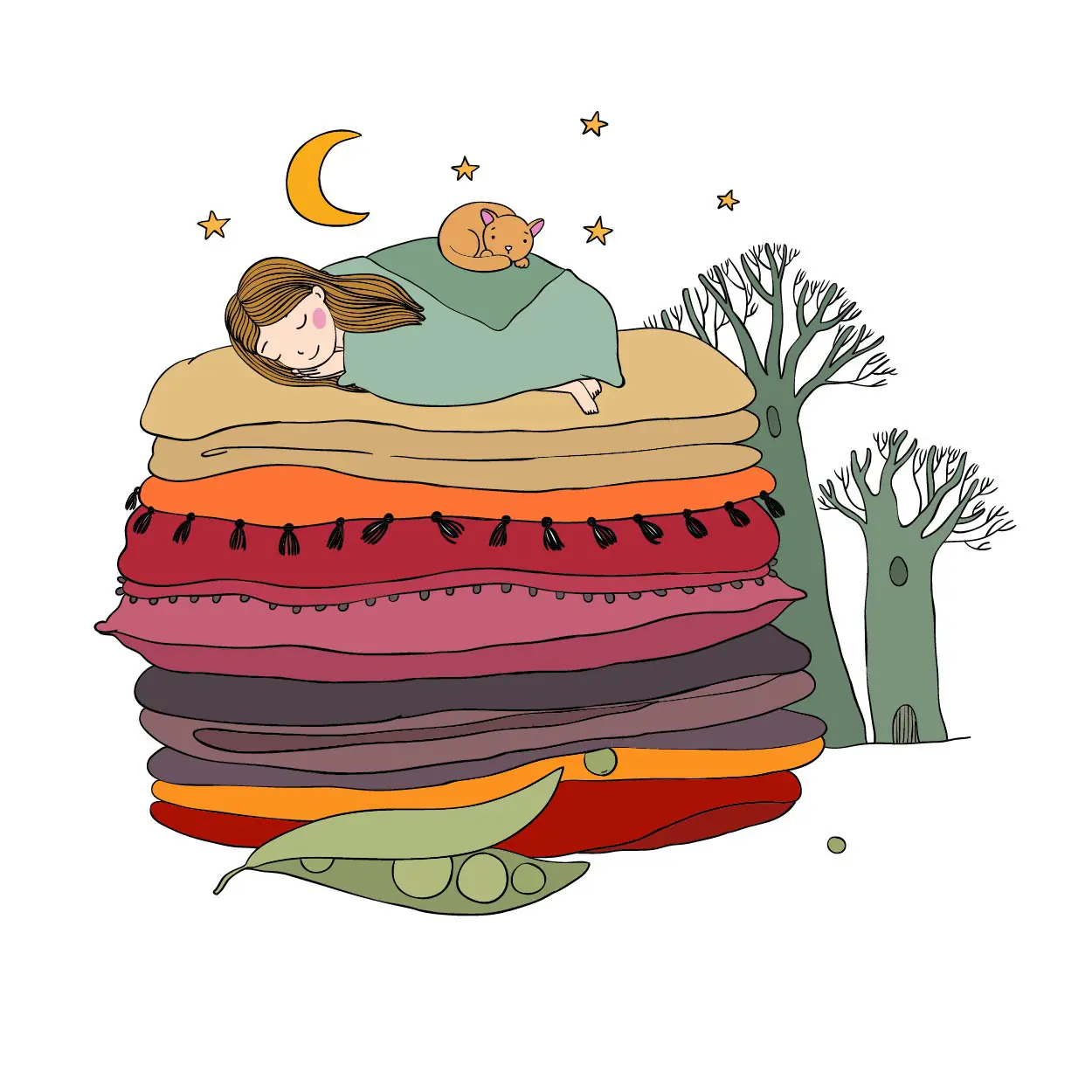
Image source: Storynory
How the Queen Proved She Was a Real Princess
The Queen's test is a masterclass in subtle observation. By placing the pea at the very bottom of the bedstead, she creates a situation where only someone with "supernatural" sensitivity could possibly be bothered. In the context of the 1830s, this sensitivity was a coded way of discussing class. The aristocracy believed they were biologically different from commoners, possessing a refinement that extended even to their nervous systems.
The Logistics of the Forty-Layer Bed
Modern readers often wonder about the practicalities of such a bed. According to historical analysis of the tale , the princess would have required a ladder to reach the top of the mattress stack. This visual has been used in countless stage adaptations to create a comedic effect. The sheer height of the bed serves as a metaphor for the barriers placed between the royal family and the outside world.
The "pea" itself is a fascinating choice. In some variations, it is a bean or a small stone, but the pea remains the most enduring version. It represents the smallest possible annoyance—a minor detail that a "normal" person would never notice, but which becomes an unbearable burden to the highly refined.
The Morning After and the Museum Ending
When the princess emerges the next morning, her complaint is specific: she is "black and blue." This suggests that the pea didn't just cause discomfort; it caused physical bruising. This extreme reaction is what finally convinces the royal family of her status. The prince, who had been searching for a "real" princess, is satisfied that her physical fragility is proof enough of her worth.
The story ends with a characteristic Andersen touch of cynicism. The pea is placed in the Royal Museum, where it can still be seen "if no one has stolen it." This final line reminds the reader that even the most sacred relics of royalty are subject to the mundane realities of theft and time. It grounds the fairy tale in a slightly gritty, realistic world.
What Does the Story of The Princess and the Pea Actually Mean?
Interpretations of this story have shifted significantly over the last two centuries. While it was once read as a simple validation of royal "delicacy," modern scholars and readers see much more complex layers—much like the bed itself.
Traditional Morals and the Concept of Nobility
Traditionally, the moral was seen as "true nobility will always reveal itself." No matter how wet or dirty the princess was, her inner nature (her sensitivity) could not be hidden. This aligns with the "Don't judge a book by its cover" sentiment found in modern summaries for children . She looked like a commoner, but her body "knew" she was a queen.
Modern Interpretations and Class Satire
Fairy tale scholar Jack Zipes offers a different view. He suggests that Andersen, who came from a poor background and struggled to fit into the Danish upper class, was actually mocking the aristocracy. The idea that a "real" princess is someone so fragile that a pea can bruise her through 40 mattresses is, in Zipes' view, a biting satire of the ridiculous standards of the elite. It suggests that royalty is defined by a lack of resilience—a trait that is hardly a virtue in the real world.
- Blue Blood
- A traditional term for nobility, originating from the idea that the skin of aristocrats was so pale that their blue veins were clearly visible.
- ATU 704
- The specific classification for stories involving a "sensitivity test" to prove royal status.
- Eider-down
- The soft under-feathers of the eider duck, used as a symbol of extreme luxury and comfort.
Comparing Different Versions of the Classic Tale
While the 1835 Danish original is the most famous, several variations exist that change the tone and motivation of the characters. Some versions emphasize the prince's own "fussiness," while others turn the story into a full-scale musical comedy.
| Feature | Original (1835) | The "Fussy" Version | Once Upon a Mattress |
|---|---|---|---|
| Prince's Goal | Wants a "real" princess | Wants a "fussy" wife | Wants to marry so his kingdom can too |
| The Test | One pea, 40 layers | One pea, 40 layers | A series of impossible tests |
| The Ending | Marriage & Museum | Marriage & Mutual Fussiness | A comedic subversion |
| Tone | Wry & Satirical | Moralistic | Farce & Comedy |
In the "Fussy" variation, often attributed to Dutch or regional folklore , the Prince is portrayed as someone who cannot stand anything that isn't perfect. He specifically seeks a wife who is as difficult to please as he is. This version frames the ending not as a discovery of nobility, but as a "perfect match" of two equally annoying people.
Why Is the Princess So Sensitive? (Modern Perspectives)
In recent years, the story has been reclaimed by communities who see the princess's sensitivity not as a royal flaw or a satirical joke, but as a legitimate psychological trait. This has given the story a new life in the 21st century.
The Highly Sensitive Person (HSP) Connection
The "Highly Sensitive Person" (HSP) community, a term coined by psychologist Elaine Aron, often points to this story as a metaphor for their experience. For an HSP, the "pea" represents the small sensory inputs—a flickering light, a loud noise, a scratchy clothing tag—that others might ignore but which cause them genuine distress. In this light, the princess is a top-tier icon of sensory awareness. The story validates the idea that just because others don't feel something doesn't mean it isn't there.
Sensory Processing and Feminist Critiques
Similarly, those with Sensory Processing Disorder (SPD) find the story resonates with their daily lives. As noted in literary analyses of the tale , the "pea" is a perfect metaphor for sensory overload. However, not all modern views are positive. Feminist critics, such as Toksvig in 1934, argued that the story promotes a harmful image of women as "thin-skinned" and fragile. They suggest that defining a woman's value by her inability to handle discomfort is a significant step backward for gender equality.
Fun Facts and Trivia About the Story
- Publication Date: May 8, 1835, in Copenhagen.
- Word Count: The original story is fewer than 1,000 words, making it one of the shortest famous fairy tales.
- Audio Duration: A standard reading of the story takes approximately 4 minutes and 30 seconds.
- The "Dutch" Confusion: While Andersen is Danish, the story is frequently misattributed as a Dutch folk tale in some European collections.
- The Museum: Andersen’s mention of the pea being in a museum is likely a reference to the Royal Danish Collections at Rosenborg Castle.
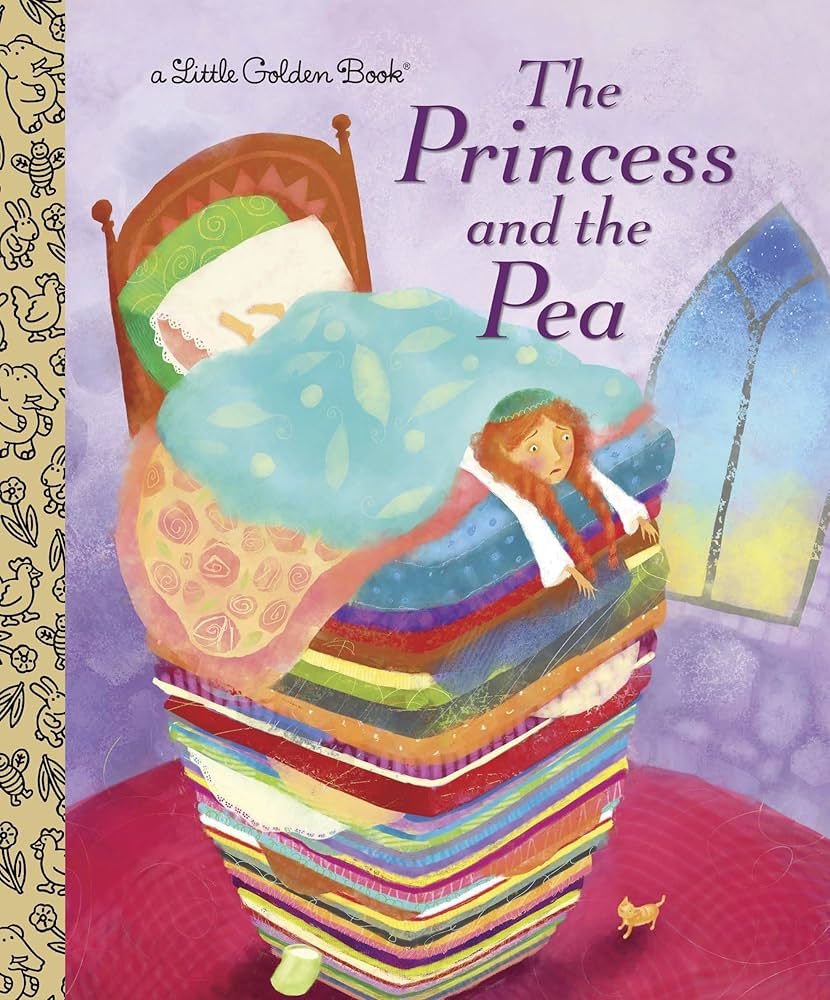
Image source: Amazon.com
Frequently Asked Questions
How many mattresses were in The Princess and the Pea?
What is the moral of The Princess and the Pea?
Is The Princess and the Pea a true story?
What was the princess's name in the original story?
Why did the Queen put a pea under the mattress?
Key Takeaways from The Princess and the Pea
The story of the Princess and the Pea remains a cornerstone of children's literature, offering a unique blend of whimsy and social commentary. Here are the essential points to remember:
- Historical Origin: Written by Hans Christian Andersen and published in 1835, it is one of his most enduring works.
- The 40-Layer Test: The test involves 20 mattresses and 20 eider-down beds, a staggering height that symbolizes royal isolation.
- Sensitivity as Nobility: The story equates physical delicacy with high social status, a concept known as "blue blood."
- Satirical Roots: Many scholars believe Andersen was mocking the aristocracy rather than praising them.
- Modern Relevance: The tale is now a premier metaphor for the Highly Sensitive Person (HSP) and Sensory Processing Disorder (SPD).
- Cultural Impact: From the ATU 704 classification to Broadway musicals, the story continues to evolve across media.
To truly appreciate the depth of this tale, consider reading it not just as a children's story, but as a reflection on how we perceive sensitivity and truth in our own lives.