Home
What Are the Best Short Stories of All Time and Why Should You Read Them?
Short stories offer a "distilled hit" of narrative intensity that novels often cannot match. Whether you have five minutes or an hour, these works represent the pinnacle of the craft.
Short stories are often described as a "shot of something"—an intense, concentrated burst of narrative that demands the reader's full attention. Unlike the sprawling canvas of a novel, a short story must achieve its emotional and intellectual impact within a limited word count, often leaving the reader transformed by the final sentence. According to the National Centre for Writing , the medium requires every bit of imaginative work to be hinted at in only a few lines, creating a unique pressure that results in some of the most memorable literature ever produced.
In this exploration, we look beyond the standard academic lists to find stories that are not only technically proficient but also culturally resonant and deeply engaging. From the psychological terrors of the 19th century to the silkpunk fables of the 21st, these works represent the diversity and power of the short form.
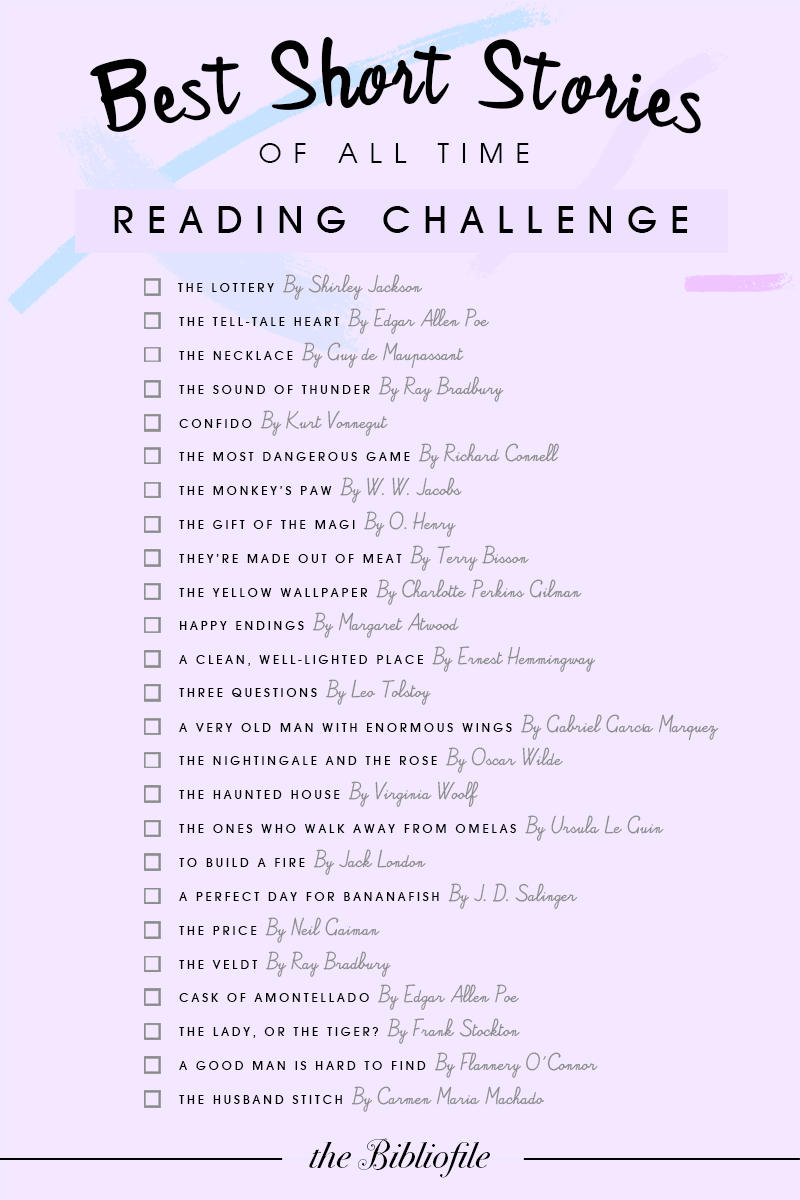
Image source: The Bibliofile
Which 10 Short Stories Are Absolute Must-Reads for Everyone?
For those looking to dive into the medium, certain stories stand out as essential benchmarks. These works have earned their place in the canon not just through longevity, but through their ability to provoke discussion and emotional response decades after their publication. The following table provides a quick-start guide to these top-tier selections.
| Story Title | Author | Genre | Est. Reading Time |
|---|---|---|---|
| "The Lottery" | Shirley Jackson | Dystopian / Horror | 15 Minutes |
| "The Tell-Tale Heart" | Edgar Allan Poe | Gothic Horror | 10 Minutes |
| "The Dead" | James Joyce | Literary Fiction | 45 Minutes |
| "A Good Man Is Hard to Find" | Flannery O’Connor | Southern Gothic | 25 Minutes |
| "The Yellow Wallpaper" | Charlotte Perkins Gilman | Psychological Realism | 20 Minutes |
| "Story of Your Life" | Ted Chiang | Science Fiction | 40 Minutes |
| "In a Grove" | Ryūnosuke Akutagawa | Mystery / Literary | 15 Minutes |
| "The Library of Babel" | Jorge Luis Borges | Philosophical Fiction | 15 Minutes |
| "The Paper Menagerie" | Ken Liu | Magical Realism | 20 Minutes |
| "The Lady with the Dog" | Anton Chekhov | Realism | 30 Minutes |
Each of these stories offers a different entry point into the medium. For instance, Shirley Jackson’s "The Lottery" is widely regarded as one of the most impactful stories in American literature, serving as a cultural shorthand for the dangers of blind tradition. Meanwhile, James Joyce’s "The Dead" is often cited by critics as a near-perfect example of the form, balancing intricate character work with a profound, snowy epiphany that resonates long after the final page.
If you are new to short fiction, start with Edgar Allan Poe or Roald Dahl. Their stories are highly accessible, plot-driven, and often feature "twist" endings that make them particularly satisfying for beginners.
Why Do These Classic Short Stories Still Haunt Readers Today?
The endurance of classic short stories often lies in their technical precision. Writers like Poe and O'Connor were masters of the "single effect"—the idea that every word in a story should contribute to a specific emotional impact. When a story is this concentrated, it bypasses the reader's intellectual defenses and strikes directly at their psyche.
How Edgar Allan Poe Perfected the Powerful Emotional Experience
Edgar Allan Poe is frequently credited with defining the modern short story. In "The Tell-Tale Heart," he utilizes what modern craft experts call the Motivation Reaction Unit (MRU) . As explained by Advanced Fiction Writing , MRUs involve a sequence of external action followed by internal sensation and resulting reaction. Poe uses this to get inside the narrator's skin, forcing the reader to experience the character's mounting paranoia and the rhythmic "beating" of the heart as if it were their own.
Why Shirley Jackson’s The Lottery Remains a Cultural Shorthand
When "The Lottery" was first published in The New Yorker in 1948, it prompted a record-breaking number of letters from outraged readers. Its power lies in its mundane beginning—a sunny day in a small town—which contrasts sharply with the brutal conclusion. It has become an iconic piece of fiction because it captures a universal truth about human nature and the chilling ease with which societies can normalize violence. According to LitHub , it is a story that has "wormed its way into general cultural consciousness."
The Psychological Depth of Charlotte Perkins Gilman’s The Yellow Wallpaper
Gilman’s masterpiece is a foundational text in feminist literature, but it is also a masterclass in the "Distilled Hit" theory. By confining the narrative to a single room and a single obsession, Gilman increases the intensity of the character's descent into madness. The brevity of the story ensures that the reader feels the claustrophobia of the narrator's situation without the "bagginess" that a longer novel might introduce.
Flannery O’Connor and the Art of the Shocking Ending
Flannery O’Connor’s "A Good Man Is Hard to Find" is famous for its sudden shift from a comedic family road trip to a violent confrontation with a serial killer. O’Connor uses the short form to explore themes of grace and morality in a way that is both jarring and deeply thoughtful. The story’s ending is not just a shock for shock’s sake; it is the logical, if horrific, conclusion of the characters' moral failings.
James Joyce and the Emotional Resonance of The Dead
While some debate whether "The Dead" qualifies as a short story or a novella due to its length, its inclusion in Joyce’s Dubliners cements its status in the short fiction canon. It is a story of quiet realizations, culminating in one of the most beautiful passages in English literature. It demonstrates that a short story doesn't need a high-concept hook to be effective; it only needs a profound understanding of the human heart.
How Do Global Masterpieces Expand the Short Story Tradition?
To truly understand the "best" of the medium, one must look beyond the English-speaking world. The short story is a global tradition, with masters in every culture using the form to explore unique regional histories and philosophical questions. These stories often challenge Western narrative structures, offering new ways to experience time, reality, and identity.
The Unreliable Narrators of Ryūnosuke Akutagawa
Japanese author Ryūnosuke Akutagawa is often called the "Father of the Japanese Short Story." His work "In a Grove" (the basis for the film Rashomon ) presents multiple conflicting accounts of a single crime. By refusing to provide a definitive truth, Akutagawa uses the short story to explore the subjectivity of human perception. It remains a top choice for readers who enjoy literary puzzles and psychological depth.
Magical Realism in the Works of Gabriel García Márquez
Gabriel García Márquez brought the wonders of Latin American magical realism to the short form in stories like "A Very Old Man With Enormous Wings." By treating the supernatural as mundane, Márquez creates a sense of wonder that feels grounded in reality. This story, in particular, serves as a critique of how humans react to the miraculous with greed and indifference, all within a few thousand words.
Post-Colonial Perspectives from Chinua Achebe and Ngũgĩ wa Thiong’o
African writers have used the short story to document the complexities of post-colonial life. Chinua Achebe’s "Civil Peace" explores the resilience of the human spirit in the aftermath of the Nigerian Civil War, while Ngũgĩ wa Thiong’o’s "Minutes of Glory" provides a searing look at class and aspiration in Kenya. These stories are essential for understanding the global reach of the medium and its power as a tool for social witness.
The Labyrinthine Logic of Jorge Luis Borges
Argentine writer Jorge Luis Borges is perhaps the most influential short story writer of the 20th century. His stories, such as "The Library of Babel" and "The Immortal," are less about characters and more about ideas. He creates vast, metaphysical universes within the span of a few pages, challenging the reader to rethink the nature of infinity, memory, and language. Few competitors match Borges for sheer intellectual density.
Which Modern Short Stories Are Defining the 21st Century?
The short story is far from a dying art; in the 21st century, it is thriving, particularly in the realms of speculative fiction and digital-first platforms. Modern writers are using the form to grapple with technology, climate change, and the shifting nature of human connection.
Ted Chiang
"Story of Your Life" uses the concept of alien linguistics to explore grief and determinism. It is widely considered one of the top speculative stories of the modern era.
Ken Liu
"The Paper Menagerie" was the first work of fiction to win the Nebula, Hugo, and World Fantasy Awards. It is a heartbreaking look at the immigrant experience through the lens of magical origami.
qntm
Modern speculative fiction writers like qntm are pushing the boundaries of the form with digital-first stories that experiment with structure and perspective, such as "The Frame-By-Frame."
Ted Chiang, in particular, has become a standard-bearer for the modern short story. His collection Exhalation and the earlier Stories of Your Life and Others demonstrate how science fiction can be used to ask deep philosophical questions. Similarly, Ken Liu’s "silkpunk" fables blend traditional Chinese folklore with modern sensibilities, creating a new subgenre that feels both ancient and fresh.
What Makes a Short Story Great According to Literary Experts?
Literary experts often look for specific qualities that distinguish a "good" story from a "great" one. While personal taste varies, several frameworks help explain why certain stories endure while others fade from memory.
The Bath Test for Perfect Story Length
A popular benchmark among readers and critics is the "Bath Test." The idea is that a perfect short story should be readable in a single sitting—ideally the length of time one spends in a bath. This constraint ensures that the reader remains fully immersed in the story's world from beginning to end, allowing the "single effect" to take full hold. According to the London Review Bookshop , this brevity is what gives the short story its unique power.
Understanding the Difference Between a Story and a Novel
Writer Jenn Ashworth suggests that while novels allow for "bagginess" and redundancy, short stories require every word to work toward the whole. A novel is a journey; a short story is a destination. In a short story, the reader is often dropped into the middle of a crisis ( in media res ) and left to piece together the context through subtle hints and subtext. This active participation is what makes the reading experience so rewarding.
Ray Bradbury’s Advice for Aspiring Readers and Writers
The legendary Ray Bradbury was a staunch advocate for the short form. He famously recommended a "1,000 nights" challenge: reading one short story, one poem, and one essay every night for 1,000 nights. He believed this was the most effective way to "stuff your head" with diverse ideas and develop a deep understanding of narrative structure. For Bradbury, the short story was the laboratory of literature.
Proactive Scenes versus Reactive Sequels
Craft experts often categorize story segments into "scenes" (proactive action) and "sequels" (reactive processing). Great short stories often balance these two elements perfectly. For example, in "The Tell-Tale Heart," the "scene" is the murder, while the majority of the story is the "sequel"—the narrator's internal reaction to his own deed. Understanding this balance can help readers appreciate the technical skill involved in their favorite works.
How to Choose Your Next Story Based on Reading Time and Mood
One of the advantages of short stories is their versatility. You can choose a story that fits your current attention span and emotional state. Use the following framework to find your next read.
| If you feel... | And you have... | Try this story: |
|---|---|---|
| Stressed / Low Energy | 5 Minutes | Micro-fiction by qntm or Lydia Davis |
| Intellectually Curious | 15 Minutes | "The Library of Babel" (Borges) |
| Ready for a Good Cry | 20 Minutes | "The Paper Menagerie" (Liu) |
| Like Debating Ethics | 20 Minutes | "The Lottery" (Jackson) |
| Immersive / Melancholy | 45 Minutes | "The Dead" (Joyce) |
This "Attention Span Filter" helps solve the problem of feeling overwhelmed by a long reading list. By matching the story to your current mood, you are more likely to have a meaningful experience with the text.
Where Can You Read These Iconic Stories for Free Online?
Many of the most acclaimed short stories are now in the public domain, meaning they are free to read online. This accessibility is one reason why stories by Poe, Chekhov, and Gilman remain so popular in classrooms and reading groups.
- Project Gutenberg: A top-rated resource for classic works by Poe, Hawthorne, and Joyce.
- LibriVox: Offers free public domain audiobooks, perfect for listening to stories like "The Tell-Tale Heart" on the go.
- Literary Journals: Modern stories by authors like Ken Liu or Ted Chiang can often be found in the archives of magazines like Lightspeed , Tor.com , or The New Yorker (though some may require a subscription).
- Standard Ebooks: Provides high-quality, formatted versions of public domain classics.
While modern masterpieces usually require the purchase of a collection, the wealth of classic fiction available for free ensures that anyone with an internet connection can access the foundations of the craft.
Frequently Asked Questions
- What is considered the most acclaimed short story ever written?
- While "best" is subjective, James Joyce’s "The Dead" and Shirley Jackson’s "The Lottery" are consistently ranked among the top by literary critics and scholars. "The Dead" is celebrated for its emotional depth and prose, while "The Lottery" is noted for its cultural impact and chilling social commentary.
- What are the best short stories for beginners?
- For those new to the medium, stories with strong plots and clear themes are often a top choice. Edgar Allan Poe’s "The Tell-Tale Heart" or Roald Dahl’s "Lamb to the Slaughter" are highly recommended for their accessibility and engaging narrative hooks.
- How long is a typical short story?
- While there is no strict rule, most iconic short stories fall between 1,000 and 7,500 words. Stories under 1,000 words are often called "flash fiction," while those over 7,500 words may be categorized as novelettes or novellas.
- What is the difference between a short story and a novelette?
- The primary difference is word count. A short story typically ends around 7,500 words. A novelette usually ranges from 7,500 to 17,500 words, allowing for slightly more character development and subplot than a standard short story but less than a full novella.
- Why are short stories so popular in schools and universities?
- Short stories are ideal for academic study because they offer a "distilled hit" of literary themes that can be analyzed in a single class period. Their brevity allows students to look closely at every word and narrative choice, making them excellent tools for learning literary analysis.
Final Thoughts on the Best Short Stories Ever Written
The short story remains a vital and evolving medium that offers an intensity novels often cannot replicate. By exploring both the classic canon and modern masterpieces, readers can gain a profound understanding of the human experience in bite-sized portions.
- Intensity over Breadth: Short stories focus on a "single effect," providing a concentrated emotional experience.
- The Bath Test: A top-tier story should be readable in a single sitting to maintain its narrative spell.
- Global Diversity: Masterpieces from Japan, Argentina, and Nigeria are essential for a complete perspective on the craft.
- Modern Frontiers: Speculative fiction writers like Ted Chiang are defining the 21st-century short story.
- Technical Precision: Concepts like Motivation Reaction Units (MRUs) explain why classic stories remain so impactful.
- Accessibility: Many of the most celebrated stories are available for free in the public domain.
To start your journey, pick one story from the list above and read it tonight before bed—it might just change the way you look at the world.