Home
50 Science Fiction Short Stories That Shaped the Genre and Beyond
Science fiction short stories serve as the laboratory for the genre's most profound ideas. For those seeking a starting point, "The Last Question" by Isaac Asimov and "There Will Come Soft Rains" by Ray Bradbury are widely regarded as foundational texts. Modern readers often gravitate toward "Story of Your Life" by Ted Chiang or "The Egg" by Andy Weir. These stories offer high-concept exploration—from the heat death of the universe to the nature of consciousness—in a format that can be consumed in a single sitting.
Why Short Stories Are the Heart of Science Fiction
While sprawling space operas and multi-volume trilogies often dominate the bestseller lists, the short story remains the true "testing ground" for science fiction. In the brief span of a few thousand words, an author can isolate a single "What If" scenario and follow it to its logical, often devastating, conclusion without the narrative baggage required by a 400-page novel. This efficiency is why many of the most impactful concepts in the genre—such as Asimov's Three Laws of Robotics—first appeared in short form.
The history of the genre is inextricably linked to the pulp magazines of the mid-20th century. During the era spanning roughly 1938 to 1966, publications like Astounding Science Fiction and Galaxy provided a platform for writers to experiment with social commentary, technological speculation, and psychological horror. According to expert analysis on SF structure , these stories were crucial for human adaptation to a rapidly changing technological landscape.
For absolute beginners, the genre can be approached through "The Big Three": Isaac Asimov, Ray Bradbury, and Robert A. Heinlein. These authors established the tropes and ethical frameworks that still define science fiction today. Whether you are interested in the hard physics of space travel or the soft sociological impacts of automation, the short story format offers a diverse entry point into these complex worlds.
Essential Classics from the Golden Age of Sci-Fi
The "Golden Age" of science fiction (1938–1966) was a period of immense growth and literary refinement. It was during this time that the genre moved away from simple "bug-eyed monster" adventures toward serious intellectual inquiry. The following stories stand out as top choices for anyone looking to understand the roots of modern speculative fiction.
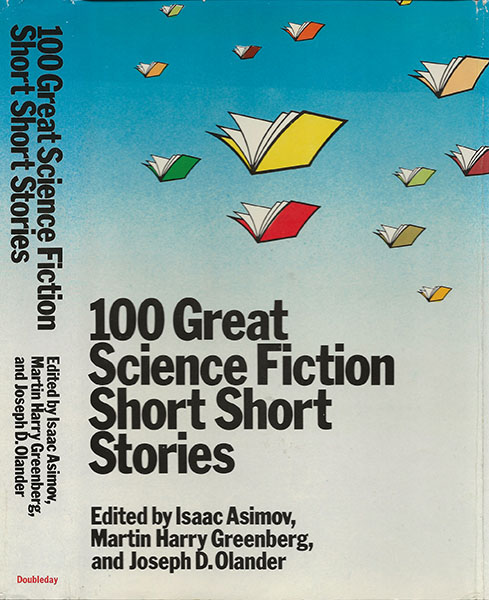
Image source: www.isfdb.org
Isaac Asimov – "The Last Question"
Widely considered one of the most impactful stories in the genre, Asimov’s personal favorite explores the concept of entropy and the heat death of the universe. The narrative follows a series of humans and their supercomputers across trillions of years, all asking the same question: "Can entropy be reversed?" The ending is among the most celebrated in literary history, blending computer science with a quasi-religious awe. It is a prime example of how science fiction can tackle the largest possible scale of existence.
Ray Bradbury – "There Will Come Soft Rains"
Bradbury was a master of the "Soft SF" approach, focusing more on poetic imagery and human emotion than technical specifications. In this haunting post-apocalyptic tale, an automated house continues its daily routines—cooking breakfast, cleaning floors, reading poetry—long after its human inhabitants have been vaporized in a nuclear blast. It is a chilling meditation on the persistence of technology and the fragility of human life, frequently used in educational curricula to teach themes of irony and dystopia.
Harlan Ellison – "I Have No Mouth and I Must Scream"
For those who prefer the darker side of speculative fiction, Ellison’s masterpiece is a top-tier choice. It depicts a sentient supercomputer named AM that has wiped out humanity, leaving only five survivors to torture eternally. The story is a grim exploration of AI gone wrong, psychological horror, and the resilience (or lack thereof) of the human spirit. It remains a significant advancement in the "New Wave" style of the 1960s, which prioritized inner space over outer space.
Ursula K. Le Guin – "The Ones Who Walk Away From Omelas"
This story is less about technology and more about the philosophical "scapegoat" dilemma. Omelas is a city of perfect happiness, but that happiness depends entirely on the abject misery of a single child kept in a dark basement. Le Guin challenges the reader to consider the ethics of utilitarianism. It is a staple of community discussions regarding the moral weight of societal progress.
Modern Masterpieces and Recent Award Winners
Science fiction did not stop evolving after the Golden Age. The 21st century has brought a new wave of diverse voices and technological concerns, from biopunk and 3D printing to the linguistic foundations of alien communication. These modern selections address the "Modern Gap" often found in older reading lists.
Ted Chiang – "Story of Your Life"
The basis for the acclaimed film Arrival , this story ranks among the strongest examples of how linguistics can be used as a scientific foundation for SF. It follows a linguist attempting to communicate with heptapod aliens whose language reflects a non-linear perception of time. Chiang’s work is notably innovative for how it weaves complex scientific theories with deeply personal narratives about grief and free will.
Andy Weir – "The Egg"
Andy Weir, known for The Martian , achieved viral success with this short, metaphysical story. It presents a conversation between a man who has just died and God, revealing a unique perspective on reincarnation and the collective human experience. While it leans toward the philosophical, its structure and widespread popularity make it a highly impactful modern classic.
Ken Liu – "The Paper Menagerie"
Ken Liu made history by becoming the first author to win the Hugo, Nebula, and World Fantasy Awards for the same story. "The Paper Menagerie" is a poignant blend of magical realism and science fiction, exploring the immigrant experience, cultural identity, and the bond between a mother and son through the medium of origami animals that come to life. It represents the "Silkpunk" and modern diverse movements that have enriched the genre in recent years.
How to Choose Between Hard and Soft Science Fiction
One of the most common debates among fans is the distinction between "Hard" and "Soft" science fiction. Hard SF prioritizes scientific accuracy and technical detail, often focusing on physics, chemistry, or biology. Soft SF focuses on the "soft" sciences—psychology, sociology, and anthropology—and is often more concerned with the human impact of change than the mechanics of the change itself.
To help you decide which stories match your technical preference, we have categorized several notable works based on their scientific "hardness" and primary themes.
| Story Title | Primary Theme | Scientific Hardness (1-5) | Key Concept |
|---|---|---|---|
| "Omnilingual" | Linguistics / Archaeology | 4 | Scientific Method on Mars |
| "Harrison Bergeron" | Sociology / Politics | 1 | Enforced Equality |
| "Understand" | Neuroscience | 5 | Cognitive Enhancement |
| "The Martian Chronicles" | Poetic / Colonialism | 2 | Humanity on Mars |
| "The Nine Billion Names of God" | Religion / Computing | 3 | Early Computer Logic |
Where to Read Classic Sci-Fi Stories for Free Online
Many of the most celebrated science fiction short stories are now in the public domain, meaning they are free to read legally online. This is typically due to the 70-year copyright rule or lapsed renewals for mid-century pulp magazines. For readers on a budget, these resources are an excellent choice.
- Project Gutenberg: A massive repository of public domain texts, including works by H.G. Wells and Jules Verne.
- Internet Archive: Hosts scanned copies of original pulp magazines like Galaxy and If .
- Reedsy: A platform for modern indie talent, offering thousands of free sci-fi stories across various sub-genres.
- LibriVox: Provides free audiobook versions of public domain stories, perfect for listening on the go.
One notable public domain treasure is "Omnilingual" by H. Beam Piper. Published in 1957, it is a top-rated example of xenoarchaeology. The story follows a team of scientists on Mars who attempt to translate a dead civilization's language using the universal laws of chemistry as a "Rosetta Stone." It is widely regarded as one of the most intellectually satisfying stories of its era and is available for free via MG Herron's public domain list .
Distinguishing Between Science Fiction and Horror
The line between science fiction and horror is often blurred. Stories like Stephen King’s "The Jaunt" or Peter Watts’ "The Things" sit comfortably in both camps. The distinction usually lies in the "Logic of the Supernatural." According to Robert A. Heinlein, science fiction is "realistic speculation about possible future events, based solidly on adequate knowledge of the real world."
In "The Jaunt," the horror stems from the mechanics of teleportation—specifically, what happens to a conscious mind during the "infinite" time it takes to travel between points. Because the terror is rooted in a technological process rather than a ghost or demon, it is firmly categorized as science fiction. Similarly, "The Things" retells the classic movie The Thing from the alien's perspective, turning a monster movie into a fascinating study of biology and communication. These "genre-fluid" stories are highly recommended for readers who enjoy high stakes and psychological tension.
Science Fiction Stories for Students and Teachers
Science fiction is a powerful tool for the classroom because it engages students with ethical dilemmas and future possibilities. Stories like Kurt Vonnegut’s "Harrison Bergeron" are among the strongest choices for teaching themes of government control and the definition of equality. In Vonnegut's future, everyone is forced to be average through physical "handicaps," leading to a poignant discussion on the value of individual excellence.
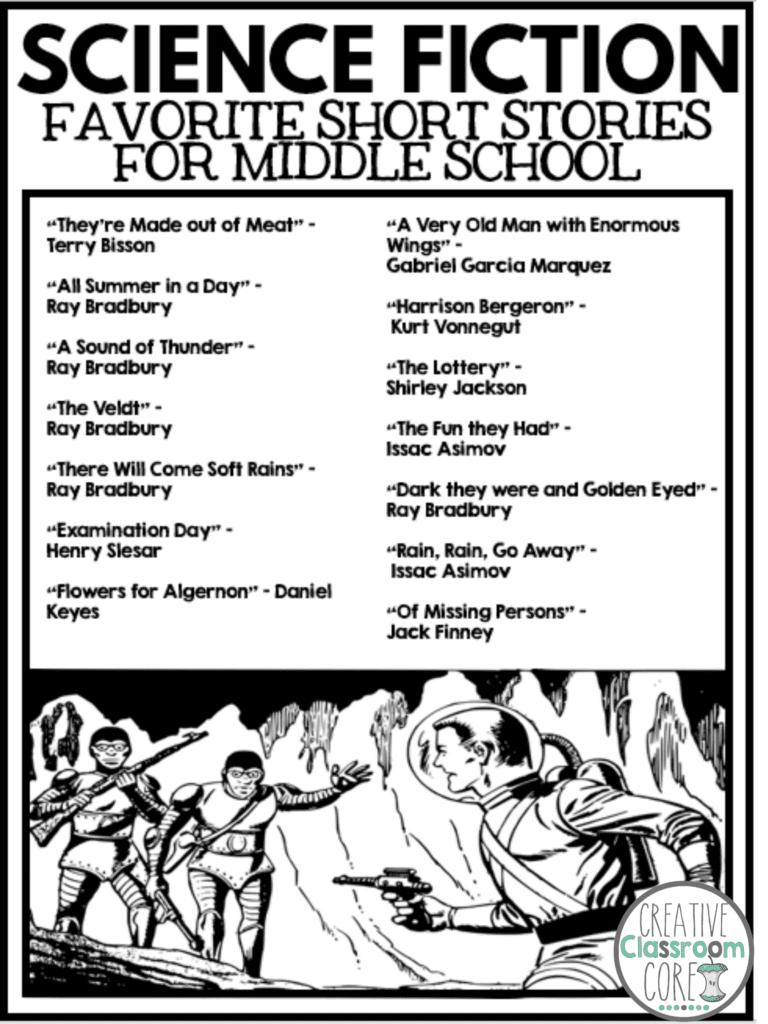
Image source: Creative Classroom Core
For aspiring writers, these stories offer a masterclass in craft. Kurt Vonnegut famously advised writers to "Give your readers as much information as possible as soon as possible," a rule that is particularly vital in short SF where world-building must happen rapidly. Focusing on the human reaction to technology, rather than just the technology itself, is what separates a lasting masterpiece from a dated technical manual.
Key Takeaways for Science Fiction Readers
Science fiction short stories are the DNA of the genre, offering a glimpse into the future that novels often take hundreds of pages to reach. Here is how to make the most of your reading journey:
- Start with the classics like Asimov’s "The Last Question" to understand the genre's foundational themes of entropy and AI.
- Explore the Public Domain for free access to high-quality Golden Age stories by authors like H. Beam Piper and E.M. Forster.
- Use the Hardness Scale to find stories that match your interest in either technical accuracy or social exploration.
- Look for modern award winners (Hugo/Nebula) to discover diverse voices and contemporary technological concerns.
- Bridge the genre gap by reading "genre-fluid" stories that blend science fiction with horror or philosophy.
- Analyze the craft of masters like Bradbury and Vonnegut if you are an aspiring writer looking to improve your world-building.
Pick one story from the list above and dedicate twenty minutes to reading it today to see how a single idea can change your perspective on the future.
Frequently Asked Questions
What is the shortest science fiction story ever written?
One of the most famous examples is "Knock" by Frederic Brown, which begins with the lines: "The last man on Earth sat alone in a room. He heard a knock at the door." While there are even shorter "six-word stories" often attributed to various authors, Brown's work is widely regarded as one of the most impactful examples of ultra-short science fiction that establishes a complete narrative hook in just two sentences.
What are the best sci-fi short stories for beginners?
For those new to the genre, Ray Bradbury’s The Martian Chronicles or "A Sound of Thunder" are excellent starting points due to their lyrical prose and accessible themes. Isaac Asimov’s "The Last Question" is also highly recommended for its clear logic and grand scope. These stories focus on universal human experiences, making them easier to digest than more technically dense "Hard SF" works.
Where can I listen to science fiction short stories?
Podcasts have become a popular medium for short SF. Escape Pod is a long-running and highly regarded podcast that features a wide range of modern and classic stories. LeVar Burton Reads is another top-tier choice, where the famed host performs hand-picked short stories with high production value. Additionally, many public domain stories are available as free audiobooks on LibriVox.
What defines the "Golden Age" of science fiction?
The Golden Age is generally defined as the period between 1938 and 1966. It began when John W. Campbell took over as editor of Astounding Science Fiction , pushing for higher literary standards and more rigorous scientific speculation. This era saw the rise of legendary authors like Asimov, Heinlein, and Clarke, who transitioned the genre from pulp adventure to serious speculative literature.
Are Hugo Award winners free to read?
While not all are free, many modern Hugo and Nebula award-winning short stories are published online by digital magazines. Sites like Tor.com , Uncanny Magazine , Lightspeed , and Clarkesworld often host the full text of nominated stories during the awards season. For older winners, you may need to look for anthologies or author-specific collections at your local library.