Home
Why Are We Obsessed With Humanoid Fish and Do They Actually Exist?
While legends of "fish people" have existed for millennia, there is no scientific evidence of a humanoid aquatic species. Most modern "sightings" are the result of pareidolia (seeing faces in non-human objects), viral hoaxes involving malformed poultry embryos or AI, and real biological oddities like the Sheepshead fish , which possesses eerily human-like teeth. In fiction, these creatures tap into the Uncanny Valley , a psychological space where something looks almost human but is off-puttingly different.
Real Fish That Look Uncannily Like Humans
Nature often produces biological structures that, by sheer coincidence, mirror human anatomy. When we encounter these traits in the deep, our brains struggle to categorize them, leading to the sensation that we are looking at something "humanoid." This phenomenon is most prevalent in species that have evolved specific dental or facial structures for survival in their respective niches.
The Sheepshead Fish and Its Human-Like Teeth
The Sheepshead fish ( Archosargus probatocephalus ) is perhaps the most famous example of a real animal with human-like features. Found along the Atlantic coast of the United States, this species possesses several rows of teeth that include incisors at the front and molars at the back. To the casual observer, the open mouth of a Sheepshead looks remarkably like a human dental chart.
Biologically, these teeth serve a highly functional purpose. The Sheepshead feeds primarily on crustaceans, mollusks, and small crabs. The front incisors allow the fish to scrape barnacles off pilings, while the heavy molars are designed to crush the hard shells of its prey. While the visual is unsettling, it is a top-tier example of convergent evolution, where two unrelated species develop similar traits to solve similar problems—in this case, the need to grind down tough materials.
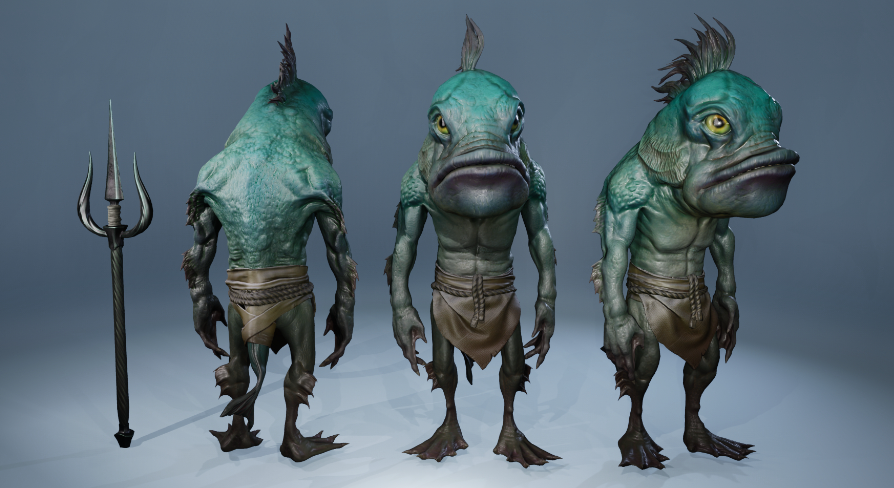
Image source: Fab
Why the Axolotl Looks Like a Smiling Human Face
The Axolotl, a critically endangered salamander from Mexico, is often cited as a "human-faced" aquatic creature. This perception is driven by neoteny , a biological condition where an animal retains its larval features throughout its adult life. The Axolotl’s wide mouth, forward-facing eyes, and lack of eyelids create a permanent "smiling" expression that humans find relatable.
According to biological research on facial structures , our brains are hardwired to recognize the "baby schema"—large eyes and a small nose—which triggers a nurturing response. The Axolotl’s face accidentally hits all these psychological triggers, making it one of the most popular "humanoid" amphibians in modern culture.
The Sad Fish of the Philippines and Other Groupers
In recent years, viral videos have surfaced showing what social media users call the "sad fish." One specific clip from the Philippines shows a fish with drooping, fleshy eyes and a downturned mouth that mimics human grief. Marine biologists have identified these specimens as species of Grouper or Carp with unique fleshy protrusions.
These features are often the result of age, injury, or specific environmental adaptations. The "sadness" we perceive is entirely a product of human projection. Groupers are known for their large, expressive eyes and heavy jaws, which can appear humanoid when viewed from specific angles, especially when the fish is gasping for air or stationary in murky water.
The Truth Behind Viral Humanoid Fish Hoaxes
The internet is a breeding ground for misinformation, and the "humanoid fish" niche is particularly susceptible to hoaxes. From historical sideshow attractions to modern AI-generated TikToks, these fabrications often gain traction because they play on our innate fear of the unknown.
The Real Origin of the Area 51 Mutant Fish Video
A viral video claiming to show a "mutant humanoid fish" kept in Area 51 has circulated widely. However, investigative analysis reveals the footage is actually linked to Chick Master , a global leader in poultry incubation systems. The "creatures" in the video are malformed poultry embryos or industrial biological waste from a Russian branch of the company, misidentified by conspiracy theorists to drive engagement.
Modern hoaxes also frequently utilize AI tools. As of 2026, generative video technology has reached a point where "leaked" footage of cryptids can be created in minutes. These videos often feature intentional blurring, low lighting, and shaky camera movements to hide the digital artifacts that would otherwise expose the fabrication.
P.T. Barnum and the Legacy of the Fiji Mermaid
Long before the internet, P.T. Barnum captivated the public with the "Fiji Mermaid." This historical hoax was a masterpiece of taxidermy, created by sewing the upper torso of a juvenile monkey onto the tail of a large fish. The resulting specimen was dried and blackened to look like a mummified deep-sea discovery.
The Fiji Mermaid set the template for the "cryptid" industry. It proved that people are willing to pay to see something that challenges their understanding of biology. Even today, similar "gaffs" (fake taxidermy) are sold at oddity shops, continuing a tradition of manufactured mystery that dates back to the 19th century.
Is the Japanese Ningen a Real Deep Sea Animal?
The "Ningen" (Japanese for "human") is a modern urban legend that originated on the 2channel forums. It is described as a massive, whale-like creature with human-like arms, legs, and a face, purportedly sighted by Japanese research vessels in the Antarctic. While the stories are chilling, experts suggest these sightings are likely misidentifications of known animals.
Albino whales, giant rays, or even large icebergs with unusual shapes can appear humanoid in the harsh, low-visibility conditions of the Southern Ocean. The Ningen remains a popular topic in "creepypasta" communities, but it lacks any physical evidence or peer-reviewed documentation.
Could a Humanoid Fish Actually Survive Seven Miles Down?
The Mariana Trench, reaching depths of nearly seven miles, is one of the most hostile environments on Earth. If a humanoid fish were to exist there, it would require biological adaptations that differ significantly from anything seen in terrestrial mammals.
Biological Constraints of the Mariana Trench
At the bottom of the trench, the pressure is over 1,000 times that at sea level. A human-like skeletal structure made of bone would be crushed instantly. According to speculative biological theories , a deep-sea humanoid would likely need a skeleton made of flexible cartilage, similar to a shark, or even a fluid-filled body that equalizes internal and external pressure.
Furthermore, the "midnight zone" is completely devoid of sunlight. A humanoid living here would likely be blind or possess massive, light-sensitive eyes. Alternatively, they might use bioluminescence for communication, with glowing patterns on their skin serving as a visual language in the dark.
The Evolution of Deep Sea Physiology
Real creatures in the Barents Sea have evolved traits that mimic human limbs. Some deep-sea fish have fins that have become fleshy and leg-like, allowing them to "walk" along the ocean floor. Their skin is often pale, translucent, and devoid of scales, giving them a ghostly, human-like appearance when caught in a submersible's spotlight. These adaptations are highly impactful for survival in high-pressure, low-energy environments where swimming long distances is inefficient.
Why Fish People Creep Us Out More Than Mermaids
There is a distinct psychological difference between a mermaid and a "fish person." While mermaids are often depicted as beautiful and alluring, humanoid fish—like those in horror films—trigger a visceral disgust response. This is largely due to the Uncanny Valley .
The Uncanny Valley of Aquatic Horror
The Uncanny Valley occurs when an object looks almost human but has subtle, non-human flaws. A mermaid is a clear hybrid (human top, fish bottom), which our brains can easily categorize. A "fish person," however, often retains a humanoid shape but replaces human skin with scales, slime, or gills. This "Abhorrent Admirer" trope, as defined by TV Tropes taxonomy , triggers an evolutionary avoidance of disease and decay.
From Bird-Women to Fish-Women: The Evolution of the Siren
Interestingly, the concept of the aquatic humanoid has shifted over time. In original Greek mythology, Sirens were actually bird-women—creatures with the heads of women and the bodies of birds. It wasn't until the Middle Ages that the image of the Siren merged with the mermaid, becoming the fish-tailed temptress we recognize today. This shift reflects a cultural transition from fearing the dangers of the sky to fearing the mysteries of the deep sea.
Famous Fish People in Mythology and Pop Culture
Humanoid fish have been a staple of human storytelling for thousands of years. From ancient deities to modern anime, these creatures represent our complex relationship with the water.
| Archetype | Key Features | Famous Example |
|---|---|---|
| Deep Ones | Intelligent, amphibious, malevolent | H.P. Lovecraft's Innsmouth |
| Fish-Men | Species-based (Shark, Carp, etc.) | One Piece |
| Amphibian Man | Sympathetic, bioluminescent | The Shape of Water |
| Ningyo | Fish-like body, human head | Japanese Folklore |
Lovecraft’s Deep Ones and the Shadow Over Innsmouth
H.P. Lovecraft essentially defined the modern "fish person" archetype with his Deep Ones . These creatures are described as having a "greyish-green" color, white bellies, and fishy, unblinking eyes. Unlike mermaids, they are fully amphibious and capable of interbreeding with humans. This narrative introduced the idea of "aquatic horror" as a form of genetic and cultural contamination, a theme that persists in horror cinema to this day.

Image source: 70s Sci-Fi Art - Ghost
The Design Evolution of Cinematic Amphibians
The visual representation of humanoid fish has seen a significant advancement since the mid-20th century. The 1954 Gill-man from Creature from the Black Lagoon was a man in a rubber suit, emphasizing a monstrous, prehistoric look. In contrast, the 2017 Amphibian Man from The Shape of Water utilized a blend of practical effects and CGI to create a creature that felt biologically plausible, with translucent skin and bioluminescent pulses. This evolution shows a move away from "monsters" toward "biological entities."
How to Ethically Handle a Fish With a Human Face
If you are an angler and happen to catch a fish with unsettlingly human features—such as a Sheepshead or a large Grouper—it is important to handle the animal with care. These species are often vital to their local ecosystems.
Expert Techniques for Anglers
According to humane catch and release guidelines , protecting the fish's mucous membrane is critical. This "slime coat" is the fish's primary defense against infection and parasites.
- Use barbless hooks: This minimizes tissue damage to the mouth, which is especially important for fish with human-like teeth.
- Keep the fish in the water: If you are taking a photo, only lift the fish out for a few seconds.
- Wet your hands: Never touch a fish with dry hands, as this strips away their protective coating.
- Use rubber nets: Traditional nylon nets can act like sandpaper on a fish's skin.
The Science of Hook Dissolution
If a fish swallows a hook and it cannot be safely removed, it is often better to cut the line. Data suggests that a hook left in a fish can take up to 120 days to dissolve, depending on the material and the strength of the fish's digestive enzymes. While not ideal, many fish can survive and recover if the handling process is kept brief and professional.
- Pareidolia is the primary reason we see human faces in fish like the Axolotl or Groupers.
- The Sheepshead fish has real human-like teeth used for crushing shells, not for supernatural reasons.
- Viral Area 51 videos are often misidentified industrial waste or malformed poultry embryos from companies like Chick Master.
- Historical hoaxes like the Fiji Mermaid were created using monkey and fish parts to deceive the public.
- Deep-sea humanoids are biologically unlikely due to extreme pressure, requiring cartilage rather than bone.
- The Uncanny Valley explains why "fish people" trigger a disgust response compared to the more "human" mermaid.
- Ethical catch and release is essential for protecting real "human-faced" fish and their ecosystems.
Start your journey into marine biology by exploring the documented species of the midnight zone through official oceanographic databases.
Frequently Asked Questions
What fish looks most like a human?
Is the Area 51 humanoid fish real?
What is the difference between a mermaid and a siren?
Are there any undiscovered humanoid species in the ocean?
Why do some fish have human-like teeth?