Home
What Was the First Cyberpunk Book and How Did the Genre Begin?
While the roots of the genre stretch back to the 1950s, William Gibson’s Neuromancer (1984) is widely considered the first solidified cyberpunk novel. It was the first work to combine the "high tech, low life" aesthetic with a fully realized virtual reality landscape known as "cyberspace." However, the term "cyberpunk" was actually coined by Bruce Bethke in his 1980 short story of the same name, and the genre's philosophical foundations were laid by Philip K. Dick in Do Androids Dream of Electric Sheep? (1968).
The origins of cyberpunk literature are not found in a single moment of inspiration, but rather in a slow-burning fusion of counter-culture, emerging computer science, and hard-boiled detective fiction. To understand what the first cyberpunk book truly was, one must distinguish between the first time the aesthetic appeared, the first time the word was used, and the first time the genre was recognized as a distinct movement.
Why Neuromancer Stands Out as the Definitive Starting Point
Published on July 1, 1984, William Gibson’s Neuromancer is the cornerstone of the genre. While earlier works experimented with similar themes, Neuromancer was the first to synthesize them into a cohesive world that felt entirely new yet disturbingly familiar. It follows Case, a washed-up computer hacker (or "console cowboy"), who is hired by a mysterious employer for one last job that takes him into the depths of a global computer network.
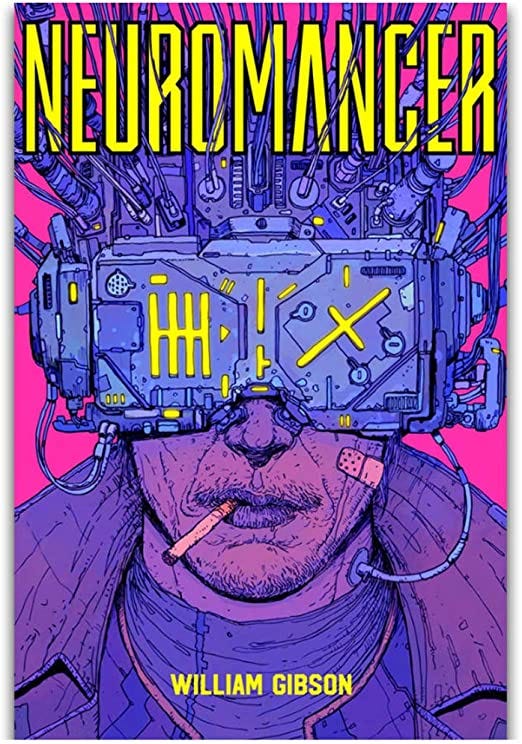
Image source: Naveen Reads - Substack
Gibson’s achievement was not just in the plot, but in the language. He popularized terms that are now staples of modern technology, such as "cyberspace," "jacking in," and "ICE" (Intrusion Countermeasure Electronics). The book’s impact was so significant that it became the only novel to win the "Triple Crown" of science fiction: the Hugo, Nebula, and Philip K. Dick Awards. According to historical records , Gibson wrote the book in a state of "blind animal panic," fearing that the visual style of the film Blade Runner (released in 1982) would make his written descriptions seem derivative.
The Sprawl Trilogy and Genre Tropes
Neuromancer was the first entry in what would become the "Sprawl Trilogy," a series that defined the "high tech, low life" mantra. The setting—a massive urban megacity stretching from Boston to Atlanta—became the template for every cyberpunk city that followed. Gibson’s prose was dense, neon-drenched, and heavily influenced by the noir style of Raymond Chandler, creating a gritty atmosphere where corporate power was absolute and individual life was cheap.
How the Term Cyberpunk Was Actually Coined by Bruce Bethke
While Gibson wrote the most famous book, he did not invent the name. The credit for the term "cyberpunk" goes to author Bruce Bethke . In 1980, Bethke wrote a short story titled "Cyberpunk," which was eventually published in the November 1983 issue of Amazing Stories . Bethke’s goal was not to launch a literary movement but to describe a specific type of character: a teenager with technical fluency and an "ethical vacuity."
The term was later popularized by editor Gardner Dozois , who used it in Asimov’s Science Fiction Magazine to describe the emerging group of writers—including Gibson, Bruce Sterling, and Rudy Rucker—who were moving away from traditional space opera toward a more grounded, gritty, and technologically focused future. As noted by Wikipedia , the term quickly became a marketing label for a movement that the authors themselves often referred to as "The Mirrorshades Group."
The Proto-Cyberpunk Books That Paved the Way for the Movement
Long before Case jacked into the matrix, several authors were exploring the themes that would eventually define cyberpunk. These "proto-cyberpunk" works are essential for understanding how the genre evolved from 1950s science fiction into the 1980s movement.
Often cited as the "OG" influence, this book features corporate superpowers, body modification, and a gritty, vengeful protagonist that predates the typical cyberpunk anti-hero.
This novel provided the philosophical foundation for the genre, asking what it means to be human in a world of artificial life and decaying urban environments.
A notably innovative work that introduced the concept of a "computer worm" and explored a society dominated by information networks and rapid technological change.
One of the earliest and most detailed explorations of virtual reality, where characters interact in an "Other Plane" using digital avatars.
These works are exceptionally strong precursors, but they often lacked the specific "punk" aesthetic—the neon lights, the street-level grit, and the specific fusion of rock-and-roll culture with silicon chips—that Gibson would later solidify. According to discussions in reader communities , these books are often categorized as "New Wave" science fiction, a movement that prioritized psychological depth and social commentary over hard science.
The Forgotten Blueprint in The Girl Who Was Plugged In
Many genre historians argue that the true narrative blueprint for cyberpunk was not a novel at all, but a 1973 novella by James Tiptree Jr. (the pen name of Alice Sheldon) titled "The Girl Who Was Plugged In." This story features a dystopian future where advertising is illegal, so corporations use "remotes"—beautiful, bio-engineered bodies controlled by social outcasts—to influence public buying habits.
The novella contains almost every major cyberpunk trope: corporate overlords, bio-technological control, the commodification of the human body, and the use of technology to escape a miserable physical reality. While it is often excluded from the "first book" conversation because of its length, its influence on the genre's thematic DNA is undeniable. It stands out as a top-tier example of how early writers were already grappling with the dark side of the information age a decade before the 80s boom.
Comparing Proto-Cyberpunk and High Cyberpunk Characteristics
To help distinguish between the precursors and the solidified genre, the following table outlines the key shifts that occurred as the movement matured in the early 1980s.
| Feature | Proto-Cyberpunk (1950-1979) | High Cyberpunk (1980-1992) |
|---|---|---|
| Primary Setting | Space colonies or decaying cities | Neon-drenched megacities (The Sprawl) |
| Technology Focus | Robotics, Teleportation, Nuclear Power | Cyberspace, Neural Links, Bio-hacking |
| Protagonist Type | Philosophical seekers or vengeful heirs | Hackers, Street Samurais, Low-level criminals |
| Visual Aesthetic | Clinical or Post-Apocalyptic | Noir, Rain-slicked streets, Punk fashion |
| Corporate Role | Background entities or governments | Omnipresent, sovereign superpowers |
Why Early Cyberpunk Books Can Be Challenging for Modern Readers
For those picking up Neuromancer or Schismatrix for the first time, the experience can be disorienting. Early cyberpunk writers, particularly Gibson, utilized a dense, non-linear prose style that dropped readers into the middle of a world without explaining the jargon. This "prose barrier" is a common hurdle for modern readers who are used to more transparent world-building.
As noted by FanFiAddict , Gibson’s writing often feels like a sensory overload. He doesn't tell you what a "deck" is; he shows a character plugging it into their head and feeling the "matrix" rush in. This immersive technique requires the reader to "tune in" to the frequency of the book.
A Beginner Glossary for Navigating First-Time Cyberpunk Reads
To help you navigate the foundational texts of the genre, here is a breakdown of the most common terms you will encounter in early cyberpunk literature.
- ICE (Intrusion Countermeasure Electronics): The security software used by corporations to protect their data. In the cyberpunk world, "Black ICE" can actually kill a hacker in the real world.
- The Sprawl: The colloquial name for the Boston-Atlanta Metropolitan Axis (BAMA), a continuous urban environment that serves as the setting for much of Gibson's work.
- Jacking In: The act of connecting one's nervous system directly to a computer or the global network via neural implants.
- Simstim (Simulated Stimulation): A form of entertainment where a user can experience the sensory input (sight, sound, even emotion) of another person, often a celebrity.
- Deck: A portable computer used by hackers to access the matrix. Think of it as a high-powered, neural-linked laptop from the 1980s imagination.
Beyond the Books and the Influence of Blade Runner
It is impossible to discuss the first cyberpunk books without mentioning the 1982 film Blade Runner . Directed by Ridley Scott and based on Philip K. Dick’s Do Androids Dream of Electric Sheep? , the movie provided the visual grammar for the entire genre. The rain-slicked streets of Los Angeles, the massive digital billboards, and the fusion of high-tech skyscrapers with low-tech street stalls created a "look" that authors immediately adopted.
There was a feedback loop between the literature and the cinema. Gibson famously walked out of a screening of Blade Runner because the visuals were so close to what he was imagining for Neuromancer that he feared he would be accused of copying the film. In reality, both works were tapping into the same cultural anxieties about the rise of Japanese corporate power, the decay of the American city, and the encroaching digital frontier.
Where to Start Your Cyberpunk Reading Journey Today
If you are looking to explore the origins of the genre, your starting point depends on what you value most in a story. There are three primary paths for the modern reader:
1. The Purist Path: Neuromancer (1984)
If you want to see where the tropes were born, start here. It is the definitive entry point. While the technology (like floppy disks) might feel dated, the themes of AI, corporate greed, and digital identity remain highly relevant. It ranks among the top recommendations for any sci-fi fan.
2. The Philosophical Path: Do Androids Dream of Electric Sheep? (1968)
For those who prefer a slower, more contemplative burn, Philip K. Dick’s masterpiece is an excellent choice. It focuses less on the "hacking" and more on the internal struggle of what it means to have a soul in a world of replicas. According to Goodreads data , this book often holds a higher average rating (4.09) than Neuromancer (3.89) due to its broader appeal.
3. The Modern Bridge: Snow Crash (1992)
If the 80s prose feels too dense, Neal Stephenson’s Snow Crash serves as a bridge to modern sensibilities. It is faster-paced, more satirical, and introduced the concept of the "Metaverse." It is widely regarded as the book that transitioned cyberpunk from a niche movement into a mainstream cultural force.
Frequently Asked Questions About Cyberpunk Origins
Technically, no. Philip K. Dick is considered a "proto-cyberpunk" writer. He provided the thematic foundations—such as the blurring of reality and the dehumanizing effects of technology—but he did not use the "punk" aesthetic or the specific computer-hacking tropes that defined the 1980s movement. He is a precursor rather than a member of the core cyberpunk group.
The primary difference lies in the technology and the time period. Cyberpunk focuses on a high-tech future dominated by silicon, AI, and digital networks. Steampunk is a subgenre of speculative fiction that features steam-powered technology, often set in an alternate version of the 19th-century British Victorian era or the American "Wild West."
While "best" is subjective, Neuromancer is widely considered one of the most influential and significant books in the genre. It set the standard for the aesthetic and vocabulary. However, many readers prefer the satirical edge of Snow Crash or the hard-science approach of Bruce Sterling’s Schismatrix .
The "Big Three" typically refers to William Gibson, Bruce Sterling, and Rudy Rucker. These authors were the primary drivers of the movement in the early 1980s, often collaborating and promoting each other's work to establish the genre's identity in the literary world.
The first use of the word was in Bruce Bethke's short story "Cyberpunk," written in 1980 and published in 1983. The story follows a group of tech-savvy teenagers who use their skills to bypass security systems and cause mischief, perfectly illustrating the "punk" side of the technology equation.
Key Takeaways on the History of Cyberpunk Literature
- Neuromancer (1984) stands as the first definitive novel that solidified the genre's tropes and aesthetic.
- Bruce Bethke coined the term "cyberpunk" in 1980 to describe tech-savvy, rebellious youth.
- Proto-cyberpunk roots date back to the 1950s with Alfred Bester and the 1960s with Philip K. Dick.
- James Tiptree Jr. provided a narrative blueprint for the genre as early as 1973.
- Blade Runner (1982) was highly impactful in establishing the visual "neon and rain" identity of the movement.
- The "Triple Crown" of sci-fi awards was first achieved by Neuromancer , cementing its historical status.
- Readability can be a challenge in early works due to dense, noir-influenced jargon and non-linear prose.
To truly appreciate the genre, start by reading the first 50 pages of Neuromancer twice to fully immerse yourself in its unique linguistic world.