Home
What Is a Humanoid Spider and How Do You Design One?
A humanoid spider is a chimeric creature blending human anatomy with arachnid features. The most common forms include the mythological Arachne (human torso on a spider body) and the Drider (a specific Dungeons & Dragons variant). While physically impossible in the real world due to the square-cube law and respiratory limitations, these beings remain a staple of fantasy worldbuilding. Designing a realistic version requires balancing limb counts (8 vs. 10) and considering biological resource management for silk production.
The Origins of the Half-Human Half-Spider Hybrid
The concept of the humanoid spider is deeply rooted in ancient storytelling, serving as a cautionary tale about pride and the divine. The most prominent origin is the Greek Myth of Arachne . According to Mythical Bestiary , Arachne was a mortal weaver whose skill rivaled that of the goddess Athena. After a weaving contest, Athena transformed the boastful mortal into the first "spider-woman," condemning her to weave for eternity. This mythological foundation established the "Arachne" as a creature with a human upper body and a spider's lower abdomen and legs.
Over centuries, the trope has evolved from a singular cursed individual into diverse races of "Beast Men" in modern fiction. As noted by TV Tropes , spider people often occupy the roles of either seductive predators or stealthy, misunderstood outcasts. This shift reflects a broader cultural fascination with hybridity and the "monstrous feminine."
In modern media, we see this evolution continue through various lenses:
- Anime: Series like Demon Slayer feature the Spider Demon family, while Monster Musume introduces Rachnera Arachnera, a character who leans into the "seductive spider" archetype.
- Western Animation: Characters like Angel Dust from Hazbin Hotel utilize spider-like traits (multiple arms) without the full arachnid lower body, showcasing a more integrated humanoid design.
- Horror: Films often use the "human-faced spider" to trigger primal fears of the uncanny valley, where human features appear in non-human contexts.
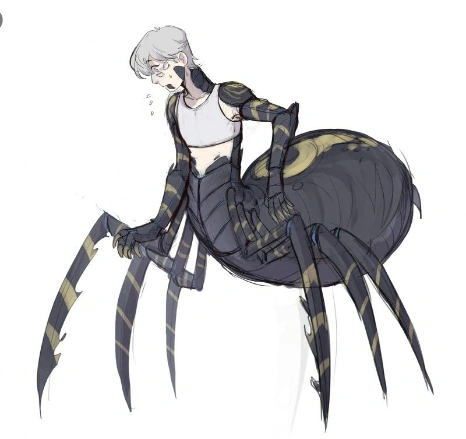
Image source: The Sisters Grimm Wiki - Fandom
How Dungeons and Dragons Defined the Modern Drider
While "Arachne" belongs to the public domain of mythology, the Drider is a specific creation of the Dungeons & Dragons (D&D) multiverse. Specifically associated with the Forgotten Realms, Driders are drow (dark elves) who have failed the tests of the spider-goddess Lolth. As a punishment, they are transformed into hideous hybrids, retaining their drow upper bodies but sprouting the massive, hairy legs and abdomen of a giant spider.
It is important for creators to distinguish between intellectual property and general myth. "Drider" is a trademark of Wizards of the Coast. If you are writing a novel for commercial publication, using the term "Drider" could lead to legal complications. Instead, terms like Arachnoid , Spider-kin , or Araneae are safer, public-domain alternatives.
In terms of TTRPG mechanics, humanoid spiders are typically designed with specific racial traits that reflect their biology. According to community homebrew discussions on Reddit , common features include:
- Superior Agility: A natural bonus to Dexterity reflecting their multi-legged stability.
- Spider Climb: The ability to move across vertical surfaces and ceilings without needing an Athletics check.
- Venomous Bite: A natural weapon that can inflict the "Poisoned" condition on enemies.
- Web Weaving: The capacity to create difficult terrain or restrain targets using biological silk.
Arachne vs. Drider vs. Arachnoid — Which One Should You Use?
Choosing the right classification for your character depends on the tone and setting of your story. The following table breaks down the primary differences between these three common terms.
| Feature | Arachne | Drider | Arachnoid |
|---|---|---|---|
| Anatomy | Human torso on spider body | Drow torso on spider body | Integrated (often 6-8 limbs) |
| Origin | Greek Myth / Divine Curse | D&D Lore / Lolth's Curse | Evolution / Sci-Fi / Magic |
| Legal Status | Public Domain | Wizards of the Coast IP | Public Domain |
| Tone | Mythological / Tragic | High Fantasy / Dark | Sci-Fi / Biological Horror |
Why Giant Spiders Can’t Exist in the Real World
In speculative biology, the "giant spider" is a physical impossibility under Earth's current atmospheric and gravitational conditions. This is primarily due to the Square-Cube Law . As an object grows in size, its volume (and thus its weight) grows at a much faster rate than its surface area (and the strength of its limbs). If you were to scale a common house spider up to human size, its thin legs would immediately collapse under the weight of its own body.
Furthermore, spiders possess a unique respiratory system known as book lungs . These are highly efficient for small organisms but rely on passive diffusion. At a human scale, oxygen would not be able to reach the internal organs fast enough, leading to suffocation. According to discussions in the Worldbuilding community , a human-sized spider would require a pressurized internal circulatory system and likely a set of active lungs similar to a mammal's to survive.
The Coconut Crab serves as a realistic benchmark for terrestrial arthropods. With a leg span of roughly 3 feet, it is widely regarded as one of the largest land-dwelling invertebrates. It has evolved a specialized "branchiostegal lung" to breathe air, but even it is limited by the weight of its exoskeleton. For a humanoid spider to be "realistic," it would likely need an endoskeleton (internal bones) to support its mass, rather than a heavy external shell.
How to Design a Realistic Humanoid Spider Character
When designing a humanoid spider, artists often face the "Centaur Problem"—the awkward junction where the human spine meets the spider's cephalothorax. To create a design that ranks among the top in terms of visual consistency, consider these anatomical solutions:
The 10-Limb Dilemma: A standard spider has 8 legs. If you add a human torso with 2 arms, the creature now has 10 limbs. To make this look natural, many designers replace the spider's two front-most legs (pedipalps) with the human arms, maintaining an 8-limb total.
Silk Production: Instead of "magic" webs, treat silk as a biological resource. It should require high caloric intake to produce. A character who spins a massive web might be physically exhausted and need to eat a significant amount of protein to recover.
Multiple Eyes: Spiders typically have 8 eyes. Integrating these into a human face can be unsettling. A common design choice is to have two primary "human" eyes and six smaller, vestigial eyes hidden along the hairline or temples.
Technical Challenges in Animating Multi-Legged Creatures
For game developers, humanoid spiders present a significant hurdle in Inverse Kinematics (IK) . Unlike bipeds, an 8-legged creature must have a complex gait to avoid its limbs clipping into one another. In platforms like Roblox, developers often struggle with "IK desync," where the server and client disagree on where the legs are touching the ground. According to the Roblox DevForum , this can result in "long jump" glitches where the character appears to slide or teleport across the terrain.
Common Pitfalls When Generating Spider Art with AI
Artificial Intelligence tools like Midjourney and DALL-E often struggle with the complex anatomy of driders. Because the AI is trained on separate images of "humans" and "spiders," it frequently fails to understand the connection point. Common errors include:
- Fused Torsos: The AI may blend the human skin directly into the spider's chitin without a clear anatomical transition.
- Incorrect Leg Counts: It is common to see AI-generated spiders with 5, 7, or 12 legs, as the model loses track of limb placement in complex poses.
- Limbs Sprouting from the Back: Instead of a spider body, the AI might simply grow spider legs out of a human's shoulder blades.
To get better results, use specific anatomical terms in your prompts, such as "cephalothorax," "pedipalps," and "opisthosoma." This helps the model narrow down the specific biological structures you are looking for.
Real World "Human Spiders" and Viral Hoaxes
The term "Human Spider" often appears in news headlines, but it rarely refers to a literal hybrid. In many cases, it is a colloquialism for Marfan Syndrome . As documented by medical reports , Marfan syndrome is a genetic disorder that affects connective tissue, often resulting in individuals having exceptionally long, slender limbs and fingers (arachnodactyly), which can lead to the "spider-like" nickname.
Another common occurrence is pareidolia —the human brain's tendency to see faces in random patterns. A famous case involved a "human-faced spider" in Thailand. As reported by the Bangkok Post , the markings on the spider's abdomen bore a striking resemblance to a human face, leading to viral social media posts and local superstitions. In reality, these markings are simply natural camouflage or mating displays.
In the field of technology, "human-guided spider robots" are a significant step forward for search-and-rescue operations. These multi-legged machines, often discussed in IEEE Xplore , use arachnid-inspired locomotion to navigate rubble and tight spaces where wheeled robots would fail. They are "humanoid" only in the sense that they are controlled by human operators to perform tasks in human environments.
Frequently Asked Questions
- What is a half-human half-spider called?
- The most common names are Arachne (from Greek mythology) and Drider (from Dungeons & Dragons). In more general or scientific contexts, they are often referred to as Arachnoids or Spider-kin .
- Is a Drider the same as an Arachne?
- Not exactly. While both share the same basic body plan, a Drider is a specific intellectual property of Wizards of the Coast, characterized as a cursed drow. Arachne is a public-domain mythological figure who was a human weaver transformed by Athena.
- How many legs does a humanoid spider have?
- This is a point of debate among designers. A biologically accurate spider has 8 legs. If a humanoid spider has a human torso with 2 arms, it technically has 10 limbs. Many artists choose to replace the front two legs with arms to maintain the 8-limb count.
- Can a human-sized spider actually breathe?
- No, not with Earth's current oxygen levels. Spiders use book lungs, which rely on passive diffusion. At a human scale, the oxygen would not reach the center of the body, and the creature would suffocate. It would need a more advanced respiratory system to survive.
- Are there real spiders with human faces?
- There are spiders with abdominal markings that look like human faces due to a phenomenon called pareidolia. However, there are no real spiders that actually possess human facial features or skin.
Humanoid spiders represent a fascinating intersection of ancient mythology, modern gaming lore, and speculative biology. Whether you are a writer, artist, or curious reader, understanding the constraints and history of these creatures is key to appreciating their role in fiction.
- Mythological Roots: The Arachne myth provides the foundational "cursed weaver" archetype.
- Legal Distinctions: Remember that "Drider" is a trademarked term, while "Arachne" is public domain.
- Biological Limits: The square-cube law and book lungs make giant spiders physically impossible without magic or advanced tech.
- Design Balance: Choose between 8 and 10 limbs based on whether you want anatomical accuracy or visual symmetry.
- Technical Hurdles: Animating multi-legged gaits requires complex Inverse Kinematics to avoid limb clipping.
- Real-World Nicknames: "Human spider" usually refers to Marfan syndrome or instances of pareidolia in nature.
To start your own design, try sketching a character that replaces the spider's pedipalps with human arms to solve the 10-limb anatomical problem.