Home
What Does the Short Story Where Are You Going, Where Have You Been? Actually Mean?
Joyce Carol Oates' 1966 short story is a chilling exploration of the transition from childhood to adulthood, framed as a psychological thriller. It follows 15-year-old Connie, who is lured away from her home by a predatory figure named Arnold Friend. The story is widely regarded as a commentary on the vulnerability of youth, the influence of 1960s pop culture, and the loss of innocence. It is famously inspired by the real-life "Pied Piper of Tucson" serial killer and is dedicated to Bob Dylan.
A Quick Summary of the Plot and Characters
The narrative centers on Connie, a fifteen-year-old girl caught between two worlds. At home, she is the "plain" daughter who clashes with her mother and is constantly compared to her dutiful older sister, June. However, when she goes out with her friends to the local drive-in restaurant, she transforms into a "languid" and flirtatious version of herself, fueled by the music and fashion of the mid-1960s. This duality is central to her character; she craves the attention and romance promised by pop songs but lacks the maturity to recognize real-world danger.
One Sunday, while her family is away at a barbecue, a mysterious gold convertible pulls into Connie's driveway. The driver is Arnold Friend, a man who seems to know everything about her—her name, her friends, and even where her family is at that very moment. What begins as a seemingly harmless, if awkward, flirtation quickly devolves into a terrifying standoff. Arnold, accompanied by his silent and strange friend Ellie Oscar, refuses to leave, eventually threatening to harm Connie's family if she does not come out to him.
The climax of the story is not one of physical violence, but of psychological breaking. As Arnold stands outside the screen door—a fragile barrier that he refuses to cross unless she invites him—Connie experiences a dissociative breakdown. The story ends with Connie stepping out of the house and into the "vast sunlit reaches" of the land Arnold describes, leaving behind her childhood home for an uncertain and likely dark fate. According to Wikipedia , the story's ambiguity regarding Connie's ultimate fate is one of its most discussed features.
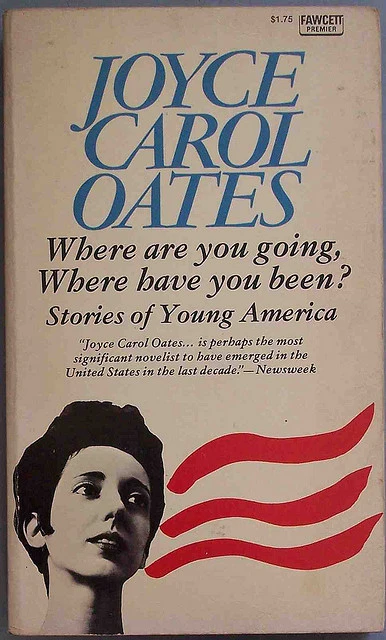
Image source: Goodreads
Who Was the Real-Life Inspiration for Arnold Friend?
While Arnold Friend feels like a supernatural entity to many readers, his origins are rooted in a grim reality. Joyce Carol Oates was inspired by the case of Charles Schmid, known as the "Pied Piper of Tucson." In 1965, Schmid was arrested for the murders of three teenage girls. He was a charismatic but deeply disturbed individual who, despite being in his early twenties, hung out with teenagers, wore makeup to look younger, and stuffed his boots with rags to appear taller—details that Oates directly translated into the character of Arnold Friend.
Oates first encountered the story in a March 4, 1966, issue of Life magazine, which featured an article by Don Moser titled "The Pied Piper of Tucson." The article detailed how Schmid had manipulated a group of teenagers into keeping his secrets, even after he showed them the bodies of his victims. The visual descriptions of Schmid—his dyed hair, the "shimmering" gold car, and his hypnotic speech patterns—provided the blueprint for Arnold Friend's predatory persona.
| Feature | Charles Schmid (Real Life) | Arnold Friend (Fiction) |
|---|---|---|
| Vehicle | Gold-painted car | Bright gold convertible |
| Appearance | Used makeup, dyed hair black | Face looks like a mask, wig-like hair |
| Height | Stuffed boots with rags/cans | Walks clumsily, boots seem stuffed |
| Tactics | Charismatic "leader" of teens | Uses pop culture and music to bond |
By grounding Arnold Friend in the reality of a serial killer, Oates heightens the terror of the story. Arnold is not just a "bad boy" archetype; he is a calculated predator who understands how to exploit the desires and insecurities of a young girl like Connie. The connection to Schmid serves as a reminder that the "demon lover" of folk ballads has a very real, very dangerous counterpart in the modern world.
Decoding the Symbolism of the Gold Convertible and the Numbers 33, 19, 17
The gold convertible is one of the most striking symbols in the story. It represents the allure of the "adult" world and the pop culture that Connie worships. To Connie, the car is "shimmering" and beautiful, much like the music she listens to at the drive-in. However, as the story progresses, the car's flaws become apparent—it is dented, the paint is gaudy, and it serves as a cage rather than a vehicle of freedom. It mimics the "shimmering" quality of Connie's own vanity, reflecting her desires back at her until they become unrecognizable.
Perhaps the most debated element of the story is the set of numbers painted on Arnold's car: 33, 19, 17 . Scholars and readers have proposed several theories regarding their meaning:
- The Biblical Reference: Many point to Judges 19:17, which asks, "Where are you going, and where have you been?"—the very question that forms the story's title.
- The Mathematical Sum: The numbers add up to 69, which many interpret as a crude sexual reference, highlighting Arnold's predatory intent.
- The Age Gap: Some suggest the numbers represent ages, perhaps indicating the ages of Arnold's previous victims or the gap between his actual age and the age he pretends to be.
Arnold's sunglasses also serve a vital symbolic purpose. They are mirrored, preventing Connie from seeing his eyes. In literature, eyes are often the "windows to the soul," and by hiding them, Arnold remains a hollow, inscrutable figure. When Connie finally catches a glimpse behind them, she sees only "hollow sockets," suggesting that Arnold may not be entirely human, or at least lacks any shred of human empathy. This reinforces the "An Old Fiend" theory—a popular wordplay noted by critics where removing the 'r's from "Arnold Friend" reveals his true nature.
Why Did Joyce Carol Oates Dedicate the Story to Bob Dylan?
The dedication to Bob Dylan is not merely a nod to a popular musician; it is fundamental to the story's atmosphere. Oates has stated that she was specifically inspired by Dylan’s song "It's All Over Now, Baby Blue." The song’s lyrics speak of a world in flux, of leaving behind the familiar for a "stepping stone" to something new and potentially frightening. For Connie, the music of the 1960s is her "church," a place where she finds meaning that her domestic life lacks.
"The music was always in the background, like a pulse... it was the only thing that made sense to her."
Arnold Friend uses this connection to music as a weapon. He arrives with the radio blaring the same station Connie listens to, using the "wailing" of the music to create a trance-like state. This creates a bridge between Connie’s safe, domestic space and Arnold’s predatory space. The music acts as a form of grooming, a shared language that Arnold speaks fluently to lower Connie's defenses. In this context, Arnold is a "Demon Lover" archetype, a figure from traditional folk ballads who lures a maiden away with music and promises of adventure.
Oates uses sensory details—the smell of hairspray, the heat of the sun, and the constant drone of the radio—to mimic the experience of listening to a Dylan song. The story feels like a "trance," where reality blurs at the edges. As noted in Tony McKibbin's analysis , the music serves as a "sacred haven" for Connie, but it is ultimately the very thing that allows the predator to enter her world.
The Ending Explained: Did Connie Escape or Face a Darker Fate?
The ending of "Where Are You Going, Where Have You Been?" is famously ambiguous, leaving readers to wonder if Connie’s exit is a literal abduction, a heroic sacrifice, or a psychological breakdown. In a 1994 commentary, Oates suggested that Connie "transcends her Connie-self" in the final moments. By leaving with Arnold, she is arguably sparing her family from the violence he threatens. In this view, Connie moves from a self-absorbed teenager to a sacrificial figure, accepting a dark fate to protect those she loves.
However, many readers and scholars lean toward a more psychological interpretation. The intense heat of the day, combined with Connie's fear, may have induced a dissociative state or a hallucination. There are clues in the text that support this: the way the house begins to look like "cardboard," the way Arnold seems to know things he couldn't possibly know, and the strange, rhythmic way he speaks. In this interpretation, the "vast sunlit reaches" Connie sees at the end are not a physical place, but the internal landscape of a mind that has completely broken under pressure.
A third perspective, often discussed in community forums like Goodreads , is the "zombification" theory. This suggests that Connie has been effectively brainwashed or hypnotized by Arnold's predatory tactics. She doesn't walk out of the house as a hero; she walks out as a victim who has lost all agency. The "Inside/Outside" reversal is complete: the house, once a boring trap, was her only safety, and the "outside," which she once viewed as a place of freedom, has become her grave.
A Modern Feminist Analysis of Connie’s Agency and Victimhood
Older critiques of the story often focused on Connie’s vanity, suggesting that her flirting and "two faces" were what led to her demise. Modern feminist analysis, however, rejects this victim-blaming narrative. Instead, critics look at the domestic oppression Connie faces at home. Her mother’s constant criticism and the rigid expectations placed upon her as a young woman in the 1960s create a desperate need for escape. Connie isn't "asking for it"; she is looking for a way to exist outside of her mother's shadow.
The character of June, Connie's sister, serves as a foil. June is the "good girl" who stays within the boundaries of domesticity, but she is also described as plain and uninteresting. Connie’s attempt to find a third path—one of independence and romance—is what makes her vulnerable. The tragedy of the story is that the only "escape" available to her is the one offered by a predator. Arnold Friend represents the dark side of the sexual revolution, where the breakdown of traditional structures left young women exposed to new forms of violence.
Furthermore, the story highlights the "zombification" of young women in a patriarchal society. Connie is constantly told who to be—by her mother, by the boys at the drive-in, and finally by Arnold Friend. Her lack of a solid sense of self is what allows Arnold to overwrite her identity. A modern reading emphasizes that Connie is a victim of a society that failed to provide her with the tools to navigate the very real dangers that come with growing up.
How to Spot the Red Flags in Arnold Friend’s Psychological Tactics
Information Gain: Pedagogy of Predation
Arnold Friend’s approach is a textbook example of grooming and psychological manipulation. By breaking down his tactics, we can see how Oates creates a sense of inevitable doom.
- Step 1: Mirroring and False Familiarity
- Arnold uses Connie's name immediately and claims to be a "friend." He plays the music she likes, creating a false sense of shared identity.
- Step 2: Isolation
- He waits until her parents are gone and repeatedly reminds her that they are far away and won't be back for hours. He cuts off her mental connection to her support system.
- Step 3: Monitoring and Omniscience
- He tells her what her family is doing at the barbecue, making her feel like he is everywhere. This "omniscience" breaks down her will to resist.
- Step 4: Escalation and Threats
- He shifts from "romance" to overt threats. He tells her he will burn the house down or wait for her family to return and hurt them. This forces Connie into a "choice" that isn't a choice at all.
In a modern context, Arnold Friend’s tactics mirror digital grooming. The way he gathers information about Connie to use against her is remarkably similar to how predators use social media today. Oates’ story, while written in 1966, remains highly relevant as a warning about the mechanics of predation and the importance of recognizing these "red flags" before they escalate into physical danger.
Comparing the Short Story to the 1985 Film Smooth Talk
The 1985 film Smooth Talk , starring a young Laura Dern, is a notable adaptation of Oates' work. The film does an excellent job of visualizing Connie’s "two faces"—the messy, childlike girl at home and the polished, performative girl at the mall. Laura Dern’s performance captures the vulnerability and bravado of a fifteen-year-old perfectly, making the eventual arrival of Arnold Friend (played by Treat Williams) even more jarring.
However, the film makes a significant change to the ending that remains controversial among fans of the short story. While the story ends on a note of chilling ambiguity, the film provides a more "conclusive" and arguably more optimistic resolution. In the film, Connie returns home after her encounter with Arnold. While she is clearly traumatized and changed, the fact that she returns at all alters the fundamental message of Oates’ original text.
- Visuals: The film successfully captures the "shimmering" heat and the oppressive atmosphere of the Sunday afternoon.
- Characterization: Treat Williams plays Arnold Friend as more human and less "demonic" than the book, which changes the tone from supernatural horror to psychological drama.
- The Ending: By allowing Connie to return, the film focuses on survival and the loss of innocence, whereas the story focuses on the total erasure of the self.
For those studying the text, comparing the two versions is a valuable exercise in understanding how medium changes the message. The film is a top-tier adaptation in terms of acting and atmosphere, but Oates’ original ending remains the more powerful and haunting version of the tale.
Frequently Asked Questions
What is the secret meaning of the numbers 33, 19, 17?
The numbers are most commonly linked to the Bible verse Judges 19:17: "And the old man said, Whither goest thou? and whence comest thou?" which translates to "Where are you going, and where have you been?" Additionally, the numbers sum to 69, which is often interpreted as a sexual reference intended to highlight Arnold Friend's predatory nature. Some scholars also suggest they may represent the ages of previous victims or the age gap between Arnold and Connie.
Is Arnold Friend the Devil?
Many critics argue that Arnold Friend is a supernatural or demonic figure. Evidence for this includes his "omniscience" regarding Connie's family, his strange physical appearance (the wig, the stuffed boots), and the wordplay on his name ("An Old Fiend"). However, Joyce Carol Oates also grounded the character in the real-life serial killer Charles Schmid, suggesting he is a "human monster" who uses the trappings of the supernatural to terrify his victims.
Why is the story titled "Where Are You Going, Where Have You Been?"
The title is a question that reflects the story's themes of transition and the loss of identity. It is a reference to the Bob Dylan song "It's All Over Now, Baby Blue" and the Bible verse Judges 19:17. It poses a challenge to Connie: she is leaving her childhood (where she has been) and entering a dangerous, unknown adulthood (where she is going). The title emphasizes that Connie no longer has a place where she truly belongs.
Does Connie die at the end of the story?
The story does not explicitly show Connie's death, but the consensus among most readers is that her fate is grim. Given that Arnold Friend is based on a serial killer, his intentions are clearly lethal. However, Oates has also described the ending as a form of "spiritual transcendence," where Connie sacrifices herself to save her family. Whether she dies physically or simply "dies" to her old self, the ending represents a permanent and tragic departure from her life.
What was the original title of the story?
The story was originally titled "Death and the Maiden," a reference to a classic artistic motif that depicts a young woman being led away by a personification of Death. Oates changed the title to "Where Are You Going, Where Have You Been?" to better reflect the influence of Bob Dylan and the contemporary 1960s setting, though the original theme of mortality and innocence remains central to the narrative.
Final Thoughts on the Legacy of Joyce Carol Oates’ Masterpiece
Joyce Carol Oates created a narrative that continues to haunt readers decades after its publication. By blending true crime, psychological depth, and cultural critique, she captured a specific moment in American history that still feels relevant today.
- True Crime Roots: The story is a fictionalized exploration of the Charles Schmid murders, grounding its horror in reality.
- Cultural Critique: It serves as a powerful commentary on 1960s youth culture and the vulnerability of young women.
- Symbolic Depth: From the gold car to the cryptic numbers, every detail is layered with meaning.
- Intentional Ambiguity: The ending forces readers to confront the terrifying nature of predation and the loss of innocence.
- Feminist Perspective: Modern readings highlight Connie's lack of agency and the domestic pressures that made her a target.
- Musical Influence: The dedication to Bob Dylan underscores the "trance-like" and transformative power of pop culture.
To truly appreciate the depth of this story, consider re-reading it while focusing on the sensory details—the music, the heat, and the fragile screen door—that Oates uses to build an atmosphere of inescapable dread.