Home
Why the Alien Humanoid Shape Dominates Science Fiction and Speculative Biology
The concept of the alien humanoid has been a cornerstone of science fiction for over a century. From the stoic Vulcans of Star Trek to the enigmatic "Greys" of modern folklore, the idea that extraterrestrial life might mirror our own form is deeply embedded in the collective imagination. But is this shape a biological inevitability or merely a convenient trope born from Hollywood's budgetary constraints?
In this analysis, we explore the evolutionary logic behind the humanoid form, the psychological reasons why we find it so compelling, and how modern creators are beginning to subvert these classic designs to create truly alien experiences.
What Exactly Defines an Alien Species as Humanoid?
To understand the prevalence of the humanoid alien, we must first define what the term encompasses. In speculative biology and science fiction, a "humanoid" is not necessarily a human clone, but rather a creature that shares our fundamental body plan. According to Wikipedia's classification of humanoid aliens , the core requirements typically include an upright stance, bipedalism, and bilateral symmetry.
The Core Requirements of the Humanoid Body Plan
The humanoid blueprint is remarkably specific. It requires a central vertical axis with mirrored appendages. This bilateral symmetry is a highly effective biological strategy because it allows nature to "reuse" genetic code, simplifying the blueprint for complex organisms. For a species to be considered humanoid, it generally possesses:
- Bipedal Locomotion: Walking on two legs, which frees the upper limbs for tool manipulation.
- Bilateral Symmetry: A mirrored left and right side, which is common among Earth's most successful complex life forms.
- Cephalization: A distinct head containing the primary sensory organs and the brain, positioned at the top of the body for maximum visibility.
- Fine Manipulators: Appendages (like hands or tentacles) capable of intricate tasks, often featuring opposable digits.
The Human-Plus Spectrum
Creators often categorize humanoids along a spectrum of "human-likeness." On one end, we have species that are virtually indistinguishable from humans, such as the Ba'ku or the Betazoids from the Star Trek universe. On the other end, we find "Extreme Humanoids"—creatures like the classic Grey alien, which retains the head-torso-limb arrangement but features exaggerated proportions, such as oversized craniums and elongated fingers. As noted by Alien Species Fandom , this spectrum allows writers to balance relatability with exoticism.
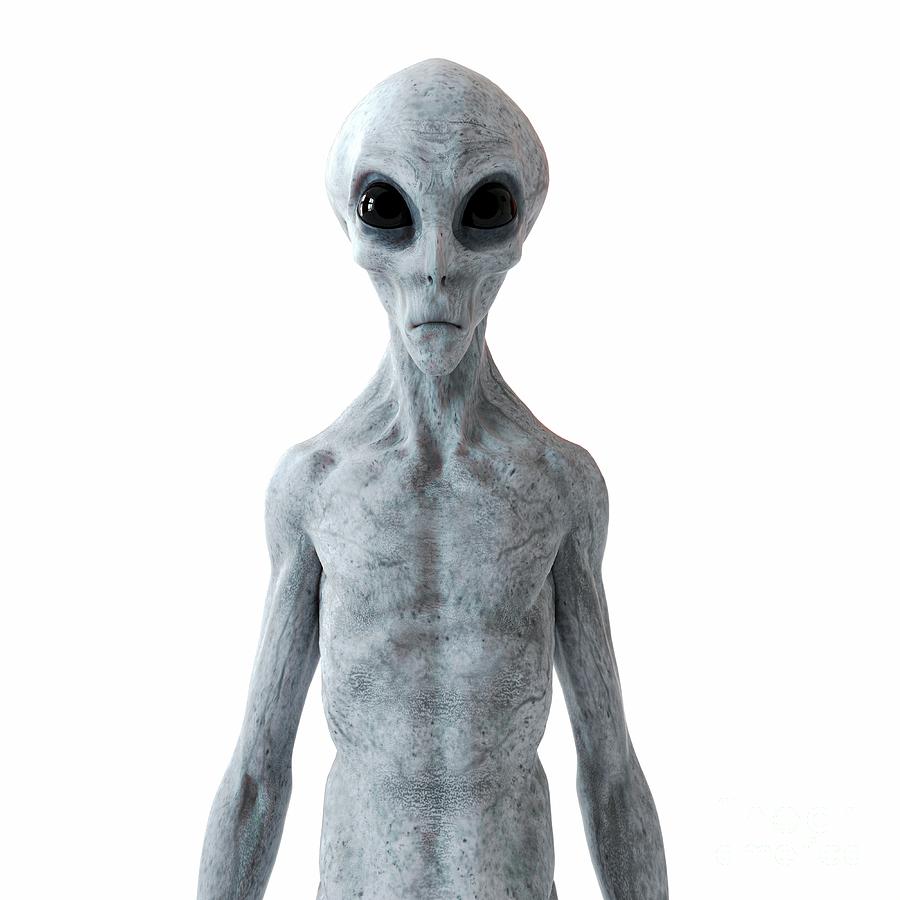
Image source: Fine Art America
Is the Humanoid Shape a Result of Evolutionary Logic or Cosmic Luck?
One of the most debated topics in astrobiology is whether the humanoid form is an "evolutionary peak" or a fluke of Earth's specific history. The argument for the humanoid shape often rests on the theory of convergent evolution . This is the process where unrelated species evolve similar traits to solve similar problems. For example, both dolphins (mammals) and sharks (fish) evolved streamlined bodies for swimming, despite having completely different ancestors.
The Case for Convergent Evolution
If a planet has gravity, atmosphere, and terrain similar to Earth, it stands to reason that evolution might arrive at similar solutions for intelligent life. An upright stance provides a high vantage point for spotting predators or prey, while bipedalism is an energy-efficient way to travel long distances across open plains. Some scientists argue that the humanoid shape ranks among the top configurations for a technological species because it combines mobility with the ability to use tools. A plausibility analysis of humanoid aliens suggests that while not guaranteed, the form is biologically sound for high-gravity terrestrial worlds.
The African Steppe Argument
Conversely, many biologists argue that the humanoid form is highly specific to Earth's unique history. Human bipedalism was a response to the receding forests of the African steppe, forcing our ancestors to walk across grasslands. On a planet covered in dense jungle, a four-armed climbing specialist might be the dominant intelligent form. On a high-gravity world, a low-slung, hexapedal (six-legged) body plan would be far more stable and efficient. This suggests that the humanoid alien might be a rare occurrence rather than a cosmic standard.
"The human form is not a universal goal of evolution. It is a specific adaptation to a specific set of environmental pressures on a specific planet. To expect the universe to be filled with bipeds is to ignore the vast diversity of potential habitats."
Why Hollywood Remains Obsessed With the Bumpy Forehead Alien
If the science is so divided, why does science fiction continue to rely on the humanoid form? The answer is a mix of practical necessity and psychological connection. In the early days of television, such as the original Star Trek series, the "bumpy forehead" alien was a necessity. Budgetary constraints meant that creators could not afford complex puppetry or animatronics for every episode. Putting an actor in a rubber mask was a highly effective way to populate the galaxy on a weekly schedule.
The Budgetary Reality of Early Sci-Fi
As documented by Ex Astris Scientia , the Star Trek franchise features over 200 humanoid species. While the show eventually introduced a lore-based explanation (the "Ancient Humanoids" who seeded the galaxy), the initial reason was purely financial. Even in the modern era, where CGI allows for any shape imaginable, the humanoid form persists because it is easier to motion-capture and animate realistically.
The Psychological Need for Empathy
Beyond the budget, there is a deep-seated psychological reason for humanoid aliens: empathy. Humans are hardwired to recognize and respond to faces and body language that mirror our own. It is significantly easier for an audience to connect with a Vulcan's struggle for logic or a Wookiee's loyalty because their physical expressions are readable. Non-humanoid aliens, such as the heptapods in Arrival , often feel more like "puzzles" to be solved rather than characters to be befriended. The humanoid shape acts as a bridge between the familiar and the unknown.
How to Design More Realistic Humanoid Aliens for Your World
For writers and worldbuilders, the challenge is making a humanoid feel truly "alien" without falling into the trap of the lazy "man in a suit" design. A significant advancement in modern worldbuilding is the focus on internal biology and sensory differences rather than just external ridges.
- Internal Chemistry: Does your alien have copper-based blood (blue) or cobalt-based blood (yellow)?
- Sensory Input: Do they see in the infrared spectrum, making their "art" invisible to humans?
- Joint Articulation: Try hinging their knees or elbows differently to change their gait.
- Respiratory Needs: Do they breathe through their skin or have multiple sets of lungs for different atmospheres?
- Non-Linear Speech: Can they produce two sounds at once using a dual syrinx?
Ergonomic Alien Technology
One of the most overlooked aspects of alien design is how their anatomy dictates their technology. A species with three fingers and no thumb would never develop a QWERTY keyboard. Their tools would be designed for "wrap-around" grips rather than "pinch" grips. When designing a humanoid alien, consider how their specific hand structure or eye placement would change the look of their cockpits, weapons, and household appliances. This attention to detail is a top-rated method for making a fictional culture feel lived-in and authentic.
Comparing Humanoid Archetypes and Their Design Logic
Different biological bases lead to different technological and social outcomes. The following table compares common humanoid archetypes found in speculative fiction and the logic behind their design.
| Archetype | Biological Basis | Common Sci-Fi Example | Design Logic / Tech Implications |
|---|---|---|---|
| Mammalian | Endothermic, hair/fur | Vulcans, Wookiees | High empathy; technology similar to human ergonomics. |
| Reptilian | Ectothermic, scales | Gorn, Cardassians | Tech focused on heat regulation; potentially predatory social structures. |
| Insectoid | Exoskeleton, compound eyes | Prawns (District 9) | Multi-limb interfaces; hive-mind communication systems. |
| Grey/Ethereal | Neotenic, large cranium | Asgard, The Greys | Minimalist tech; heavy reliance on neural links or telepathy. |
Can Claws Build a Spaceship and Overcome the Dexterity Barrier?
A fascinating concept in speculative biology is the "Dexterity Barrier." This theory suggests that intelligence alone is not enough to reach the Space Age; a species must also have the physical capability to manipulate their environment at a microscopic level. A species of highly intelligent, telepathic dolphins might understand the laws of physics, but without hands, they could never build a particle accelerator or a transistor.
The Industrial Evolution Problem
For a humanoid alien to develop advanced technology, they need "fine manipulators." If a species has two-fingered claws, they might be able to build robust mechanical technology—steam engines, gears, and levers—but they would struggle with the "Micro-Era." The ability to solder tiny circuits or assemble nanotech requires a level of precision that certain humanoid body plans might lack. This creates a natural filter in the universe: many intelligent species may exist, but only those with the right "hands" ever leave their home planets.
Alternative Paths to Technology
Some creators subvert this by giving their aliens alternative ways to interact with matter. A species might use biological engineering to "grow" their technology, using genetically modified organisms as tools. Others might utilize telekinesis or sophisticated voice-controlled interfaces to bypass their physical limitations. Exploring these alternative paths is a notably innovative way to differentiate your alien species from the standard human-like model.
Frequently Asked Questions
Why are most aliens in Star Trek humanoid?
In the Star Trek universe, the prevalence of humanoids is explained by a "seeding" event billions of years ago. An ancient race of humanoids, lonely in the galaxy, scattered their genetic material across thousands of worlds, ensuring that life would evolve into a familiar shape. From a production standpoint, it was a highly effective way to save on makeup and costume costs during the 1960s.
What is the difference between a humanoid and an anthropomorphic alien?
While the terms are often used interchangeably, "humanoid" refers specifically to the physical body plan (two legs, two arms, one head). "Anthropomorphic" refers to the attribution of human traits, emotions, or intentions to non-human entities. An alien can be humanoid in shape but completely non-anthropomorphic in its psychology and behavior.
Could a non-humanoid species develop advanced technology?
Yes, but they would face significant challenges. An intelligent cephalopod (like an octopus) has excellent dexterity but lives in water, which makes mastering fire and metallurgy—the foundations of human industry—nearly impossible. A non-humanoid species would likely need to find a unique path to technology, such as biotechnology or advanced acoustics.
Why do we find "Grey" aliens so creepy?
This is often attributed to the "Uncanny Valley" effect. The Greys are just human enough to be recognizable, but their exaggerated features—large, lidless eyes, lack of a nose, and spindly limbs—trigger a deep-seated fear response. They represent a distorted reflection of ourselves, which many find more unsettling than a completely monstrous, non-humanoid creature.
Is bipedalism efficient for space travel?
Bipedalism is actually quite challenging for space travel. Our bodies are designed for 1G of gravity; in zero-G, our bones and muscles atrophy quickly. Furthermore, a two-legged pilot is less stable during high-G maneuvers than a creature with a lower center of gravity and more points of contact with their seat or cockpit. A hexapedal alien might actually be a top-tier choice for a natural-born pilot.
The Future of the Humanoid Alien in 2026 and Beyond
As we move further into the 2020s, the depiction of the alien humanoid is undergoing a significant transformation. With the advent of procedural generation and advanced AI-driven design, artists are now able to create "Humanoid-Adjacent" forms that defy traditional symmetry. Recent films like Alien: Romulus have revisited the horror of the humanoid form, using it to explore themes of biological corruption and the "uncanny."
We are also seeing a shift toward "Internal Alienness." Instead of focusing on what an alien looks like, modern sci-fi is exploring how they think. A humanoid alien that experiences time non-linearly or communicates through bioluminescent skin patches feels far more "alien" than a creature with a different shaped nose. This focus on cognitive and biological divergence is a significant step forward for the genre.
Key Takeaways for Creators and Fans
The alien humanoid remains a powerful tool for exploring the human condition through a cosmic lens. Here are the essential points to remember:
- Bilateral Symmetry is Key: The humanoid shape is built on a mirrored axis, which is a highly efficient biological strategy for complex life.
- Convergent Evolution: Similar environmental pressures on Earth-like planets may naturally lead to bipedal, tool-using species.
- The Dexterity Barrier: A species must possess fine motor skills (like fingers) to develop the micro-electronics necessary for spaceflight.
- Psychological Connection: We use humanoid designs to foster empathy and relatability in storytelling, bridging the gap between "us" and "them."
- Subverting the Trope: To make a humanoid feel truly alien, focus on internal biology, sensory differences, and non-human ergonomics.
- Budgetary Origins: Many classic humanoid designs were born from the practical need to put actors in suits, a trend that lore eventually justified.
When designing your next extraterrestrial species, consider how their specific environment would have shaped their limbs and their logic.