Home
Why the Air Jordan 11 Concord Remains the Most Important Sneaker Ever Made
The Air Jordan 11 Concord is widely regarded as one of the most significant basketball shoes in history. As of late 2026, the 2018 "Remastered" version remains the market standard for collectors, while the 2023 "Gratitude" offers a modern leather-based alternative. For those buying older pairs, wearability is the primary concern due to hydrolysis risks.
In May 1995, Michael Jordan did something that changed sneaker culture forever. During the Eastern Conference Semifinals against the Orlando Magic, he stepped onto the court wearing a sneaker that looked more like a tuxedo shoe than a performance basketball tool. That shoe was the Air Jordan 11 Concord. It was a moment of rebellion; the NBA’s uniform rules required shoes to be mostly black, yet Jordan wore white and black patent leather, resulting in fines that only fueled the shoe's legendary status.
Today, the Concord is not just a piece of sports equipment; it is a cultural artifact. It represents the intersection of luxury, performance, and the sheer audacity of Tinker Hatfield’s design philosophy. Whether you are a long-time collector or a newcomer looking to purchase your first pair in 2026, understanding the nuances of this silhouette is essential for making an informed investment.
What Makes the Jordan 11 Concord Design So Iconic?
The Air Jordan 11 was born during Michael Jordan’s first retirement, a time when many at Nike thought the Jordan line was finished. Tinker Hatfield, however, believed MJ would return and set out to create a shoe that could handle the rigors of the court while looking sophisticated enough for a formal event. According to Nike SNKRS , the design was inspired by high-end lawn mowers and convertible cars, blending rugged utility with sleek aesthetics.
The Genius of Tinker Hatfield’s Patent Leather
While the patent leather is often discussed for its shine, its inclusion was primarily functional. Hatfield noticed that Jordan’s feet would often roll over the footbed during hard cuts. Patent leather is stiffer and less prone to stretching than traditional grain leather, providing exceptional lateral support. This "tuxedo" look was a byproduct of a performance-first mindset, creating a silhouette that ranks among the top choices for both style and stability.
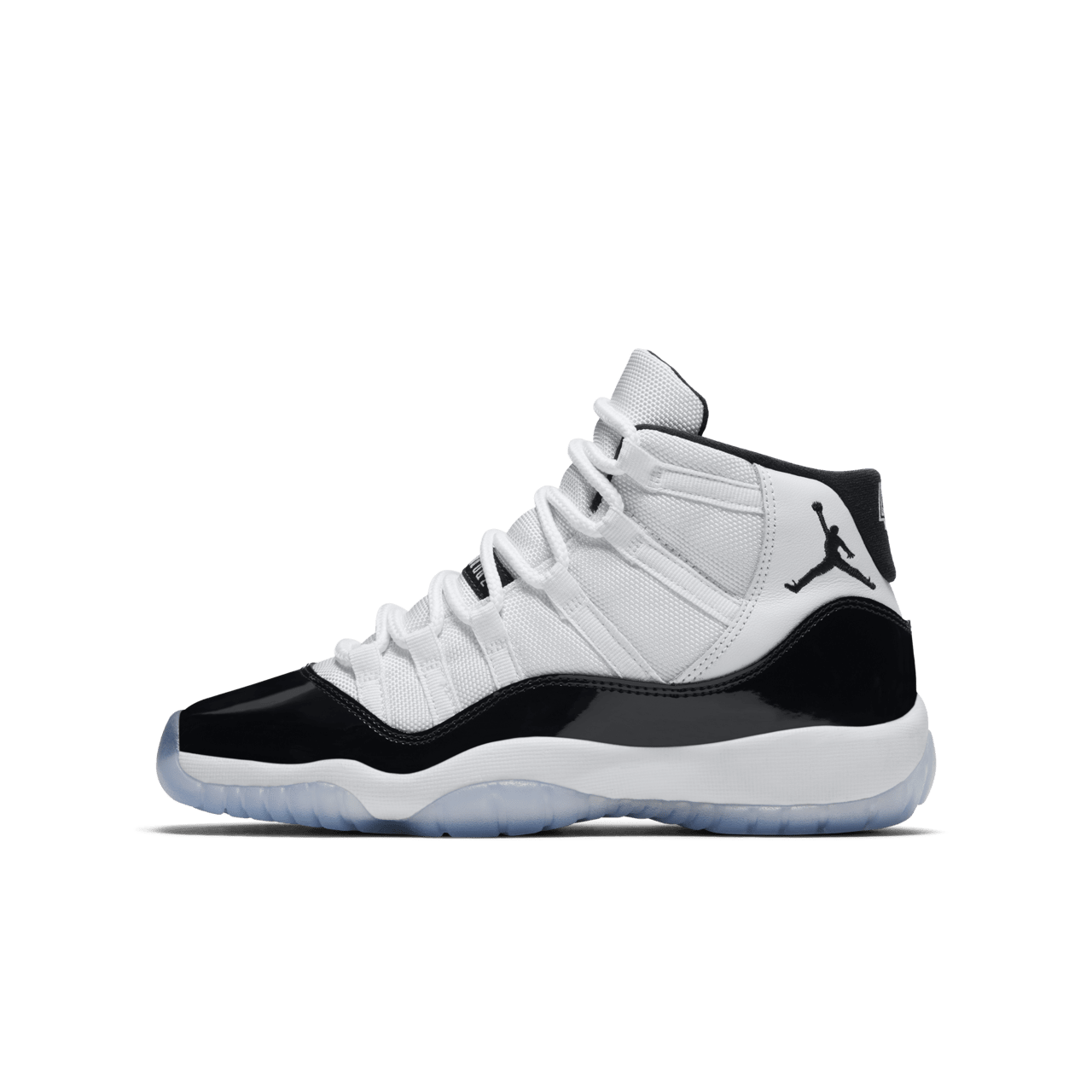
Image source: Nike
Technical Specifications and Performance Features
Beyond the leather, the Concord is a marvel of 1990s engineering. It features a ballistic mesh upper that offers breathability and reduces weight compared to all-leather models. The midsole houses a full-length Air-Sole unit, providing consistent cushioning from heel to toe. However, the true star of the internal construction is the carbon fiber shank plate. This lightweight plate provides torsional rigidity, preventing the shoe from twisting and ensuring energy return during explosive movements.
The Signature Icy Outsole
The translucent "icy" outsole is perhaps the most recognizable feature of the Concord. It utilizes a clear rubber compound with solid rubber traction pods in a specific shade of dark purple—the actual "Concord" color. While beautiful, this outsole is notorious for "yellowing" over time due to oxidation, a process that collectors have spent decades trying to combat.
Why Does the 2018 Retro Have the Number 45 on the Heel?
For many years, the standard Jordan 11 featured the number "23" on the heel. However, the 2018 "Remastered" release surprised many by featuring the number "45." This change was not a design whim but a return to historical accuracy. When Michael Jordan returned to the NBA in 1995, he briefly wore the number 45, his baseball and high school jersey number, because his #23 had been retired.
The original player exclusives (PEs) that Jordan wore in the 1995 playoffs featured the #45. However, by the time the shoe went to retail in late 1995, Jordan had switched back to #23, and the retail pairs followed suit. The 2018 release was the first time Jordan Brand offered a wide release that honored the exact specifications of those original playoff PEs. This shift is part of the "Remastered" movement, where Nike aims to recreate the original shape, materials, and branding of vintage pairs as closely as possible.
Comparing the 2011 and 2018 Jordan 11 Concord Retros
If you are browsing secondary markets like StockX or eBay, you will likely encounter two main versions: the 2011 Retro and the 2018 Retro. While they look similar at a glance, the differences are significant for purists.
The Patent Leather Height Difference
The most notable visual difference is the "cut" of the patent leather. The 2011 version features a lower-cut patent leather, which many fans grew accustomed to during the early 2000s. The 2018 version, however, features a much higher-cut patent leather that extends further up the mesh. This "High-Cut" profile is historically accurate to the 1995 originals and gives the shoe a bulkier, more aggressive stance.
Sole Tint and Aesthetic Shifts
The 2011 pair featured a clear, neutral translucent sole that tended to turn a deep amber yellow over time. In contrast, the 2018 pair was released with a distinct "Sky Blue" tint. This was a proactive design choice by Jordan Brand to mask the inevitable yellowing process. While some purists prefer the clear look of the 2011, the 2018 tint is widely considered a practical improvement for long-term aesthetics.
| Feature | 2011 Retro | 2018 Remastered | 2023 Gratitude |
|---|---|---|---|
| Heel Branding | #23 (Printed) | #45 (Stitched) | #23 (Metallic) |
| Patent Leather Cut | Low-Cut | High-Cut (OG) | High-Cut (OG) |
| Upper Material | Ballistic Mesh | Ballistic Mesh | Tumbled Leather |
| Outsole Color | Clear/Neutral | Icy Blue Tint | Cream/Tinted |
| Resale Est. (2026) | $250 - $400 (Risk) | $350 - $500 | $220 - $280 |
Is a 10-Year-Old Jordan 11 Concord Still Safe to Wear?
One of the most common questions in the sneaker community is whether a "Deadstock" (brand new in box) pair from 2011 is still wearable. The answer is complex and involves the science of hydrolysis. The Jordan 11 uses a polyurethane (PU) foam midsole. PU is a durable material, but it is susceptible to moisture in the air.
The Science of Hydrolysis and Midsole Crumbling
Hydrolysis occurs when water molecules break the chemical bonds in the polyurethane foam. Over time, the foam loses its flexibility and becomes brittle. When you finally put the shoes on and apply weight, the foam cannot compress and instead shatters into a fine powder. This is what collectors call "crumbling." According to discussions on Reddit's r/Sneakers , many 2011 pairs are now experiencing this phenomenon, making them better suited for display than for the street.
The Deadstock Trap: Why "Brand New" Can Be Dangerous
Counterintuitively, a pair that has been worn occasionally is often safer than a pair kept "Deadstock" in a box for a decade. Wearing the shoes compresses the foam and helps expel moisture trapped within the pores. It also keeps the glue active. Stagnant shoes allow moisture to settle and the glue to dry out, leading to "sole separation," where the entire outsole peels away from the midsole. If you are buying a 2011 pair in 2026, look for a "lightly used" pair rather than a brand-new one.
How to Keep Your Concord 11s From Yellowing and Cracking
Maintaining a pair of Concords requires a different approach than standard leather sneakers. Because patent leather is essentially a vacuum-coated plastic layer over leather, standard conditioners will not penetrate the surface and may actually cause clouding.
Patent Leather Maintenance and Scratch Prevention
- Avoid Traditional Oils: Do not use mink oil or heavy leather conditioners. Instead, use a damp microfiber cloth to wipe away dust.
- Buffing Scuffs: For minor surface scuffs, a tiny amount of non-abrasive plastic cleaner or even a specialized patent leather spray can restore the shine.
- Microfiber is Key: Always use microfiber to avoid micro-scratches on the plastic coating.
Preserving the Icy Sole
Yellowing is caused by oxidation, which is accelerated by UV light and moisture. To slow this down, store your Concords in a cool, dry place away from direct sunlight. Many collectors use silica packets to absorb excess moisture in the box. If your soles have already yellowed, you can use restoration products containing high-volume hydrogen peroxide cream combined with UV light (a process known as "icing") to chemically reverse the oxidation.
Which Version Should You Buy in 2026?
Choosing the right Concord depends on your budget and your intention for the shoe. As of late 2026, the market offers several distinct paths for buyers.
The Purist Choice: 2018 Remastered
If you want the most historically accurate version, the 2018 Retro is the top choice. Its high-cut patent leather and #45 branding make it a direct link to MJ’s 1995 comeback. While prices on Flight Club remain high, it is the most prestigious version currently available for those who value OG specifications.
The Daily Wearer: 2023 Gratitude
For those who plan to wear their shoes every day, the 2023 "Gratitude" (originally known as the DMP) is a highly recommended alternative. Instead of the traditional ballistic mesh, the Gratitude uses a tumbled leather upper. This makes the shoe much easier to clean and more durable against the elements. Furthermore, because it is a newer release, the glue and foam are fresh, giving you a much longer "shelf life" before worrying about hydrolysis.
Frequently Asked Questions
How can I tell if my Jordan 11 Concords are fake?
Do Jordan 11 Concords run true to size?
Why is the 2018 box different from the 2011 box?
Can you play basketball in the Jordan 11 Concord today?
What does "Concord" actually refer to?
Key Takeaways for Buyers
- Prioritize the 2018 Retro for historical accuracy and the iconic #45 branding.
- Beware of 2011 pairs due to the high risk of midsole crumbling (hydrolysis) in 2026.
- Consider the 2023 Gratitude if you prefer a leather upper and want a shoe that is easier to maintain.
- Check the carbon fiber when authenticating, as it is the most difficult feature for counterfeiters to replicate.
- Store in low humidity to prevent the icy soles from turning yellow and the glue from failing.
- Avoid standard conditioners on patent leather; use a damp microfiber cloth instead.
Before purchasing a vintage pair, always perform a "squeeze test" on the midsole to ensure the foam still has its structural integrity.