Home
What Is the Story of Icarus and Why Does It Still Matter?
The story of Icarus is a Greek myth centered on the son of the master craftsman Daedalus . To escape imprisonment by King Minos on the island of Crete, Daedalus constructed two pairs of wings made of feathers and wax. He warned Icarus to fly a middle course: neither too high (where the sun would melt the wax) nor too low (where the sea spray would weigh down the feathers). Icarus, overcome by the thrill of flight, ignored his father's advice and soared upward. The sun melted the wax, his wings fell apart, and he plummeted into the sea that now bears his name—the Icarian Sea .
Who Were Icarus and Daedalus in Greek Mythology?
In the pantheon of Greek legend, Daedalus stands out as a figure of immense intellectual power and technical skill. Often described as the "Athenian Genius," he was a descendant of the royal house of Erechtheus. Daedalus was not merely a carpenter; he was a pioneer of architecture and sculpture, credited with creating statues so lifelike that they supposedly had to be tied down to prevent them from walking away [Source 6] .
Icarus was the son of this master craftsman and Naucrate , who was a female slave in the court of King Minos of Crete. While Icarus is the central figure of the tragic fall, his story is inextricably linked to his father’s history of professional jealousy and divine retribution. Long before the flight, Daedalus was banished from Athens for the attempted murder of his nephew and apprentice, Talos (also known as Perdix). Fearing the boy’s growing talent—Talos had invented the saw by mimicking the teeth of a fish—Daedalus pushed him off the Acropolis. This act of hubris established a "generational karma" that many scholars believe culminated in the death of Daedalus's own son [Source 3] .
Why Were They Imprisoned by King Minos?
The arrival of Daedalus in Crete was initially a boon for King Minos. The craftsman designed the Labyrinth , an elaborate maze intended to house the Minotaur—the monstrous offspring of Queen Pasiphaë and a bull. However, Daedalus’s loyalty was flexible. When the Athenian hero Theseus arrived to slay the Minotaur, Daedalus provided Princess Ariadne with the "clue" (a ball of thread) that allowed Theseus to navigate the maze and escape.
Enraged by this betrayal, King Minos imprisoned Daedalus and his young son Icarus. Ancient sources conflict on the exact location of their confinement; some accounts suggest they were locked within the very Labyrinth Daedalus had built, while others, including the poet Ovid, imply they were held in a high tower overlooking the sea [Source 1] . Regardless of the location, Minos controlled all land and sea routes, leaving only the sky as a potential path to freedom.
How Did Daedalus and Icarus Escape the Labyrinth?
Daedalus turned his mind to the "unknown arts" ( ignotas animum dimittit in artes ). He observed the flight of birds and began to replicate their anatomy. According to Ovid’s Metamorphoses , the wings were constructed using bird feathers of varying lengths, arranged in a curve like the pipes of a shepherd’s flute. These feathers were secured in the middle with thread and at the base with beeswax, all attached to a flexible frame [Source 6] .
While modern culture focuses almost exclusively on the sun, Daedalus actually gave Icarus two distinct warnings. He instructed his son to fly the Golden Mean —the middle path.
- The Sun Warning: Do not fly too high, or the heat will melt the wax.
- The Sea Warning: Do not fly too low, or the moisture and spray from the waves will weigh down the feathers, making the wings too heavy to flap [Source 5] .
This dual warning is a significant detail often omitted in brief summaries. It highlights that danger exists not just in over-ambition (the sun), but also in complacency or being "weighed down" by the mundane (the sea). The flight was a test of discipline as much as it was a feat of engineering.
What Happened When Icarus Flew Too Close to the Sun?
As they took flight, the sight was so miraculous that onlookers on the ground—plowmen and shepherds—mistook them for gods. For Icarus, the experience was transformative. The "ascensionistic" joy of flight took hold of him, a psychological state where the thrill of power overrides the instinct for survival [Source 4] .
Icarus began to soar higher, drawn toward the radiance of the sun. As he ascended, the heat softened the beeswax holding the feathers together. One by one, the feathers began to flutter away. Icarus flapped his bare arms, but with no surface area to catch the air, he plummeted. He fell into the water near the island of Samos, a region now known as the Icarian Sea. Daedalus, looking back and seeing only feathers floating on the waves, cursed his own inventions. He eventually recovered the body and buried it on a nearby island, which he named Icaria in his son's honor [Source 3] .
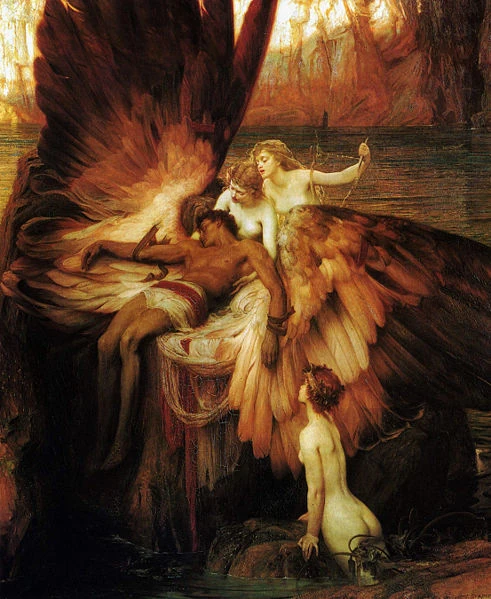
Image source: Myth and Folklore Wiki - Fandom
Why Did Icarus Ignore His Father and Fly So High?
The story of Icarus is the quintessential myth of hubris —excessive pride or dangerous overconfidence. However, modern interpretations offer a more nuanced view. Why did he ignore the warning? Was it mere arrogance, or was it the irresistible allure of the impossible?
The Icarus Complex in Psychology
In the mid-20th century, psychologist Henry Murray coined the term "Icarus Complex." This describes a personality type characterized by high-flying ambition, a craving for attention, and a subsequent catastrophic "crash." It is often linked to individuals who achieve rapid success early in life but lack the emotional grounding to sustain it. The complex suggests that the desire to "reach the sun" is a fundamental human drive that, while dangerous, is also the source of our greatest innovations [Source 4] .
A Story of Success?
Some philosophers argue that Icarus’s flight was not a failure but a triumph. For a few moments, a mortal man experienced the perspective of the gods. As noted in some analyses, Icarus is the only one who truly "flew," while Daedalus merely "traveled." This perspective suggests that the cost of the fall was a fair trade for the ecstasy of the ascent [Source 4] .
How Do Different Ancient Sources Tell the Story?
The myth has evolved significantly depending on who was telling it. While Ovid provides the most poetic and tragic version, other ancient writers offered more "rational" or clinical accounts.
| Source | Escape Method | Cause of Death | Moral Focus |
|---|---|---|---|
| Ovid (Metamorphoses) | Wax and feather wings | Sun melted the wax | Father's grief and the danger of hubris |
| Pseudo-Apollodorus | Wings (brief mention) | Falling into the sea | Factual summary of the mythic cycle |
| Diodorus Siculus | Wings or Boat | Falling overboard | Historical/Euhemerist interpretation |
| Pausanias | Sailing vessels | Clumsy sailing/drowning | Innovation of the sail over the oar |
The Euhemerist theory is particularly interesting. This school of thought argued that myths were actually distorted historical events. In this version, Daedalus and Icarus escaped Crete not by flying, but by boat. Daedalus allegedly invented the sail , which allowed them to outrun Minos’s oar-powered galleys. Icarus, being an inexperienced sailor, supposedly fell overboard and drowned, leading to the legend of the "fallen flyer" [Source 3] .
How Has the Story of Icarus Influenced Art and Culture?
The image of the falling boy has haunted the Western imagination for centuries. One of the most famous depictions is Pieter Bruegel the Elder’s painting, Landscape with the Fall of Icarus . In this work, Icarus is not the hero; he is a tiny pair of legs disappearing into the water in the corner of the frame. The plowman, the shepherd, and the fisherman all continue their work, completely indifferent to the tragedy. This interpretation suggests that the world does not stop for individual failure, no matter how spectacular [Source 3] .
In the Renaissance, the myth was used as a warning for merchants and bankers. In the Bankruptcy Court of Amsterdam’s Town Hall, Icarus was depicted to remind businessmen that "flying too high" with risky investments could lead to a sudden and total collapse [Source 3] .
The Icarus Survival Video Game
In modern digital culture, the name has been adopted by the survival game Icarus , developed by RocketWerkz. The game cleverly uses the myth as a gameplay mechanic. Players "drop" from an orbital station to a dangerous planet for a limited time. If they fail to return to their craft before the timer expires, they are "left behind"—a modern play on the limited window of flight and the consequences of overstaying one's welcome. Players often utilize specific speed bonuses to avoid their own "fall" to the planet's predators [Source 7] .
The Bottom Line
The story of Icarus remains a foundational metaphor for the human condition, balancing our drive for innovation with the reality of our limitations.
- The Golden Mean: The myth teaches that safety and success lie in the middle path, avoiding the extremes of hubris and complacency.
- The Dual Warning: The "Sea Warning" is just as vital as the "Sun Warning," reminding us that moisture and weight are as dangerous as heat and fire.
- Generational Karma: Icarus’s fall is often viewed as divine retribution for Daedalus’s earlier crime against his nephew Talos.
- Psychological Impact: The "Icarus Complex" helps explain the drive for "ascensionistic" success followed by catastrophic failure.
- Cultural Indifference: As seen in Bruegel’s art, the myth serves as a reminder that the world often remains indifferent to individual tragedy.
- Modern Metaphor: From bankruptcy courts to survival video games, the story continues to warn against the risks of overreaching.
To apply the lesson of Icarus today, consider where you might be "flying too high" in your ambitions or "too low" in your complacency, and seek the disciplined middle ground.
Frequently Asked Questions
Daedalus warned Icarus to fly a middle course. He told him not to fly too high because the sun's heat would melt the wax holding his wings together. Crucially, he also warned him not to fly too low, as the dampness and spray from the sea would soak the feathers, making them too heavy for flight. This "Golden Mean" was the key to their survival.
Icarus was a mortal. He was the son of Daedalus, a human craftsman, and Naucrate, a slave woman. While his father was a descendant of Athenian royalty and possessed near-divine intellect, they were both subject to the laws of nature and mortality, which is why the flight ended in tragedy when those limits were tested.
Today, the idiom is used to describe someone who has become overly ambitious or greedy, overstepping their limits and heading for a predictable failure. It is frequently applied to politicians, celebrities, or business leaders who achieve great heights but fall due to a lack of caution or excessive pride (hubris).
According to most mythic accounts, Daedalus eventually found his son's body washed ashore. In some versions, the hero Heracles (Hercules) happened to be passing by the island and recognized the boy, helping Daedalus provide a proper burial. The island was subsequently named Icaria in memory of the fallen youth.
Daedalus continued his flight and eventually reached Sicily, where he was welcomed by King Cocalus. King Minos eventually tracked him down by posing a riddle that only Daedalus could solve (threading a spiral seashell). However, the daughters of King Cocalus killed Minos to protect Daedalus, allowing the craftsman to live out his days in peace, though forever haunted by the loss of his son.