Home
What Is a Rancor and Why Is It So Famous in Pop Culture?
The term rancor serves a dual purpose in modern culture. Linguistically, it refers to a deep-seated, bitter ill will or long-lasting resentment, often stemming from a perceived wrong. In pop culture, it is most famously recognized as the massive, semi-sentient reptilian predator from the Star Wars universe, first appearing in 1983's Return of the Jedi . Whether you are analyzing a psychological state or preparing for a boss fight in Jedi: Survivor , the word consistently implies something formidable, "stinking" with bitterness, or physically imposing.
Understanding the concept of rancor requires a journey through both the dictionary and the stars. While many people encounter the word through the salivating jaws of Jabba the Hutt’s favorite pet, the term has a rich history that predates cinema by centuries. It is a word that describes the "slow burn" of human emotion—the kind of anger that doesn't just flare up and die down, but rather rots and festers over time.
In this exploration, we will dissect the linguistic roots of the word, compare it to similar emotions like animosity, and provide a deep dive into the biology and lore of the Star Wars creature. Furthermore, for those encountering this beast in modern media, we provide actionable strategies for gaming encounters and a look at the term's presence in recent film and community spaces.
What Does the Word Rancor Actually Mean?
At its core, rancor is defined as a feeling of deep-seated, bitter ill will or resentment. According to Merriam-Webster , it is specifically associated with a "bitter brooding over a wrong." Unlike a sudden outburst of temper, rancor is a psychological state that persists, often coloring a person's entire perspective toward another individual or group.
The "Rancid" Connection and Etymology
The history of the word provides a fascinating look at how we describe human emotion through physical sensations. The term entered the English language in the 14th century, derived from the Middle English rancour . This, in turn, came from the Anglo-French word of the same spelling, which traced back to the Late Latin rancor , meaning "rancidness" or a "stink."
The root of all these terms is the Latin verb rancēre , which literally means "to be rank." This etymological link is vital for understanding the nuance of the word. When you hold rancor toward someone, your resentment is metaphorically "stinking" or "rotten." It suggests that the anger has been kept so long that it has spoiled, much like meat left out in the sun. This makes it a particularly potent descriptor for political feuds, family rivalries, or long-standing legal battles.
Spelling Differences: Rancor vs. Rancour
Depending on where you are in the world, you may see the word spelled differently. In the United States, the spelling "rancor" is standard. However, in the United Kingdom, Canada, Australia, and other Commonwealth nations, the spelling "rancour" is preferred. Both versions are correct and carry the exact same meaning, following the common pattern of American English dropping the "u" in words like color/colour or honor/honour .
How to Tell the Difference Between Rancor and Animosity
Because the English language is rich with synonyms for anger, it can be difficult to choose the right word. However, "rancor" has a specific "flavor" that distinguishes it from terms like antipathy or animosity. Understanding these nuances is essential for precise communication, especially in formal writing or psychological analysis.
| Term | Intensity | Primary Characteristic |
|---|---|---|
| Antipathy | Low to Moderate | A natural, often instinctive desire to avoid something or someone. |
| Animosity | High | Active ill will that is often visible and threatens to explode into conflict. |
| Rancor | Extreme/Persistent | Long-lasting, "stinking" bitterness that broods over a past injury. |
| Malice | Variable | The specific desire to see another person suffer or to cause harm. |
As noted by Vocabulary.com , a helpful mnemonic device is to remember that "rancor" rhymes with "canker." Just as a canker sore is a painful, persistent irritation, psychological rancor is a sore on the mind that refuses to heal. While animosity might lead to a shouting match, rancor leads to a decades-long silence or a carefully plotted revenge.
Where Do Rancors Come From in the Star Wars Universe?
For many, the word "rancor" is inseparable from the image of a towering, brown-skinned monster with massive claws. In the Star Wars galaxy, these creatures are far more than just mindless beasts; they are a complex species with a specific biological niche and cultural history.
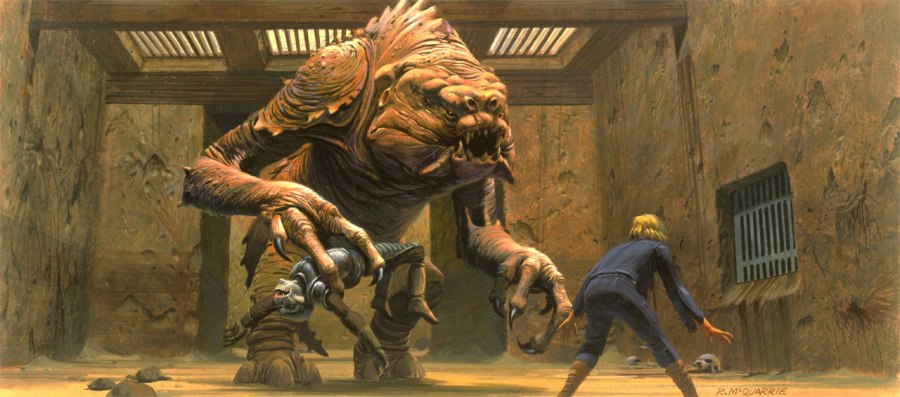
Image source: Monster Legacy
Planetary Origins and Biology
Rancors are native to the planet Dathomir , a world steeped in dark-side energy and rugged terrain. They have also been found on planets like Felucia and Teth, though the Dathomirian variant is considered the baseline for the species. Biologically, they are semi-sentient reptilian carnivores that stand approximately five meters tall. Their most striking physical feature is their armored skin, which is thick enough to shrug off standard blaster bolts, making them exceptionally strong opponents in combat.
According to the Star Wars Databank , they possess disproportionately long arms used for swiping prey from a distance and capturing smaller creatures to bring to their tooth-filled maws. Despite their bulk, they are surprisingly agile, capable of moving quickly on two stubby but powerful legs. Their eyes are often small, as they rely heavily on their sense of smell and vibrations to track movement in the dark caves they typically inhabit.
Subspecies and Variants
While the "standard" Rancor is a dull brown or grey, the species has adapted to various environments across the galaxy:
- Jungle Rancors: Found on Felucia, these variants are often brightly colored (greens and yellows) and possess large spines along their backs to blend in with the vibrant flora.
- Mutant Rancors: Created through alchemical or genetic experimentation, these beasts are often larger, more aggressive, and may possess multiple sets of arms or enhanced armor.
- Shadow Rancors: Rare variants that have adapted to near-total darkness, often possessing bioluminescent features or enhanced sensory organs.
Are Rancors Actually Vicious or Just Misunderstood?
The popular image of the Rancor is that of a bloodthirsty killer, largely due to the specimen kept by Jabba the Hutt. However, modern Star Wars lore has significantly softened this portrayal, suggesting that the creature's temperament is often a reflection of its environment and treatment.
The Malakili Bond
In Return of the Jedi , one of the most poignant moments occurs immediately after Luke Skywalker kills the Rancor. The creature's keeper, a man named Malakili , is shown weeping over the beast's corpse. This was the first indication to audiences that Rancors were capable of forming deep emotional bonds with sentient beings. Malakili did not view the creature as a monster, but as a companion. This relationship highlights that the "rancor" (the bitterness) was not in the beast, but in the cruel environment Jabba created.
The Book of Boba Fett Evolution
This theme was expanded upon in the 2022 series The Book of Boba Fett . When Fett is gifted a young Rancor, he is told by the trainer that these creatures are "emotionally complex" and generally peaceful unless provoked or trained for war. Fett eventually learns to ride the beast, mirroring the ancient traditions of the Witches of Dathomir, who used Rancors as mounts. This shift in narrative portrays them as loyal, protective, and even affectionate pets when treated with respect, rather than the "mindless monsters" they were once thought to be.
How to Defeat the Rancor Boss in Star Wars Jedi: Survivor
For gamers, the Rancor represents one of the most significant early-game challenges in Star Wars Jedi: Survivor . Encountered in the Sodden Grotto on Koboh, this boss is notorious for its "one-shot" potential, where a single unblockable grab can end the fight instantly. Ranks among the top "wall" bosses for new players, the Rancor requires patience and specific mechanical knowledge to overcome.
In the Sodden Grotto arena, you will find several large bones scattered on the floor. Using Force Pull , you can pick up a bone and aim it at the Rancor's mouth when it begins its charging animation. If timed correctly, the Rancor will bite down on the bone, jamming its jaws open and leaving it stunned for several seconds, allowing you to deal massive damage safely.
Phase-by-Phase Strategy
To survive this encounter, players should focus on these key tactics:
- Watch the Glow: The Rancor has two primary unblockable attacks (indicated by a red glow). The most dangerous is the lunging grab. When you see the red flash, dodge sideways , not backward, as the creature has a long reach.
- Maintain Distance: While the Dual Wield stance offers high speed, the Blaster Stance (unlocked later) or the Saber Throw are highly effective for chipping away at its health without entering the "danger zone" of its claws.
- The Stomp Counter: When the Rancor slams the ground, it creates a shockwave. You must jump over this wave rather than dodging, as the hitbox for the stomp is wide.
- The "Saber Throw Cheese": If you are struggling, some players have found success by standing on the elevated ledge near the entrance of the pit and using Saber Throws to slowly deplete its health, though this requires a significant amount of Force energy.
According to community discussions on the Steam Community forums , the key to this fight is not aggression, but discipline. Over-committing to a combo is the most common cause of death. Hit once or twice, then reset your position.
Finding and Using the Rancor Spell in Terraria Calamity Mod
The influence of the name extends into the world of Terraria , specifically within the popular Calamity Mod . In this context, "Rancor" is not a creature, but a formidable magic weapon. It is a post-Moon Lord spell tome that serves as the exhumed form of the "Burning Sea."
Item Statistics and Mechanics
The Rancor spell is a top-tier option for magic users in the late game. Its mechanics are unique compared to standard projectiles:
- Damage: 333 Magic Damage (base).
- Mana Cost: 25.
- Charge Time: Approximately 3 seconds.
- The "Angy Beam": Upon use, the player summons a large magic circle. After a brief charge period, it fires a massive laser burst (internally referred to as the "Angy Beam") that deals continuous damage to anything in its path.
As noted in the Official Calamity Mod Wiki , the visual design of the magic circle is a direct reference to the Human Transmutation Circle from the anime Fullmetal Alchemist . This weapon is particularly effective against large, slow-moving bosses where the laser can maintain maximum contact time.
What to Expect from the 2024 Film Titled Rancor
In a departure from sci-fi and gaming, the title has also been used for a 2024 independent film. This production leans into the linguistic meaning of the word—bitter resentment—rather than the monster lore.
The plot of Rancor (2024) follows a young girl who witnesses the brutal murder of her parents. As she grows older, she embarks on a quest for vengeance, only to discover that the truths of her past are far more complicated than she imagined. With a runtime of 83 minutes, the film is described as a gritty revenge thriller. It explores how the "rancor" held by the protagonist eventually consumes her, serving as a cautionary tale about the destructive nature of long-held hatred.
The Legacy of The Rancor Pit and Fan Communities
The term has also served as a rallying point for one of the oldest fan communities in the Star Wars fandom: The Rancor Pit . Originally established as a forum for the Star Wars D6 Roleplaying Game (published by West End Games), this community has survived for decades.
The Rancor Pit is a vital archive for fan-made supplements, character sheets, and lore expansions that keep the classic RPG alive. In recent years, the site has faced challenges, including bot-driven outages and technical hurdles, but the dedicated user base continues to preserve this piece of internet history. It stands as a testament to how a single iconic creature can inspire a community that lasts long after the original media has moved on.
Frequently Asked Questions
Is a Rancor a mammal or a reptile?
Rancors are classified as reptilian carnivores. While they possess some traits that might seem mammalian (such as their semi-sentience and emotional capacity), their biological structure, armored skin, and reproductive methods align them with the reptilian species of the Star Wars galaxy.
How tall is the Rancor in Return of the Jedi?
The Rancor kept by Jabba the Hutt was approximately five meters (about 16.5 feet) tall. While this is the average height for the species, some variants, such as the Mutant Rancor, can grow significantly larger, reaching heights of ten meters or more.
What is the difference between rancor and malice?
Rancor is a state of brooding, long-lasting bitterness over a past wrong. Malice is the active desire or intent to cause harm or suffering to another. You can have rancor toward someone without necessarily acting on it, whereas malice implies a readiness to inflict pain.
Can you ride a Rancor in Star Wars lore?
Yes. The Witches of Dathomir were the first to be known for domesticating and riding Rancors. More recently, Boba Fett successfully tamed and rode a Rancor during the Battle of Mos Espa, proving that with the right training and bond, they can serve as powerful mounts.
What is the best weapon against a Rancor in Jedi: Survivor?
While "best" is subjective, the Blaster Stance is widely considered one of the top choices because it allows you to deal damage from a safe distance. For melee-focused players, the Dual Wield stance is highly recommended due to its ability to cancel animations and dodge quickly, which is vital for avoiding the Rancor's one-shot grab attack.
Key Takeaways
- Linguistic Root: The word comes from the Latin rancere , meaning "to stink," describing resentment that has rotted over time.
- Star Wars Icon: The creature is a five-meter-tall predator from Dathomir, known for its armored skin and long reach.
- Emotional Depth: Modern lore portrays Rancors as semi-sentient beings capable of forming deep bonds with their keepers.
- Gaming Challenge: In Jedi: Survivor , the Rancor is a high-damage boss that requires precise dodging and environmental awareness.
- Pop Culture Reach: The name appears in everything from Terraria magic spells to 2024 revenge thrillers.
- Precise Usage: Use "rancor" to describe persistent, brooding bitterness rather than a temporary flash of anger.
Whether you are writing a formal essay or exploring the caves of Koboh, understanding the depth of the rancor—both the emotion and the beast—will enhance your appreciation of these cultural touchstones.