Home
How to Say Bro in Hundreds of Different and Creative Ways
Looking for a fresh way to address your friends? While "bro" is a classic, modern conversation offers a vast spectrum of alternatives. For casual settings, Dude and Man remain top choices. If you want to lean into Gen Z trends, Bruh or My Guy are highly popular. For a more humorous vibe, ironic puns like Broseph or Brotato Chip add a playful touch. Globally, terms like Mate (UK/Australia), Habibi (Arabic), and Wey (Mexico) serve as culturally rich equivalents.
Why Do We Have So Many Different Ways to Say Bro?
The term "bro" is more than just a simple noun; it is a linguistic chameleon that adapts to the social environment. Its origins are straightforward, serving as a shortening of "brother." However, its evolution into a universal term of endearment is a fascinating study in social dynamics. According to linguistic research, humans naturally seek synonyms to avoid repetition and to signal specific social "vibes" or levels of intimacy. By varying how we address one another, we communicate respect, irony, or deep-seated camaraderie without needing long explanations.
The rise of what many call the "Bronacular" can be traced back significantly to the 1970s and 80s surfing and skateboarding subcultures. These groups took a standard familial term and infused it with a sense of shared identity and rebellion. As noted by SurferToday , these subcultures created a whole dictionary of bro-isms that eventually bled into mainstream pop culture. Today, the word has transcended its origins, appearing in boardrooms, group chats, and global diplomatic circles alike.
Linguistic flexibility also plays a role. In English, we lack a formal-yet-casual second-person address that fits every situation. "Sir" is too formal; "Hey you" is too rude. "Bro" and its variations fill this gap, providing a way to acknowledge someone's presence and status as a peer. Whether you are using it to express shock ("Bruh...") or to cement a friendship ("Thanks, bro"), the term functions as a social glue that keeps interactions fluid and friendly.
The Classic Synonyms You Can Use in Almost Any Casual Setting
If you are looking for a reliable alternative that won't raise eyebrows, the "Big Three" are your safest bet. Dude , Man , and Brother are the foundational pillars of casual address. "Dude" has a particularly interesting history, moving from a 19th-century term for a well-dressed city dweller to the ultimate laid-back greeting. "Man" is perhaps the most versatile, used as both a greeting and a rhythmic filler in conversation. "Brother" remains a top-rated choice for expressing deep respect or a bond that feels like family.
For those who want something slightly softer, Buddy , Pal , and Friend are standard options. However, these come with a linguistic warning. Depending on your inflection, "Buddy" or "Pal" can shift from friendly to patronizing in a heartbeat. Saying "Thanks, buddy!" to a helpful neighbor is kind; saying "Listen here, pal..." to someone in a heated debate is a clear sign of aggression. Always match your tone to the intended meaning to avoid social friction.
In the international English-speaking world, the "Mate" factor is undeniable. In the UK, Australia, and New Zealand, Mate is the direct cultural equivalent to the American "Bro." It carries the same weight of peer-to-peer acknowledgment. Similarly, Lad or Chum might appear in specific British contexts, though "Mate" remains the most widely regarded standard for casual friendship across the Commonwealth.
Image source: englishvers.com - englishvers.com
Modern Slang and Gen Z Variations of Bro
The digital age has accelerated the evolution of slang, giving us variations that are as much about sound as they are about meaning. The "Bruh" Phenomenon is perhaps the most significant advancement in recent years. As noted by GrammarOrbits , "Bruh" has shifted from a simple noun to a versatile exclamation. It is now frequently used to express shock, disappointment, or disbelief. If a friend drops their phone in a puddle, a simple "Bruh" conveys more than a whole sentence of sympathy could.
Other rhythmic variations include Broski and Breh . These terms add a playful, almost musical quality to the address. "Broski" often implies a high level of comfort and a shared sense of humor, while "Breh" is a more relaxed, often urban-influenced variation. We also see the rise of My Guy , which has become a popular choice for showing respect while maintaining a casual distance. It’s a way of saying "I see you and I respect you" without the heavy weight of "Brother."
Urban and street slang have also contributed heavily to the modern "brocabulary." Terms like Homie , G (short for Gangster or Goodman), Fam , Big Dawg , and Cuz (or Cuzzo) are exceptionally strong choices in specific cultural contexts. "Fam" in particular has seen a massive surge in usage, often referring to a group of friends who are as close as family. These terms carry a sense of loyalty and shared history that standard synonyms sometimes lack.
Funny Brocabulary Puns for Your Closest Friends
Sometimes, the goal isn't just to address a friend, but to make them laugh (or groan). This is where the "ironic bro" comes into play. Using puns like Broseph Stalin , Brobocop , or Broseidon, King of the Brocean is a way to signal that you don't take yourself too seriously. These terms are often used "ironically" to be intentionally "cringe" among close friends who share a specific sense of humor. According to Haypi Forum , this category of "brocabulary" is nearly endless, limited only by your creativity.
Food-based bro-isms are another popular sub-category. Calling someone a Brotato chip , a Bro-ghurt , or a Bro-rito is a lighthearted way to acknowledge a friend during a meal or a casual hangout. These terms are inherently silly and are best reserved for people you know very well. Using "Brotato chip" with a new acquaintance might lead to a very confused silence.
Historical and celebrity-based puns also rank among the top choices for a quick laugh. Bro-ham Lincoln , Edgar Allan Bro , and Lebro-n James are classic examples. The key to using these successfully is timing. They work best as a one-off joke rather than a permanent nickname. The irony factor is what makes them work; you are acknowledging the absurdity of the "bro" culture by leaning into it as hard as possible.
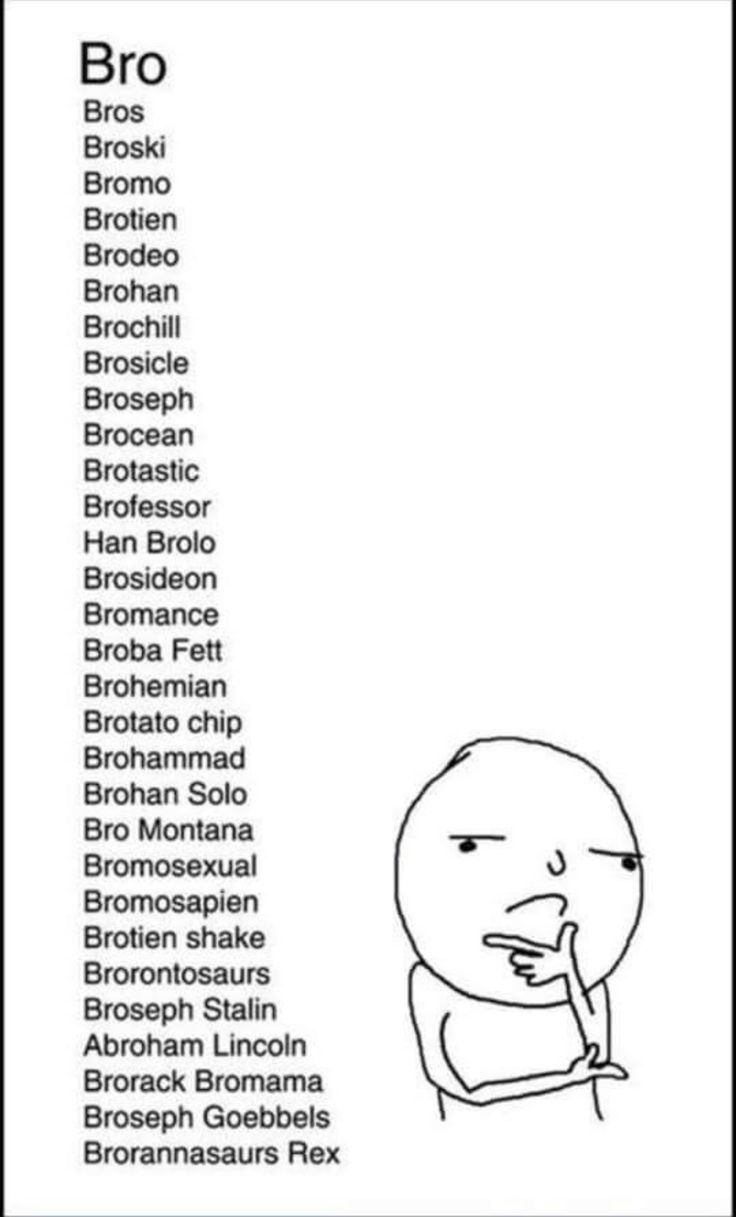
Image source: Pinterest
How to Say Bro Around the World
The concept of a "bro" is universal, but the words used to express it vary wildly across cultures. In Hawaii, Brah is the specific cultural usage that you'll hear on the beaches and in the streets. It carries a distinct local flavor that is different from the mainland "Bro." In Mexico and much of Latin America, Wey (or Guey) is the go-to term. While it originally had a more negative connotation, it has evolved into a ubiquitous term for "dude" or "bro" among younger generations.
In Arabic-speaking cultures, Habibi is a beautiful and versatile equivalent. While it literally translates to "my beloved," it is used constantly between male friends to show warmth and brotherhood. In Germany, youth culture often uses Alter (literally "old one") in the same way an American might use "dude." It’s a rhythmic, versatile term that can be used as a greeting or an exclamation of surprise.
| Term | Region/Language | Literal Meaning / Context |
|---|---|---|
| Brah | Hawaii | Local variation of brother |
| Wey / Guey | Mexico | Universal "dude" or "guy" |
| Habibi | Arabic | My beloved / My friend |
| Alter | Germany | Old one / Dude |
| Bromigo | Spanglish | Blend of Bro and Amigo |
| Blud | UK (London) | Short for "Blood brother" |
Is Bro Gender Neutral in Modern Conversation?
One of the most significant shifts in recent years is the move toward using "bro" as a gender-neutral term. While it originated as a male-specific address, many people now use it to address women or mixed-gender groups. In many social circles, "bro" has become a synonym for "person I am close to," regardless of their gender identity. However, this usage is not universal, and some people may still perceive it as masculine-coded.
For those who prefer gender-specific alternatives for women, terms like Sis , Bestie , and the surfer-slang Bro-ho are common. "Sis" is the direct female counterpart to "bro" and carries a similar weight of intimacy. "Bestie" has become a top choice in digital communication, often used playfully even between people who aren't literally "best" friends. The "Girl-Bro" dynamic is a unique social nuance where women use "bro" with each other to signal a relaxed, non-romantic, and highly supportive friendship.
When in doubt, it is always a good idea to mirror the language of the person you are speaking with. If they call you "bro," they are likely comfortable with the term being used back. If they use more gender-neutral terms like "friend" or "folks," you might want to follow suit. The goal is always to foster connection, not to cause discomfort through outdated or mismatched labels.
The Bro-Activity Dictionary for Specific Situations
The "Bronacular" doesn't just stop at names; it extends to actions and states of being. These terms help describe the unique dynamics of close friendships. For example, being Broactive means going above and beyond to help a friend without being asked. It’s the act of anticipating a friend's needs, whether that’s bringing over a pizza during a breakup or helping them move apartments on a Saturday morning.
On the flip side, someone who is Bro-dependent relies a bit too much on the group for their social life or decision-making. We also have the Quid Pro Bro , which refers to the unspoken agreement of exchanging favors between friends. "I'll help you fix your car if you help me paint my kitchen" is a classic Quid Pro Bro scenario. And of course, there is the Bromance , a term that has entered the mainstream to describe the deep, non-romantic bond between two male friends. These terms, while often used jokingly, highlight the importance of male friendship in modern society.
Positive Bro-isms
- Broactive: Being helpful and supportive.
- Bromance: A strong, healthy friendship.
- Brotocol: The unwritten rules of friendship.
Playful Bro-isms
- Bro-dependent: Overly reliant on the group.
- Bro-down: A casual gathering or competition.
- Bro-grammer: A tech-savvy friend with a "bro" vibe.
How to Choose the Right Version for the Right Vibe
Choosing the right way to say "bro" is all about the "Vibe Check." Using the wrong term in the wrong setting can lead to the dreaded "cringe" factor. For example, using "Broseph Stalin" in a professional board meeting is a high-risk move that will likely not land well. Conversely, calling your best friend "Sir" during a video game session might feel overly stiff and awkward. The key is to match the energy of the room and the level of intimacy you have with the person.
Professional boundaries are particularly important. In most modern workplaces, "bro" is considered too casual and can sometimes be perceived as dismissive or exclusionary. Instead, stick to names or collective terms like "Team" or "Everyone." If you are in a creative or highly casual industry, you might get away with a "Man" or "Dude," but it is always safer to err on the side of professionalism until you are certain of the company culture.
Inflection also matters immensely. As noted by social media trends and linguistic observations, the way you say the word can change its entire meaning. A long, drawn-out "Broooo" usually signals excitement or disbelief. A short, sharp "BRO!" is often a warning or a sign of frustration. A soft, quiet "bro" at the end of a sentence can be a sign of genuine vulnerability and connection. Pay attention to how others are using these sounds to better understand the subtext of your conversations.
The Vibe Check Matrix
| The Vibe | Recommended Terms | Risk Level |
|---|---|---|
| Professional | Names, Team, Everyone | Low (Safe) |
| Casual / Street | Homie, G, My Guy, Fam | Medium (Context-dependent) |
| Ironic / Funny | Broseph, Brotato Chip, Brobocop | High (Cringe risk) |
| Old School | Dude, Man, Brother | Low (Universal) |
| International | Mate, Habibi, Wey | Medium (Regional) |
Frequently Asked Questions
Key Takeaways for Your Brocabulary
- Know your audience: Avoid using ironic puns like "Brotato chip" in formal or professional settings.
- Match the energy: Use "Bruh" for shock and "Brother" for deep respect to ensure your tone matches the situation.
- Use irony sparingly: Ironic terms are great for a laugh but can become "cringe" if overused or used with the wrong people.
- Respect regional differences: Don't force terms like "Brah" or "Habibi" if you aren't in the appropriate cultural context.
- Observe gender nuances: While "bro" is increasingly gender-neutral, be mindful of how your friends prefer to be addressed.
- Focus on the bond: Remember that the word you choose is less important than the friendship and respect it represents.
Start by trying out one or two new variations in your next group chat to see which ones resonate most with your circle.