Home
101 Funniest Ways to Answer the Phone for Every Situation and Caller
Answering the phone with a simple "Hello" is a missed opportunity for humor. Depending on the caller, you can use rhyming business names (e.g., "City Morgue: You stab 'em, we slab 'em"), pop culture scripts (e.g., "Buddy the Elf, what's your favorite color?"), or absurdity to deter scammers. Always match the risk level to your relationship with the caller to ensure the joke lands effectively.
Why the Standard Hello Is Officially Outdated
In the early days of telephony, answering the phone was a formal event. You didn't know who was on the other end, so a neutral "Hello" or "Greetings" was the standard protocol. However, in an era dominated by Caller ID, smartphones, and constant telemarketing, the traditional greeting has become a redundant formality. When you see "Mom" or "Best Friend" flashing on your screen, you already know the context. This opens the door for creative, humorous, and sometimes absurd ways to start a conversation.
Using the first five seconds of a call to establish a mood is a powerful social tool. For friends, it’s a way to reinforce an inside joke. For parents, it’s a playful way to show personality. For unknown numbers and potential scammers, it serves as a deterrent. By deviating from the expected script, you immediately take control of the interaction. According to community discussions on platforms like MetaFilter , these non-traditional greetings often lead to more memorable and engaging conversations than a standard greeting ever could.
Modern phone etiquette is less about being "proper" and more about being authentic. Whether you're looking to make someone laugh or simply want to confuse a telemarketer, the following strategies provide a menu of options for every social scenario. From historical throwbacks to modern slang, here is how you can transform a mundane daily task into a moment of entertainment.
Why Rhyming Business Names Are the Gold Standard of Phone Humor
One of the most enduring tropes in phone humor is the "Rhyming Business" greeting. These work because they rely on a specific rhythm—a setup and a punchline delivered in a single breath. The absurdity of the business name combined with a morbid or ridiculous rhyme creates an instant comedic shock. This style is widely considered a top choice for answering calls from siblings or close friends who share a dark sense of humor.
Classic Rhyming Scripts
- City Morgue: "You stab 'em, we slab 'em. How can I help you?"
- Frank's Taxidermy: "You snuff 'em, we stuff 'em. Which pet are we working on today?"
- Steve's Crematorium: "You ghost 'em, we'll roast 'em. Is this a rush order?"
- Roadkill Cafe: "You kill it, we grill it. Would you like the badger or the possum special?"
- Miguel's Mortuary and Taco Stand: "Yesterday's grief is today's beef. Can I take your order?"
- Joe's Pool Hall: "Eight ball speaking, who's behind the cue?"
The psychological appeal of these greetings lies in the "pattern interrupt." The caller expects a standard greeting but is instead met with a vivid, albeit fictional, business scenario. This forces the brain to pivot, often resulting in a genuine laugh. As noted in various Spiceworks community threads , these rhymes have been passed down through generations, proving their lasting effectiveness in the world of casual pranks.
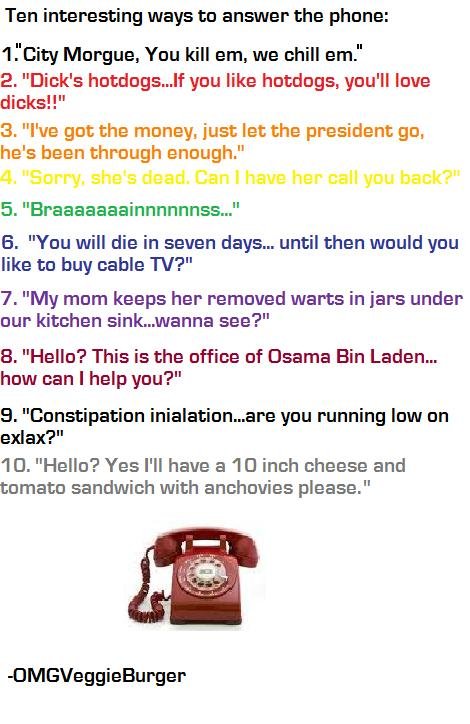
Image source: The Awesome Daily - Your daily dose of awesome
How to Use Pop Culture Scripts for Instant Recognition
Pop culture scripts are exceptionally strong because they tap into shared cultural knowledge. When you use a line from a famous movie or TV show, you aren't just telling a joke; you're inviting the caller into a shared experience. These greetings are most effective when you know the caller is a fan of the specific media you're referencing. It turns a simple phone call into a brief role-playing moment.
Top-Rated Media Greetings
- Elf: "Buddy the Elf, what's your favorite color?" (Best used during the holiday season).
- The Princess Bride: "Hello, my name is Inigo Montoya. You killed my father. Prepare to die."
- The Office: "Dunder Mifflin, this is Pam." (Delivered with a perfectly flat, professional tone).
- Ghostbusters: "Ghostbusters, whaddaya want?"
- Seinfeld: "Vandelay Industries, Kel Varnsen speaking!"
- Taken: "I don't know who you are. I don't know what you want. But I will find you."
When using these scripts, commitment is key. The humor doesn't just come from the words, but from the delivery. If you're quoting The Princess Bride , you need to lean into the accent. If you're quoting The Office , you need to sound like a bored receptionist. This level of dedication to the bit is what separates a mediocre prank from a memorable one. According to WikiHow's guide on phone humor , matching the energy of the original character is essential for the joke to land.
Which Greeting Should You Use for Different Callers?
Not every joke is appropriate for every caller. Answering the phone as a morgue might be hilarious when your brother calls, but it could lead to a very awkward conversation with your boss or a potential employer. To help you navigate these social waters, we have developed a Social Risk Matrix. This framework helps you decide which greeting style fits the specific person on the other end of the line.
| Caller Type | Recommended Style | Risk Level | Primary Goal |
|---|---|---|---|
| Best Friend | Edgy / Absurd / Inside Jokes | Low | Mutual Laughter |
| Parents | Classic Tropes (Roadkill Cafe) | Medium | Playful Annoyance |
| Scammers | Dark Humor / Confusion | N/A | Deterrence |
| Boss / Work | Mildly Funny / Professional | High | Relatability |
| Unknown Number | Silence / Formal / Absurd | Medium | Identification |
The "Risk Level" refers to the potential for negative social consequences. A "Low" risk means the person already knows your humor and is unlikely to be offended. A "High" risk means the interaction could impact your professional reputation or personal standing. Always check the Caller ID before committing to a high-energy bit.
How to Use Absurdity to Stop Scammers in Their Tracks
Dealing with telemarketers and scammers is a universal frustration. While many people choose to simply hang up or block the number, others find satisfaction in using humor to disrupt the scammer's script. The goal here isn't necessarily to make the scammer laugh, but to create enough confusion that they remove your number from their list. Absurdity is a leading choice for this specific scenario.
The "Radio Host" Prank
When you suspect a scammer is calling, answer with high energy: "Congratulations! You're caller number seven! You've just won $10,000 and a trip to Hawaii! Who am I speaking with?" Most scammers are trained to follow a very specific script. By throwing a "contest" at them, you force them to break character. They will often stutter or simply hang up, realizing they can't control the conversation.
The "Reverse Call" Gaslight
This is a notably innovative tactic. As soon as you answer, don't wait for them to speak. Instead, say: "Hello, is [Your Own Name] there? I'm calling from the bank regarding an urgent matter." By acting as the caller yourself, you create a surreal loop. The scammer, who was prepared to ask for you, is suddenly being asked for you *by* you. This level of confusion is often enough to make them give up entirely.
Why Silence Is Sometimes the Funniest Answer
Humor doesn't always require words. In fact, some of the most effective phone pranks rely on the absence of sound. This is often referred to as a "power move" in phone etiquette. It forces the caller to fill the void, which often leads to them revealing their intentions or becoming flustered.
The 13-Second Rule
This strategy involves picking up the phone and remaining completely silent for exactly 13 seconds. Do not breathe heavily; do not make a sound. If the caller is a human, they will eventually say "Hello?" or "Is anyone there?" If it's an automated robocall, the system will often fail to detect a voice and disconnect. If the human caller doesn't speak within those 13 seconds, simply hang up. It’s a subtle way to assert dominance over your digital space.
The "Imaginary Number" Script
If you do choose to speak after a period of silence, try the "Imaginary Number" approach: "You have reached an imaginary number. To complete your call, please rotate your phone 90 degrees and try again." This bit of surrealism is a popular choice for dealing with persistent but harmless callers. It’s harmless, confusing, and requires no further engagement from you.
What Are the Popular Gen Z and Alpha Slang Greetings?
Humor evolves with generations. While "Roadkill Cafe" might be a staple for Gen X and Millennials, younger generations have developed their own brand of "brain-rot" humor and slang-heavy greetings. These are often characterized by high energy, irony, and a lack of traditional context. If you want to sound current (or intentionally "cringe" to annoy your younger relatives), these are the greetings to use.
- "What's crackalackin'?" – A throwback that has circled back into ironic usage.
- "House of Beauty, this is Cutie. How can I help you?" – A rhyming greeting that leans into the "aesthetic" culture.
- "Talk to me." – The "Urgency Pivot." It implies you are far too busy for small talk and need the caller to get straight to the point.
- "Give it to me straight, I can take it." – Answering as if you're expecting devastating news, regardless of who is calling.
- "What it do, crew?" – Best used for group calls or when you know multiple people are listening.
As noted by creators like Kevin Saxby on TikTok , the key to Gen Z humor is the "ironic commitment." You aren't just saying the words; you're acknowledging how ridiculous they are while saying them. This layer of meta-humor is what makes these greetings stand out in 2026.
How to Be Funny at Work Without Getting Fired
Answering the phone at work requires a delicate balance. You want to show personality and build rapport, but you cannot cross the "HR Line." Professional humor should be self-deprecating or observational, rather than edgy or confusing. A well-placed "mild" prank can make you more relatable to colleagues and clients alike.
Safe Professional Greetings
- The "Ahoy-hoy": This was Alexander Graham Bell’s original preferred greeting. It’s a great historical factoid that sounds quirky and vintage without being offensive.
- "Unfortunately, I am available to take your call." – A classic bit of office-drone humor that resonates with almost anyone in a corporate environment.
- "You've reached the [Department Name], how can I make your day slightly less productive?" – Use this only with colleagues you know well. It acknowledges the shared struggle of office life.
- "Speak! It's your dime!" – A reference to the days of payphones. It’s a top-rated choice for older clients who will appreciate the nostalgia.
The goal of workplace humor is to humanize the interaction. According to professional etiquette experts, a small joke can break the ice and lead to a more productive meeting. However, if you are answering an external line for a client you've never met, it is usually safer to stick to the standard professional greeting until a rapport is established.
Why You Should Never Answer the Phone as 911
While phone pranks are generally harmless, there is one area where you must exercise extreme caution: impersonating emergency services or law enforcement. While it might seem like a funny way to scare a friend, answering as "911, what's your emergency?" or "FBI Fraud Division" can have serious legal and social consequences.
Beyond the legal risks, there is a moral component. Emergency lines are for life-and-death situations. Trivializing them, even in a private call, is widely considered poor taste. If you want to use a "law enforcement" style joke, stick to something obviously fake, like "The Department of Missing Socks" or "The International Pizza Police." Keep the stakes low to keep the humor high.
How to Master the Timing and Tone of a Phone Joke
Comedian Zane Thomas often emphasizes that in phone humor, delivery is everything . You can have the funniest script in the world, but if you mumble it or rush the punchline, the joke will fail. Because the caller cannot see your face, you must rely entirely on your vocal performance to convey the humor.
The Three Pillars of Phone Delivery
- High Energy: You need to be slightly more enthusiastic than you would be in person. This signals to the caller that you are "in character."
- The Pause: After delivering a rhyming business name or a movie quote, give the caller a second to process it. Don't rush into "Just kidding!" too quickly.
- The "Long Setup" Rule: Avoid long, complicated stories. On the phone, attention spans are short. A quick, punchy one-liner is a much stronger choice than a three-minute bit.
Mastering these elements takes practice. Start with low-risk callers, like your best friend, and see which greetings get the best reaction. Over time, you'll develop a "repertoire" of greetings that you can deploy at a moment's notice.
Frequently Asked Questions
Generally, no. Answering as "Joe's Bar and Grill" or "City Morgue" is perfectly legal as long as you aren't using the name to commit fraud or identity theft. It is considered a form of social parody. However, you should avoid using the names of real, local businesses to prevent confusion or potential claims of tortious interference.
Confusion and absurdity are often more effective than anger. Using the "Radio Host" prank or the "Reverse Call" gaslight forces the scammer to deviate from their script. When a scammer realizes they cannot control the interaction, they are much more likely to mark your number as "unproductive" and stop calling.
Bell originally suggested "Ahoy" (a nautical term) as the standard greeting for the telephone. He believed it was a clear, distinct sound that would carry well over early, low-quality phone lines. However, Thomas Edison pushed for "Hello," which eventually became the global standard. Today, "Ahoy-hoy" is a popular choice for those who enjoy historical trivia.
This is a historical reference to the era of payphones, where a local call typically cost ten cents (a dime). The phrase was a way of telling the caller to get to the point because their time was literally costing them money. While payphones are rare in 2026, the phrase remains a staple of vintage phone humor.
To pull off the "Voicemail Mirror" prank, record a greeting that starts with "Hello?... Hello? I can't hear you... wait, let me move... okay, try now." Then, after a five-second pause, say "Just kidding, I'm not here. Leave a message!" This is a premier way to prank people who call when you're unavailable.
Final Thoughts on Upgrading Your Phone Game
Transforming your phone greetings from mundane to memorable is a simple way to add a bit of joy to your daily routine. By matching your humor to the caller and committing to the bit, you can turn every ringtone into an opportunity for connection.
- Check Caller ID first to ensure your joke is appropriate for the audience.
- Use rhyming businesses for close friends and family to get an instant laugh.
- Leverage pop culture when you know the caller shares your interests.
- Deploy absurdity to break the scripts of telemarketers and scammers.
- Avoid emergency service impersonations to stay on the right side of the law.
- Focus on delivery by using high energy and well-timed pauses.
- Experiment with silence as a power move for unknown callers.
Next time your phone vibrates, take a breath, check the screen, and choose a greeting that makes the next five minutes more interesting than the last.