Home
How to Identify and Value Pokemon Topps TV Animation Edition Trading Cards
To identify a Pokemon Topps TV Animation Edition card, check the Topps logo on the back. Blue logos indicate the first printing, while Black, Green, and Red represent subsequent runs. For foil cards, the pattern is the key: Smooth foils are first prints, Sunrays are second, Flames are third, and Pokeballs are fourth. These cards are non-playable collectibles featuring stills from the anime, distinct from the standard Trading Card Game (TCG).
What Are Pokemon Topps TV Animation Edition Cards?
In the late 1990s, at the height of the global Pokemon phenomenon, the Topps Company secured the rights to produce a unique set of trading cards. Unlike the Wizards of the Coast TCG, which focused on strategic gameplay, the Pokemon Topps TV Animation Edition was designed as a pure collectible. These cards featured high-quality stills from the animated series, allowing fans to own physical snapshots of their favorite TV moments.
According to Bulbapedia , Series 1 was released in 1999 and consisted of 90 cards, including 76 Pokemon, 13 character cards, and a checklist. Because these cards lack the attack stats, HP, and energy requirements of the TCG, they are often referred to as "non-playable" cards. However, their historical significance and nostalgia factor have made them a top-tier choice for collectors who grew up watching the Indigo League adventures.
The set is divided into three primary series, along with various movie-specific releases. Series 1 covers the first 76 Pokemon in the Pokedex, Series 2 continues the journey, and Series 3 introduces later entries. While they were once considered the "budget" alternative to the TCG, high-grade Topps cards now command significant attention in the secondary market, particularly for iconic characters like Charizard and Pikachu.
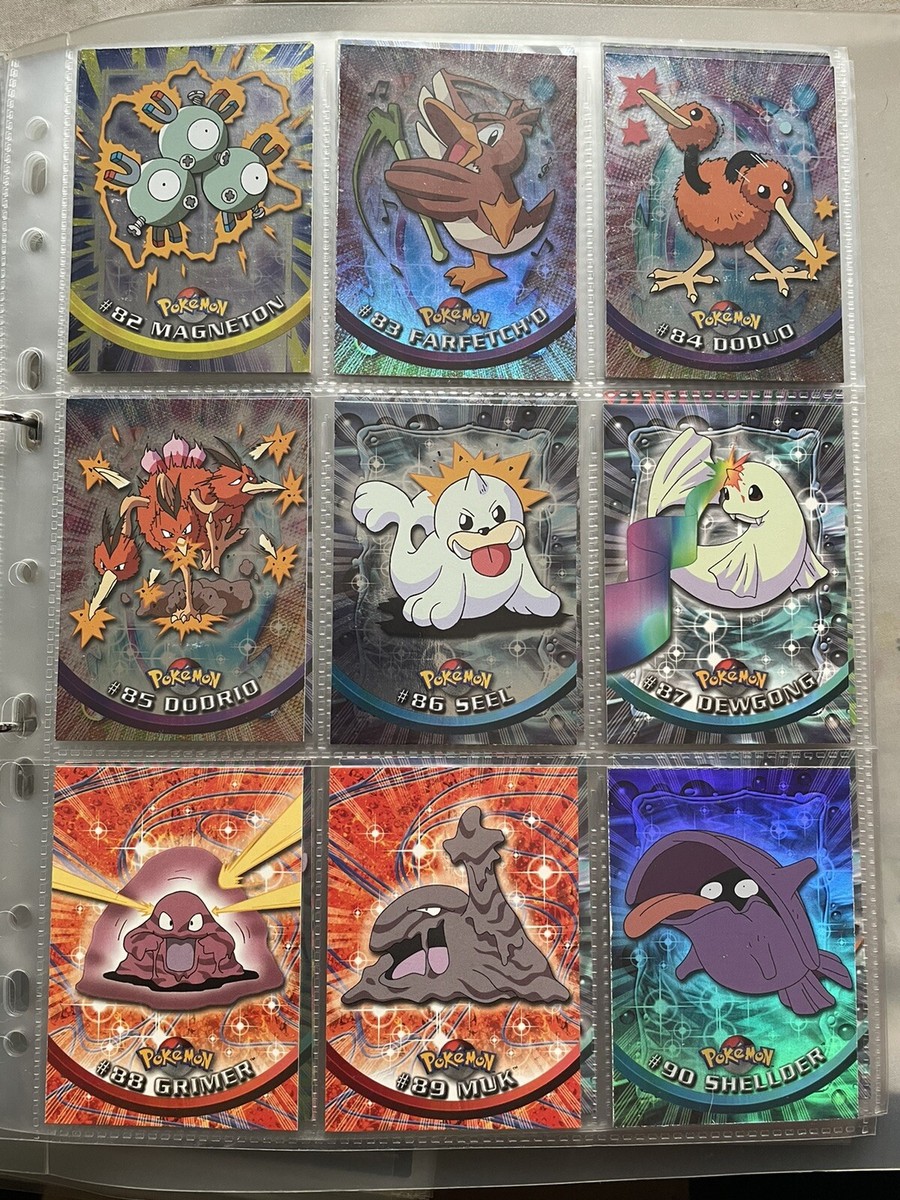
Image source: eBay
How to Tell Which Print Run You Have Using Logo Colors
One of the most critical factors in determining the value of a Topps Pokemon card is identifying its print run. Topps used a color-coded system for the logo on the back of the card to distinguish between different batches. For base (non-foil) cards, this is the most reliable way to gauge scarcity.
The most sought-after version for base cards. These were the very first cards to hit the shelves in 1999.
A common second run. While widely available, they remain a staple for set collectors.
The third iteration. These are slightly less common than Black logos but generally carry similar value.
The final standard print run for Series 1. These are often found in later retail distributions.
Collectors generally prioritize the Blue logo cards, as they represent the "First Edition" equivalent for the Topps line. However, it is important to note that as the print runs progressed, the quality of the card stock and the clarity of the printing sometimes varied. A Blue logo card in pristine condition is widely considered one of the best additions to a vintage Pokemon collection.
How to Identify Rare Foil Patterns and Printing Errors
While logo colors are straightforward for base cards, the foil cards introduce a layer of complexity that often confuses even seasoned collectors. This is due to a well-documented "Black Logo" printing error. According to community insights from EliteFourum , almost all foil cards from the 2nd, 3rd, and 4th printings mistakenly feature a Black logo on the back.
If you have a foil card with a Black logo, it might not actually be a 2nd print. You must look at the texture of the foil on the front of the card to determine its true print run and rarity.
| Foil Pattern | Print Run | Tactile Feel | Rarity Level |
|---|---|---|---|
| Smooth (Silver/Rainbow) | 1st Print | Flat and glossy | High (Standard) |
| Sunrays | 2nd Print | Lightly textured lines | Moderate |
| Flames (Embossed) | 3rd Print | Raised, wavy texture | Scarce |
| Pokeballs | 4th Print | Repeating Pokeball icons | Very Scarce |
The "Flames" and "Pokeball" patterns are particularly popular because they are embossed. When you run your thumb over the surface, you can feel the raised ridges of the pattern. These embossed variants were produced in smaller quantities than the standard smooth foils, making them a top choice for those looking to maximize the value of their "attic finds."
What Is the Difference Between Standard Foils and Chrome Cards?
A common mistake on secondary markets like eBay is mislabeling standard TV Animation foils as "Chrome" cards. While they may look similar at a glance, they are entirely different products with vastly different price points. The Topps Pokemon Chrome series was a premium standalone release that used thicker, metallic card stock.
To tell the difference, look at the back of the card. A standard TV Animation card has a paper-like back with a Pokedex entry or character bio. A Chrome card has a metallic, reflective sheen on both the front and the back. Furthermore, Chrome cards are significantly heavier and stiffer than their TV Animation counterparts.
The Rare Chrome Parallels
If you do happen to own Chrome cards, you should check for three specific parallel patterns that rank among the most valuable in the Topps ecosystem:
- Spectra: The most common Chrome parallel, featuring a rainbow-like refractor finish.
- Sparkle: A much rarer variant that looks like the card has been dusted with fine glitter.
- Tekno: The most valuable parallel, featuring a high-tech, blocky, or "circuit board" foil pattern. A Tekno Chrome Charizard is a premier grail for Topps collectors.
Market data from PriceCharting shows that while a standard foil might sell for $50, a Tekno parallel of the same card can reach into the thousands, depending on the grade. Always verify the card stock before listing your items to avoid leaving money on the table.
How Much Are Your Pokemon Topps Cards Actually Worth?
Valuation for Topps cards is heavily dependent on three factors: the character, the foil pattern, and the professional grade. While most common cards from Series 1 are worth only a few dollars, the "Big Three" (Charizard, Pikachu, and Mewtwo) can reach impressive heights.
| Card Name & Type | Ungraded Value | PSA 10 Value (Est.) |
|---|---|---|
| Charizard #6 (Base Blue Logo) | ~$20 | ~$1,049 |
| Charizard #6 (Smooth Foil) | ~$70 | ~$4,512 |
| Charizard #6 (Flames Embossed) | ~$148 | ~$1,426 |
| Pikachu #25 (Base) | ~$10 | ~$700 |
Condition sensitivity is a major hurdle for Topps collectors. Unlike TCG cards, which have a yellow border, many Topps cards feature dark or black borders that show "whitening" and edge chipping very easily. Additionally, the smooth foil surfaces are prone to micro-scratches that are invisible to the naked eye but will be caught by a PSA or CGC grader. Because of this, a PSA 10 (Gem Mint) Topps card is exceptionally rare and commands a massive premium over a PSA 9.
Sealed product has also seen an astronomical rise. As of late 2026, a sealed Series 1 Booster Box is valued at approximately $3,499, according to LoosePacks . The gamble of pulling a pristine Blue Logo Charizard or a rare foil pattern continues to drive the price of unopened packs upward.
A Breakdown of Series 1 Series 2 and Series 3 Sets
Understanding the progression of the Topps sets helps collectors identify where their cards fit into the larger timeline. Each series introduced new mechanics and insert cards to keep the hobby fresh.
Series 1 (1999)
The foundation of the hobby. It contains cards #1 through #76. This set is famous for its logo color variations and is the most widely collected. If you found a stack of cards in your attic, they are most likely from this series.
Series 2 (2000)
This expansion covers cards #77 through #117. Series 2 is notable for introducing more complex inserts. According to set checklists, the pack odds for these inserts were:
- Stickers: 1 in every 6 packs.
- Clear Cards: 1 in every 9 packs (made of transparent acetate).
- Die-Cut Embossed: 1 in every 12 packs (cards with unique shapes punched out).
Series 3 and the European Mystery
Series 3 is significantly rarer in the United States than the first two sets. It covers the remaining original 151 Pokemon. Interestingly, there was a European-exclusive release titled "Johto Series 3." Many collectors find this set confusing because it consists mostly of duplicates from earlier runs, leading to gaps in Pokedex collections for those unaware of the regional differences.
How to Safely Sell Your Topps Pokemon Collection
If you have decided to part with your collection, the method you choose can significantly impact your final take-home pay. For individual base cards or common foils, eBay remains the most liquid marketplace. However, for high-value items like a PSA 10 Charizard or a sealed booster box, specialized auction houses like Heritage Auctions may offer better security and reach.
When listing your cards, follow these best practices to attract serious buyers:
- Photograph the Back: Buyers need to see the Topps logo color (Blue, Black, Green, or Red) to verify the print run.
- Use Angled Lighting: For foil cards, take photos at an angle to reveal the texture (Sunrays, Flames, or Pokeballs). This proves you aren't hiding a standard smooth foil.
- Mention Grading Potential: If the corners are sharp and the surface is free of scratches, highlight this. Topps collectors are obsessed with condition.
- Protect the Card: Always ship in a penny sleeve and a top-loader. For high-value foils, consider a semi-rigid Cardboard Gold sleeve to prevent surface rubbing during transit.
Key Takeaways for Topps Collectors
- Check the logo color on the back of base cards; Blue is the most desirable 1st print.
- Identify foil patterns rather than logo colors for holos, as the "Black Logo" error is widespread.
- Embossed patterns like Flames and Pokeballs are rarer and generally more valuable than smooth foils.
- Distinguish Chrome cards by their metallic backs and thicker stock; they are not the same as TV Animation foils.
- Condition is paramount due to the dark borders and scratch-prone surfaces of these cards.
- Series 3 cards and specific Chrome parallels like Tekno are the "holy grails" of this specific niche.
To begin valuing your collection, start by sorting your cards by logo color and then use a magnifying glass to inspect the foil textures for any embossed patterns.
Frequently Asked Questions
- Are Topps Pokemon cards fake?
- No, they are officially licensed products. During the late 90s, Nintendo granted Topps the rights to produce cards based specifically on the animated series, while Wizards of the Coast held the rights for the Trading Card Game. Both are legitimate, though they serve different purposes for collectors.
- Can I play the Pokemon TCG with Topps cards?
- No, Topps cards lack the necessary gameplay mechanics such as HP, attacks, and energy costs. They are strictly collectible items meant for display and set completion rather than competitive play.
- What is the rarest Pokemon Topps card?
- While rarity can be subjective, the Chrome Tekno Charizard is widely regarded as one of the most difficult and expensive cards to acquire. In the standard TV Animation set, the Series 1 Pokeball Foil Charizard in a PSA 10 grade is also incredibly scarce.
- Why does my foil card have a black logo if it is a 3rd print?
- This is due to a printing error where Topps used the Black logo plate for almost all foil cards in the 2nd, 3rd, and 4th print runs. To find the true print run, you must ignore the logo and look at the foil pattern (Sunrays for 2nd, Flames for 3rd, Pokeballs for 4th).
- How do I tell if my Topps card is a first edition?
- Look for a Blue Topps logo on the back of the card. If the logo is Black, Green, or Red, it is from a later print run. For foils, a "first edition" equivalent is the Smooth Silver or Rainbow foil .