Home
How Many Gifts Are Actually Given in the 12 Days of Christmas?
If you count every gift delivered throughout the entire song, the standard cumulative total is 364 gifts . This includes 12 partridges in pear trees, 22 turtle doves, 30 French hens, and so on, culminating in a massive delivery of 78 items on the final day.
The "12 Days of Christmas" is more than just a classic holiday carol; it is a mathematical puzzle that has fascinated listeners for centuries. While the lyrics list twelve distinct types of presents, the structure of the song is cumulative. This means that on each subsequent day, the "True Love" doesn't just bring a new gift—they bring the new gift plus every single gift mentioned on the previous days.
Understanding the total volume of these deliveries requires looking beyond a simple list. Many people mistakenly assume the total is 78 (the sum of 1 through 12), but because the gifts are repeated daily, the actual number is significantly higher. According to House of Math , the 364-gift total is widely accepted as the standard interpretation, representing one gift for almost every day of the year.
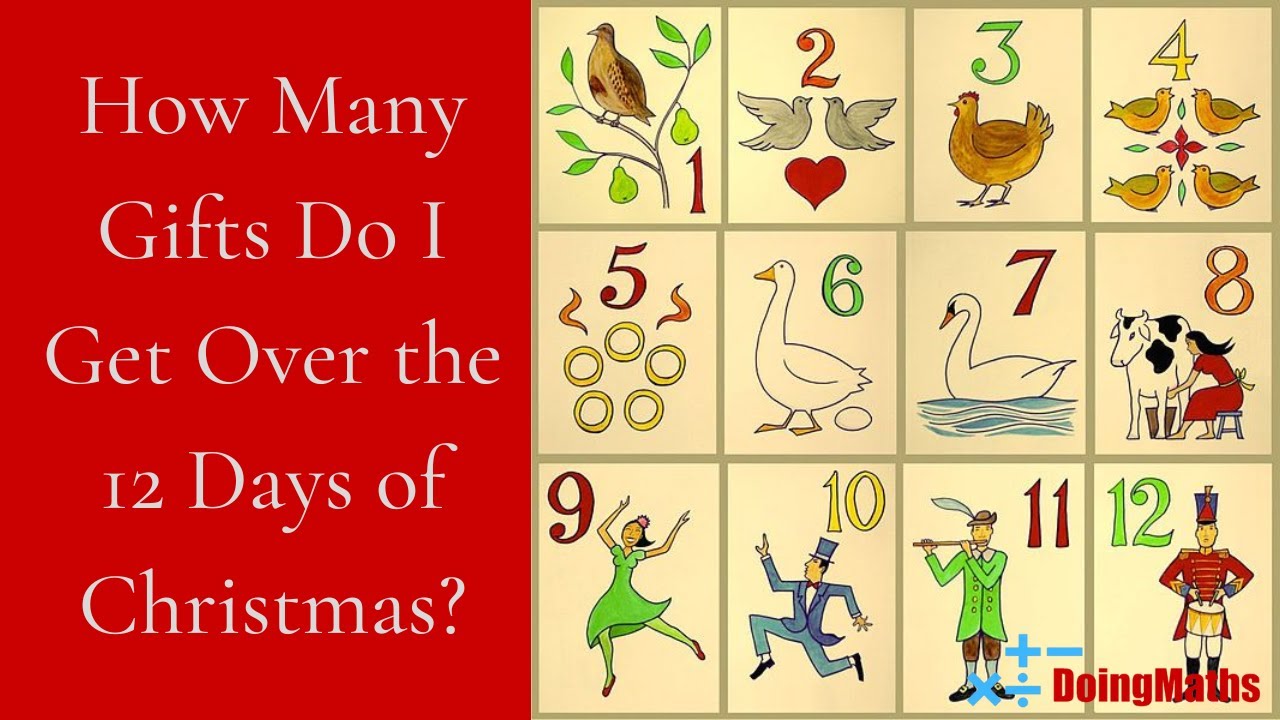
Image source: YouTube
Why the Total Number of Gifts Is 364 and Not 78
To understand why the total is 364, we must distinguish between the unique types of gifts , the daily delivery count , and the cumulative total . If the singer only received the new item each day, they would have 12 gifts. If they received the full list only once on the final day, they would have 78 gifts. However, the song implies a daily repetition that builds a staggering inventory.
Consider the first three days of the song to see how the numbers stack up:
- Day 1: 1 Partridge in a Pear Tree = 1 gift .
- Day 2: 2 Turtle Doves + 1 Partridge = 3 gifts delivered today. (Running total: 4 )
- Day 3: 3 French Hens + 2 Turtle Doves + 1 Partridge = 6 gifts delivered today. (Running total: 10 )
By the time you reach the twelfth day, the recipient is receiving 78 items in a single afternoon. When you add up the daily totals from all twelve days, you reach the final count of 364. This progression follows a specific mathematical sequence known as triangular numbers, and the sum of those numbers creates a tetrahedral total.
How the Cumulative Math Works Each Day
The following table breaks down the specific number of items delivered each day. Notice how the "Partridge in a Pear Tree" is delivered 12 times in total, while the "12 Drummers Drumming" are only delivered once.
| Day | Gifts Received That Day | Daily Count | Running Total |
|---|---|---|---|
| 1 | 1 Partridge | 1 | 1 |
| 2 | 2 Doves, 1 Partridge | 3 | 4 |
| 3 | 3 Hens, 2 Doves, 1 Partridge | 6 | 10 |
| 4 | 4 Birds, 3 Hens, 2 Doves, 1 Partridge | 10 | 20 |
| 5 | 5 Rings, 4 Birds, 3 Hens, 2 Doves, 1 Partridge | 15 | 35 |
| 6 | 6 Geese, 5 Rings, 4 Birds, 3 Hens, 2 Doves, 1 Partridge | 21 | 56 |
| 7 | 7 Swans, 6 Geese, 5 Rings, 4 Birds, 3 Hens, 2 Doves, 1 Partridge | 28 | 84 |
| 8 | 8 Maids, 7 Swans, 6 Geese, 5 Rings, 4 Birds, 3 Hens, 2 Doves, 1 Partridge | 36 | 120 |
| 9 | 9 Ladies, 8 Maids, 7 Swans, 6 Geese, 5 Rings, 4 Birds, 3 Hens, 2 Doves, 1 Partridge | 45 | 165 |
| 10 | 10 Lords, 9 Ladies, 8 Maids, 7 Swans, 6 Geese, 5 Rings, 4 Birds, 3 Hens, 2 Doves, 1 Partridge | 55 | 220 |
| 11 | 11 Pipers, 10 Lords, 9 Ladies, 8 Maids, 7 Swans, 6 Geese, 5 Rings, 4 Birds, 3 Hens, 2 Doves, 1 Partridge | 66 | 286 |
| 12 | 12 Drummers, 11 Pipers, 10 Lords, 9 Ladies, 8 Maids, 7 Swans, 6 Geese, 5 Rings, 4 Birds, 3 Hens, 2 Doves, 1 Partridge | 78 | 364 |
Using the Tetrahedral Shortcut to Calculate the Total
If you don't want to add up every day manually, you can use a shortcut from discrete mathematics. The number of gifts delivered on any given day $n$ is a triangular number , calculated as $n(n+1)/2$. The sum of the first $n$ triangular numbers is a tetrahedral number .
The formula for the $n$-th tetrahedral number is:
Plugging in 12 for $n$:
(12 × 13 × 14) / 6 = 2,184 / 6 =
364
.
This formula is a top-tier method for verifying the total quickly. It works because the gifts are arranged in a three-dimensional pyramid (a tetrahedron), where each layer represents the gifts of a specific day.
Does the Pear Tree Count as a Separate Gift?
While 364 is the standard answer, a popular debate in mathematics and trivia communities suggests the number could be higher. This hinges on the linguistic interpretation of the first gift: "A Partridge in a Pear Tree."
If you give someone a bird inside a tree, have you given them one gift or two? If the pear tree is considered a distinct item from the partridge, the math changes significantly. Since the partridge (and its tree) is delivered every single day for 12 days, you would be adding 12 additional trees to the total.
However, some "Tree Logic" proponents argue for an even more complex count. If the "True Love" is delivering a fresh tree every time they deliver a partridge, and we count the tree as a separate entity in every cumulative step, some calculations suggest a total as high as 524 presents . This version of the trivia is a favorite on social media math forums, though it remains a non-standard interpretation.
Treats the "Partridge in a Pear Tree" as a single unit. This is the most widely accepted total.
Counts the tree and the bird as separate items. The higher total assumes a more literal cumulative delivery of the tree.
What Are the 12 Specific Gifts Mentioned in the Song?
The gifts mentioned in the song are a mix of birds, jewelry, and people. While the modern version was popularized by Frederic Austin in 1909, the specific items have deep historical roots.
- A Partridge in a Pear Tree: Often thought to represent a game bird, though some historians suggest the "pear tree" might be a corruption of the French word for partridge, perdrix .
- Two Turtle Doves: Symbols of love and faithfulness.
- Three French Hens: Likely Crevecoeur or La Fleche hens, which were highly prized table birds in the 18th century.
- Four Calling Birds: Originally "Colly birds" (blackbirds). The term "calling" is a modern linguistic shift.
- Five Gold Rings: While often depicted as jewelry, some believe this refers to ring-necked pheasants, keeping with the avian theme of the first few days.
- Six Geese-a-Laying: A practical gift for a rural household, providing both food and feathers.
- Seven Swans-a-Swimming: Historically, all mute swans in England were the property of the Crown, making this a very high-status gift.
- Eight Maids-a-Milking: The first of the "human" gifts, representing labor and agricultural productivity.
- Nine Ladies Dancing: Often associated with the celebration and joy of the Christmas season.
- Ten Lords-a-Leaping: These represent high-ranking performers or members of the court.
- Eleven Pipers Piping: Musicians were a staple of 12th-night celebrations.
- Twelve Drummers Drumming: The final addition to the festive parade.
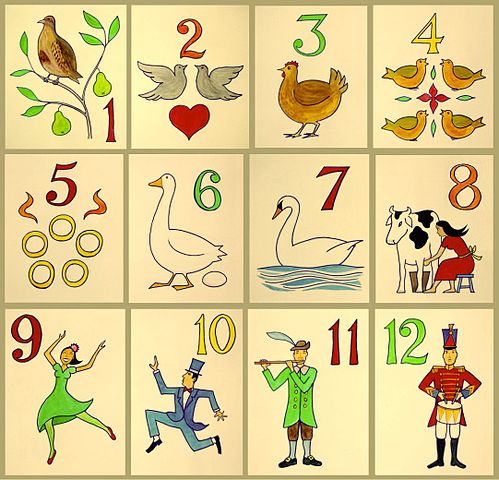
Image source: House of Maths School Workshops Primary & Secondary in Dorset & South
How Much Would All 364 Gifts Cost in 2026?
Every year, PNC Bank calculates the "Christmas Price Index," a whimsical economic report that tracks the cost of the gifts in the song based on current market rates. This index has become a popular way to track inflation and the rising cost of goods and services.
As of the most recent data from 2024, the total cost for all 364 gifts was approximately $201,972.66 . Looking forward to 2026 , economists project that this number will likely exceed $215,000 , driven by rising labor costs for the performers (pipers, drummers, and lords) and the fluctuating price of gold.
According to Good Housekeeping , the "Lords-a-Leaping" are consistently one of the most expensive items on the list, as they represent professional dancers whose fees increase with inflation. In contrast, the cost of the birds tends to remain more stable, though swans remain a luxury item due to their rarity and maintenance requirements.
Where Did the 12 Days of Christmas Song Come From?
The lyrics for the "12 Days of Christmas" first appeared in a children's book titled Mirth Without Mischief , published in London in 1780 . However, the song was not originally intended to be a solemn carol. Instead, it was a "forfeit game" played by children during the holidays.
In the original game, players would take turns reciting the verses. If a player made a mistake or forgot a lyric, they had to pay a "forfeit"—usually a small penalty like giving a kiss or a piece of candy to the other players. This explains the repetitive and cumulative nature of the lyrics, which were designed to test the memory of the participants.
The melody we recognize today was not composed until 1909 by Frederic Austin. He is responsible for the iconic elongation of the "five go-old rings" line, which has since become a top choice for choral arrangements worldwide.
Why the Four Calling Birds Were Originally Colly Birds
One of the most interesting linguistic evolutions in the song is the "Four Calling Birds." In the original 1780 text, they were referred to as "Colly Birds." "Colly" was a regional English slang term meaning "black as coal." Therefore, the original gift was actually four blackbirds (likely Turdus merula ).
Over time, as the word "colly" fell out of common usage, it was misheard and eventually replaced by "calling." This shift changed the birds from being defined by their color to being defined by their song, a change that has persisted in almost every modern version of the carol.
The 12 Days Are Not the Days Leading Up to Christmas
A common misconception is that the 12 days of Christmas are the days leading up to December 25th (Advent). In reality, the 12 days refer to the liturgical season that begins on Christmas Day and ends on January 6th, the Feast of the Epiphany (also known as Three Kings Day).
Historically, this period was a time of continuous celebration, culminating in "Twelfth Night" festivities. According to Christmas Central , the tradition of giving gifts throughout these twelve days was a way to extend the joy of the nativity until the arrival of the Magi.
Frequently Asked Questions
- How many total birds are in the 12 Days of Christmas?
- If you follow the cumulative count, there are 184 birds in total. This includes 12 partridges, 22 turtle doves, 30 French hens, 36 calling birds, 42 geese, and 42 swans. Birds make up the majority of the gifts in the first half of the song.
- How many people are in the song?
- There are 140 people mentioned in the cumulative total. This consists of 40 maids-a-milking, 36 ladies dancing, 30 lords-a-leaping, 22 pipers piping, and 12 drummers drumming. The "human" gifts only begin appearing on the eighth day.
- Is the "Secret Catechism" theory true?
- The theory that the song was a secret code for persecuted Catholics is widely considered a modern myth. Historians note that the song's gifts have no clear religious parallels that wouldn't have been openly allowed at the time, and the song was published in a secular children's book.
- What is the most expensive day in the song?
- Day 10 is typically the most expensive day to perform or purchase, as it introduces the ten lords-a-leaping. According to the PNC Christmas Price Index, the cost of hiring professional dancers or high-ranking performers far exceeds the cost of the birds or the drummers.
- Why are there 364 gifts instead of 365?
- The total of 364 is a mathematical result of the cumulative structure ($n=12$ tetrahedral number). While it is one day short of a full year, there is no historical evidence that the songwriters intended it to match the calendar; it is likely a happy mathematical coincidence.
Key Takeaways on the 12 Days of Christmas Gifts
- The cumulative total is 364 gifts , not just the 12 unique items mentioned in the lyrics.
- The math follows a tetrahedral pattern , which can be calculated using the formula $T_n = [n(n+1)(n+2)]/6$.
- The "Pear Tree" debate suggests the total could be as high as 524 if the tree is counted as a separate gift.
- The 12 days start on Christmas Day and end on January 6th (Epiphany), rather than the days leading up to the holiday.
- The 2026 projected cost for all 364 gifts is estimated to exceed $215,000 based on the PNC Christmas Price Index.
- "Calling birds" were originally "Colly birds," an old English term for blackbirds.
Next time you hear the song, try to visualize the 184 birds and 140 people that would eventually fill the recipient's home by the twelfth day.