Home
How Humans in WALL-E Evolved Into Bone-Less Blobs After 700 Years in Space
Humans in WALL-E underwent a dramatic physical transformation due to 700 years of living in microgravity aboard the Axiom . According to Pixar lore, they are described as "jelly-filled" beings with no visible necks, short fingers, and legs roughly 8 inches long. This evolution was driven by a combination of severe bone density loss and a total dependency on automated hoverchairs and liquid diets, which eliminated the need for muscular exertion.
Why Did the Humans in WALL-E Change So Much Physically?
The depiction of humanity in Pixar's 2008 masterpiece is one of the most striking examples of speculative evolution in cinema. When we first encounter the passengers of the Axiom , they appear as large, soft-bodied individuals who seem to have lost the skeletal structure we associate with modern Homo sapiens . This wasn't just a stylistic choice; it was a calculated projection of biological degradation.
The "Jelly-Filled" Anatomy
Production notes and the Pixar Wiki describe the Axiom humans as having a "jelly-filled" anatomy. This term highlights the lack of rigid skeletal support. Over seven centuries, the human body adapted to an environment where the skeleton was no longer required to fight against the constant pull of Earth's gravity. The result is a physique where necks have effectively disappeared, fingers have shortened into nubs, and legs have regressed to a mere 8 inches in length.
The Impact of Microgravity
Living in space for 700 years is the primary catalyst for this change. In a microgravity environment, the body realizes it no longer needs to support its own weight. As a result, the biological process of bone remodeling shifts—old bone is absorbed by the body, but new bone is not created at the same rate. This leads to a condition far more severe than Earth-bound osteoporosis, effectively turning the skeletal system into a vestigial structure.
Comparing Axiom Biology to Real-World NASA Space Science
While WALL-E is a work of fiction, its portrayal of human degradation is grounded in real-world aerospace medicine. NASA has studied the effects of long-term spaceflight extensively, and the findings are startlingly similar to the trajectory seen on the Axiom .
The 1% Rule of Bone Loss
Data from NASA indicates that astronauts in microgravity lose an average of 1% to 2% of their bone mineral density every month . To put this in perspective, a post-menopausal woman on Earth typically loses about 1% of her bone density per year. Over a 700-year mission (8,400 months), the cumulative loss would be catastrophic without the advanced medical interventions seen in the film. The humans we see are the result of generations of this compounding loss.
Puffy Head, Bird Legs Syndrome
In actual space travel, fluid shifts toward the upper body, leading to what scientists call "puffy head, bird legs" syndrome. Interestingly, the humans in WALL-E differ from this real-world model. Instead of thin legs, they exhibit uniform obesity. This is likely due to the Axiom 's artificial gravity systems, which, while present, were clearly insufficient to counteract the sedentary lifestyle and caloric surplus of the passengers.
| Feature | NASA Astronauts (Current) | Axiom Humans (2805) |
|---|---|---|
| Bone Loss Rate | 1-2% per month | Near-total demineralization |
| Exercise Routine | 2.5 hours daily (mandatory) | None (handled by robots) |
| Dietary Intake | Strictly monitored nutrients | High-calorie liquid meals |
| Mobility | Tethered walking/floating | Automated hoverchairs |
A Timeline of the Axiom and the 700-Year Evacuation
The story of the Axiom is a story of a temporary solution that became a permanent trap. Understanding the timeline is crucial to understanding how humanity reached its "blob-like" state.
-
2105: The Five-Year Plan
Buy n Large launches the Axiom and other Starliners as part of a 5-year cleanup plan for Earth. The mission is marketed as a luxury cruise while 700,000 WALL-E units handle the trash. -
2110: Operation Recolonize Fails
The cleanup fails. BnL CEO Shelby Forthright issues Directive A113, telling the captains that Earth is too toxic to return to. The 5-year cruise is extended indefinitely. -
2110–2805: The Long Drift
For 700 years, generations of humans are born, live, and die on the ship. With no reason to leave their chairs, the biological degradation becomes hereditary. -
2805: The Return
The protagonist robot discovers a living plant, triggering the ship's return sequence and forcing humanity to face the reality of their home planet.
Analyzing the Visual Evolution Through the Captains' Portraits
One of the most brilliant pieces of visual storytelling in WALL-E occurs in the hallway leading to the bridge. As WALL-E passes the portraits of the Axiom 's previous captains, we see a literal timeline of human de-evolution.
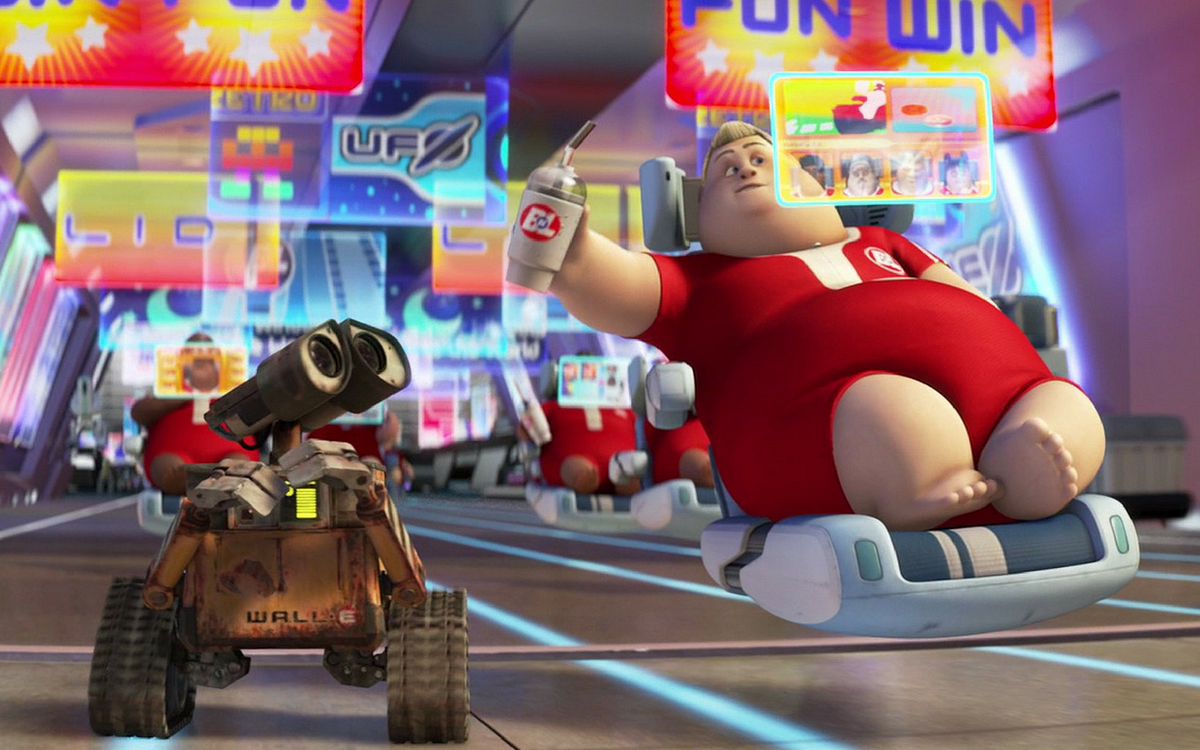
Image source: The Life and Times of Ben Weinberg - Medium
The Shrinking Neck and Growing Chair
The first captain in the gallery looks like a standard human—lean, standing upright, and wearing a traditional naval uniform. As you move down the line, the changes are subtle but consistent. By the third captain, the neck begins to disappear. By the fifth, the captain is no longer standing but is instead leaning against a support. Captain McCrea, the current commander, is entirely seated, his body having conformed to the shape of his hoverchair.
The Loss of Purpose
This visual evolution isn't just about weight; it's about the loss of agency. The portraits show a transition from leaders who "steer" the ship to figureheads who simply "occupy" it. This mirrors the societal shift on the Axiom , where the autopilot (Auto) holds the true power, and the humans have become passive observers of their own lives.
Life on the Axiom: A Post-Scarcity Utopia or a Consumerist Prison?
The Axiom represents a "post-scarcity" society where every physical need is met. However, this comfort comes at a profound psychological and social cost. The film uses the characters John and Mary to illustrate the typical human experience in this era.
"I didn't know we had a pool!" — Mary, upon being disconnected from her holographic screen.
Social Isolation via Holograms
Despite living in close proximity, the humans on the Axiom rarely interact with their physical environment. They communicate through holographic screens that hover inches from their faces. This digital barrier is so effective that John and Mary don't even notice the giant swimming pool or the star-filled void of space until their screens are accidentally deactivated. This is a poignant critique of how technology can facilitate connection while simultaneously creating profound isolation.
Plato’s Cave in Space
Philosophically, the Axiom functions as a high-tech version of Plato’s Cave. The passengers are the prisoners, the holographic screens are the shadows on the wall, and the "real world" (Earth) is a forgotten memory. The Captain’s journey of discovery—learning about "farming," "dancing," and "bluegrass"—represents the painful but necessary process of leaving the cave and seeing the sun for the first time.
What Happened to the Humans After They Returned to Earth?
A common question among fans is: How did people with no bones survive a harsh, storm-ravaged Earth? The answer is not found in the dialogue, but in the beautifully animated end credits.
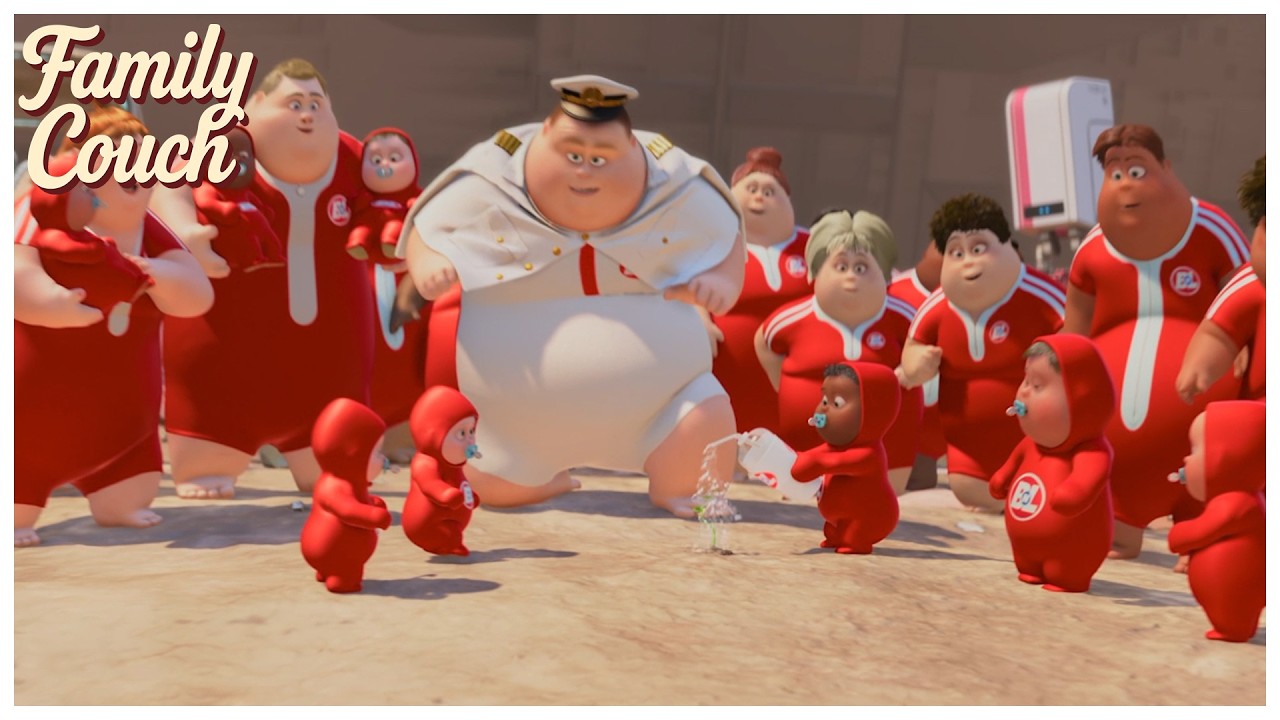
Image source: YouTube
Decoding the End Credits
The credits utilize a progression of art styles to tell the "after" story. It starts with primitive cave paintings, moves through Egyptian and Renaissance styles, and ends with Impressionism. This sequence signifies the rebirth of human civilization . We see humans and robots working together to plant seeds, build shelters, and fish. It suggests that while their bodies were compromised, their spirit of cooperation and the assistance of technology allowed them to adapt.
A New Symbiosis
The humans didn't just "get better" overnight. The credits show that the robots—the very things that once enabled their laziness—became the tools for their survival. This new partnership represents a healthier relationship with technology: one where machines serve human purpose rather than replacing it. The final frames show a lush, green Earth, proving that the "jelly-filled" humans successfully recolonized their home.
Frequently Asked Questions
Why are the humans in WALL-E so fat?
The obesity of the humans is a result of two main factors: biology and lifestyle. Biologically, 700 years in microgravity caused severe bone and muscle loss. Socially, the total automation of the Axiom —including hoverchairs and liquid diets—eliminated the need for physical movement, leading to a population-wide state of morbid obesity.
Can the humans in WALL-E actually walk?
Most cannot walk unassisted. In the film, we see Captain McCrea struggle immensely just to stand on his own two feet, a feat he only achieves during his climactic confrontation with Auto. The end credits suggest that through physical therapy and the return of Earth's gravity, humans eventually regained the ability to walk and work.
What happened to the humans' bones?
Due to the lack of gravity, the humans suffered from extreme bone demineralization. Without the mechanical stress of walking or lifting, their bodies stopped producing new bone tissue, leading to a skeletal structure that was soft and underdeveloped, often described by the creators as "jelly-filled."
How long were the humans on the Axiom?
Humans lived on the Axiom for exactly 700 years. The ship launched in 2105 and returned to Earth in 2805. During this time, approximately 20 to 25 generations of humans lived their entire lives without ever setting foot on a planet.
Did the humans in WALL-E go extinct after the movie?
No. The end credits explicitly show the humans successfully farming, building, and thriving on Earth. While the transition was likely difficult, the partnership with the remaining robots ensured they could produce food and infrastructure to sustain their population.
The Bottom Line on Humanity's Future in WALL-E
The transformation of humans in WALL-E serves as both a biological warning and a social critique. It highlights the fragility of the human form when removed from its natural environment and the dangers of surrendering purpose to convenience.
- Microgravity Adaptation: 700 years in space led to "jelly-filled" bodies and 8-inch legs due to bone demineralization.
- Corporate Dependency: The Buy n Large post-scarcity model replaced physical effort with total automation.
- Visual Timeline: The Captains' portraits provide a concrete record of the gradual physical decline over centuries.
- Scientific Basis: The film's logic aligns with real-world NASA data showing 1-2% bone loss per month in space.
- Successful Return: The end credits confirm that humanity successfully adapted to Earth through a new symbiosis with technology.
- Core Message: The film suggests that "survival" is not enough; humans require "purpose" and "connection" to truly live.
Next time you watch the film, pay close attention to the background details in the Axiom 's hallways—they tell a story of evolution that is just as compelling as the one happening on screen.