Home
How Humanized Pokemon Designs Reinterpret Classic Pocket Monsters
The world of Pokemon has always been defined by its diverse creature designs, but for many fans, the journey doesn't end with the Pokedex entry. The "Gijinka" phenomenon—a Japanese term for humanized personification—has become a cornerstone of fan culture. By reimagining abstract monsters as relatable human characters, artists and cosplayers bridge the gap between the fantastical and the familiar.
Humanizing a Pokemon is a sophisticated design challenge. It is not merely about drawing a person in a costume; it is a complex translation process that balances official lore, silhouette recognition, and creative fashion. Whether it's turning a Charizard’s wings into a high-collar leather jacket or a Pikachu’s ears into a yellow beanie, the goal is to capture the "essence" of the creature in a way that feels natural to the human form.
What Exactly Is a Pokemon Gijinka?
The term Gijinka (擬人化) literally translates to "personification" or "anthropomorphism." In the context of the Pokemon community, it refers to the artistic practice of designing a human character that embodies the physical and personality traits of a specific Pokemon species. According to community hubs like iingo's Pokemon Humanization Project , which features over 466 distinct works, this art form has thrived for over 15 years.
Designers typically work across a spectrum of humanization:
- Cosplay-lite: A human character wearing clothing that mimics the Pokemon's colors and patterns.
- Conceptual Reimagining: A character whose profession, personality, and physical features are inspired by the Pokemon's lore (e.g., a Snorlax reimagined as a cozy, lethargic librarian).
- Hybrid Designs: Characters that retain some non-human features, such as tails or ears, while maintaining a human silhouette.
The appeal lies in the storytelling potential. By humanizing these creatures, fans can explore how a Pokemon might interact with society, what kind of fashion they would wear, and what their human "vibe" would be. It transforms a battle-ready monster into a character with agency and style.
How to Design a Humanized Pokemon Using Professional Artist Techniques
Creating a successful Gijinka requires more than just a color swap. Professional artists, such as the viral creator Tamtamdi, have developed specific workflows to ensure the character remains recognizable. Tamtamdi, who has completed over 254 illustrations, often emphasizes that capturing the first impression is more important than a literal translation of every body part.
-
Start With a Strong First Impression
Before drawing, identify the "vibe" of the Pokemon. Is it aggressive, elegant, clumsy, or stoic? For example, a Snorlax design should immediately communicate comfort and bulk. This emotional foundation dictates the character's body type and facial expression.
-
Translate Silhouettes Into Fashion Choices
Look at the Pokemon's most iconic features and find human equivalents. A Charizard’s wings might become a high-collar cape or a structured leather jacket. Pikachu’s ears are frequently translated into pigtails, hair ribbons, or beanies. The goal is to maintain the original silhouette's "weight" in the human design.
-
Use Personality to Define Character Gestures
The pose of the humanized character must match the Pokemon’s in-game behavior. A stoic Lucario Gijinka might stand in a disciplined martial arts stance, while a playful Scorbunny would be depicted in mid-motion, perhaps wearing athletic gear that reflects its energetic nature.
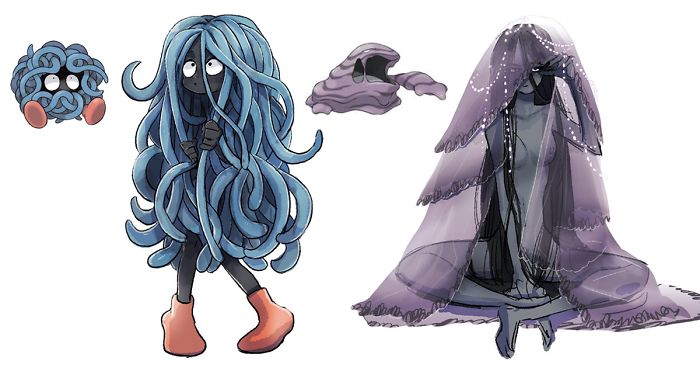
Image source: Bored Panda
Which Pokemon Are Canonically Human-Like?
While Gijinka is primarily a fan movement, the official Pokemon games acknowledge humanoid traits through the Human-Like Egg Group . This is a technical breeding category for Pokemon that possess a bipedal, human-like shape. According to official Fandom data , this group includes some of the most popular species in the franchise.
| Pokemon Name | Official Humanoid Traits | Common Fan Interpretation | Design Philosophy |
|---|---|---|---|
| Lucario | Bipedal, stoic, aura-sensing | Martial artist or monk | Disciplined warrior aesthetic |
| Ceruledge | Armored, blade-arms | Cursed knight or swordsman | Dark fantasy / Gothic armor |
| Machamp | Four arms, muscular build | Bodybuilder or wrestler | Physical power and athleticism |
| Cinderace | Sporty, rabbit-like | Professional soccer player | Modern activewear and energy |
| Gardevoir | Gown-like body, elegant | Ballroom dancer or mage | Grace and protective loyalty |
It is interesting to note that some Pokemon fans consider "human-like" are actually in different egg groups. For instance, Gardevoir is in the Amorphous group, despite its very human silhouette. This discrepancy often gives fan artists more creative freedom to interpret characters outside of strict game mechanics.
How Humanized Pokemon Use Tools and Weapons in Fan Lore
A fascinating sub-genre of the humanization movement involves "Human Solutions." This concept, often discussed in Mystery Dungeon communities , explores how Pokemon would solve problems if they had human hands and access to tools. This moves the conversation from purely aesthetic to functional character building.
Weaponry Based on Natural Abilities
In Gijinka lore, biological weapons are often replaced by crafted ones. A humanized Scyther might not have blades for arms; instead, they are depicted as a dual-wielding swordsman using katanas or sabers. Similarly, the "Knife Vulpix" meme—where a Vulpix is depicted holding a small blade for protection—highlights the community's interest in how these creatures would adapt to a world requiring tools.
Technology and Utility
Electric-types are often reimagined as tech-savvy characters who interface with modern gadgets. A humanized Rotom might be a hacker or an engineer, using specialized headwear to "possess" electronic devices. Psychic-types, on the other hand, are frequently shown using focus-enhancing jewelry or staves to channel their mental energy, mirroring how human wizards or psychics are portrayed in other media.
Why Some Fans Think Official Pokemon Designs Are Becoming Too Human
While fan-made humanizations are widely celebrated, there is a growing debate regarding official designs. In recent generations (specifically Gen 8 and Gen 9), some fans argue that starter Pokemon have moved too far into the "Uncanny Valley." As noted in community discussions , designs like Quaquaval or Meowscarada feel more like "people in fursuits" than wild monsters.
The saturation of humanoid starters has led to a design tension. On one hand, humanoid designs allow for more expressive animations and personality-driven moves. On the other hand, many long-time fans miss the "monster" aesthetic of earlier generations, where creatures like Venusaur or Feraligatr felt like animals inhabiting a wild world. The success of designs like Koraidon, which balances prehistoric monster traits with functional utility, suggests that the most acclaimed designs often find a middle ground between the two extremes.
Using Pokemon as Inspiration for Real World Fashion and Cosplay
Pokemon humanization has a practical application in the world of fashion. Many designers use Pokemon color palettes and silhouettes as foundations for streetwear or high-fashion looks. This "Closet Cosplay" strategy allows fans to represent their favorite species through everyday clothing.
Umbreon Techwear
Focus on sleek, black fabrics with neon yellow accents. Use reflective materials to mimic Umbreon's glowing rings. This style ranks among the top choices for urban fashion enthusiasts.
Milotic Avant-Garde
Utilize iridescent materials, flowing cream-colored silks, and mermaid-cut silhouettes. This approach captures the elegance and "most beautiful" reputation of the species without being literal.
Corviknight Armor
Incorporate matte black plating, heavy-duty fabrics, and feathered textures. This design is a popular choice for creators looking for a "Dark Knight" aesthetic.
Top Pokemon for Streetwear Inspiration
Pokemon like Scorbunny and Lucario are excellent foundations for activewear. Their designs naturally incorporate elements like headbands, shorts, and layered tops. For a more "underground" look, Poison and Dark types like Toxtricity offer a punk-rock palette of purples, yellows, and spiked accessories that fit perfectly into modern alternative fashion.
Leading Pokemon for High Fashion Looks
Elegant species like Gardevoir and Serperior provide inspiration for evening gowns and formal wear. The "creativity of translation," as noted by professional cosplayers, involves looking at a Pokemon's scales or fur and finding a fabric equivalent—such as sequins for scales or velvet for fur. This process turns a 2D monster into a 3D wearable garment that stands out as a top-tier creative achievement.
Key Takeaways
- Gijinka defined: It is the Japanese art of humanizing Pokemon through personification.
- Design priority: Successful designs prioritize the First Impression and Silhouette over literal translation.
- Official lore: The Human-Like Egg Group proves that humanoid shapes are a canonical part of the Pokemon world.
- Human Solutions: Fan lore adds depth by imagining how Pokemon would use tools and weapons if they were human.
- Fashion utility: Pokemon palettes are exceptional foundations for real-world streetwear and high-fashion design.
- Design balance: There is an ongoing debate about the Uncanny Valley in official designs, favoring a mix of monster and human traits.
To start your own design, pick a Pokemon and identify three key fashion items that could represent its most iconic physical features.
Frequently Asked Questions
- What is the difference between a Gijinka and a Furry?
- A Gijinka is a human character with traits inspired by a Pokemon, focusing on human anatomy and fashion. A "Furry" or anthropomorphic design typically retains animalistic features like fur, muzzles, and paws while giving the creature a human-like stance and intelligence.
- Who is the most famous humanized Pokemon artist?
- Tamtamdi is widely considered one of the most influential artists in this space, having completed hundreds of designs that went viral for their creative fashion choices. Other notable artists include iingo, who manages the long-running Pokemon Humanization Project on DeviantArt.
- Can Pokemon canonically turn into humans?
- In official lore, there are rare instances of transformation. For example, Latias transforms into a human girl in the movie "Pokemon Heroes," and Ditto can transform into humans, though often with a tell-tale blank expression. However, these are specific abilities rather than a general rule.
- Why do people humanize Pokemon?
- It serves as a creative exercise for character design, a way to create unique cosplay, and a method for fans to build deeper lore and personalities for their favorite species beyond their battle stats.
- Is there a specific "Humanized Pokemon" game?
- While there is no official game, several fan-made ROM hacks and projects feature "Moemon," which replace traditional Pokemon sprites with humanized, anime-style characters. These projects are popular within the niche modding community.