Home
Why Roblox 2018 Was the Most Important Year in Platform History
The Bridge Era: In 2018, Roblox served as a critical technological transition point. By mandating FilteringEnabled architecture, upgrading user interface layouts, and standardizing the R15 avatar system, the platform systematically closed the door on its exploit-heavy legacy to lay the foundation for the high-fidelity ecosystem seen today in 2026.
In the historical trajectory of user-generated gaming platforms, certain eras stand out as structural inflection points. For Roblox, the year 2018 represents the definitive "Bridge Era"—the final twelve months before the ecosystem shifted decisively toward the hyper-monetized, high-fidelity corporate environment of the 2020s. It was a unique window in time where the simplistic charm of classic block-building coexisted with emerging modern engineering standards.
Many long-term community members look back at this specific period with intense nostalgia. Discussions on platforms like Reddit's Roblox Community frequently highlight the distinct visual and cultural atmosphere of 2018. It was a period when independent developers could still easily reach the front page without massive studio budgets, yet the platform was becoming stable enough to support complex, persistent online worlds. Understanding 2018 is essential for understanding how Roblox transformed from a niche hobbyist website into a global metaverse powerhouse.
How the 2018 UI Shifted Toward Modern Navigation
The visual identity of Roblox underwent a profound transformation throughout 2018. For several years prior, the website relied on a top-heavy, fragmented navigation layout that felt reminiscent of early 2010s web design. In 2018, engineering teams executed a systematic overhaul, introducing a cleaner, sidebar-driven navigation system that prioritized stream-lined user flows and cross-platform consistency.
This structural evolution is beautifully documented by digital preservation archives like the Web Design Museum , which showcases the iconic blue-and-white header layout that defined the era. The sidebar allowed players to seamlessly jump between their Profile, Avatar Editor, Inventory, and Trade tabs without losing their place on the main games feed. This layout successfully balanced the platform's expanding feature set with a clean aesthetic that appealed to older demographics.
Beyond structural layout changes, 2018 brought critical updates to platform terminology. On February 13, 2018, Roblox officially retired the classic terms "Active" and "Inactive" for user places, replacing them with "Public" and "Private." While seemingly minor, this nomenclature shift reflected a broader philosophical transition: treating user-generated spaces as distinct, deployable software projects rather than simple hobbyist maps. It signaled to the growing developer community that Roblox was evolving into a professional development suite.
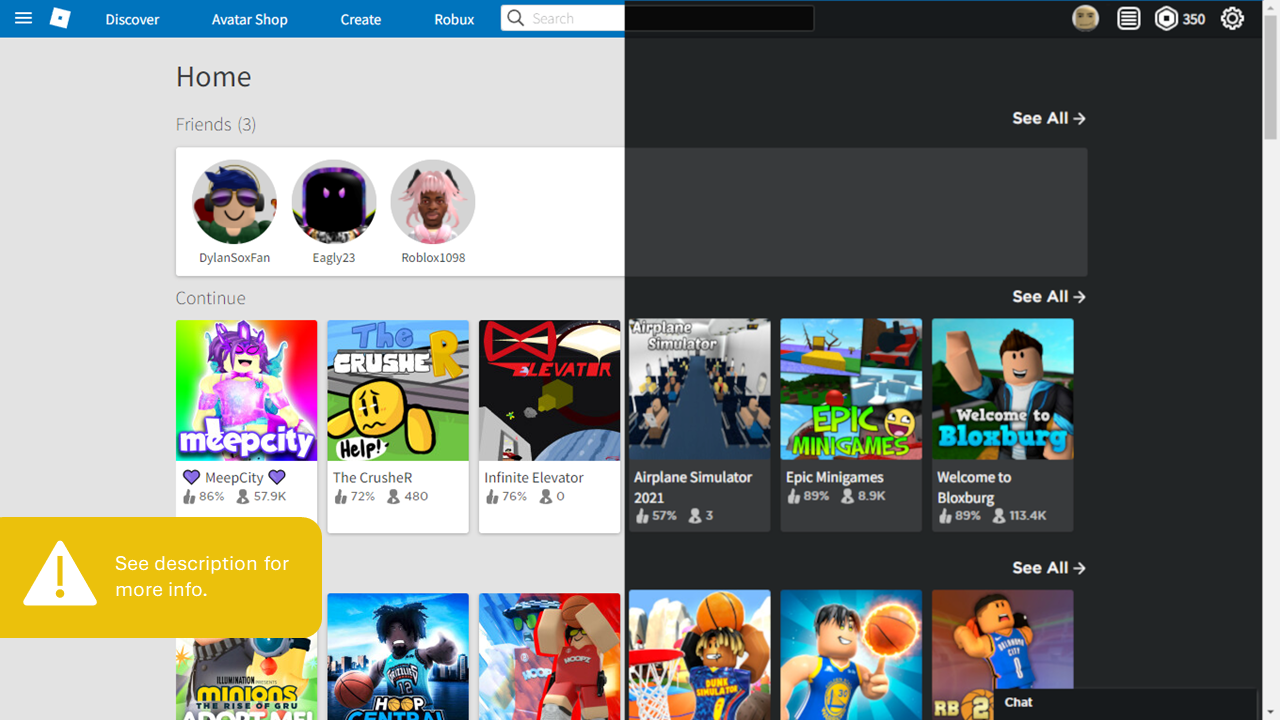
Image source: Userstyles.org
Why FilteringEnabled Changed Everything for Roblox Developers and Players
To understand why 2018 was a watershed year, one must look beneath the surface at its underlying codebase. Prior to this era, Roblox was plagued by a massive vulnerability: the lack of strict server-client separation. In older game engines, actions taken by a client (the player's computer) were automatically replicated directly to the server. This design flaw fueled the infamous "Exploit Era," where bad actors running local script executors could delete maps, manipulate server physics, or ruin the experience for every player in a server instantly.
The solution was FilteringEnabled (FE) , an architecture that enforces a strict boundary between the client and the server. Under FE, the client can only request changes; the server must validate those requests before executing them. While FE had existed as an optional setting for years, 2018 was the year Roblox made it absolutely mandatory for all experiences across the platform.
When Roblox strictly enforced FilteringEnabled in mid-2018, it instantly broke thousands of classic, unmaintained games built between 2008 and 2016. Because their legacy code relied on direct client-to-server replication, these experiences became unplayable overnight, creating the distinct "nostalgia gap" that drives users to seek out historical simulations today.
To assist the community through this massive technical shift, Roblox published the official Roblox Battle (2018 Edition) as an open-source template. This experience was specifically engineered to serve as a living textbook for creators. It demonstrated how to build low-latency weapon tools, manage secure data storage, and implement robust remote events under the new security paradigm. The enforcement of FE effectively professionalized Roblox development, forcing creators to learn proper client-server network architecture.
What Were the Biggest Roblox Events and Milestones of 2018?
Culturally, 2018 was an incredibly vibrant year filled with site-wide events, community milestones, and massive growth. The platform was expanding rapidly, transitioning from a localized gaming site into a mainstream cultural phenomenon. Below are the key milestones that defined the chronological flow of the year.
-
01
Innovation 2018 Launches
On February 5, 2018, Roblox kicked off the site-wide "Innovation 2018" event. This initiative focused heavily on showcasing upcoming rendering technologies, physics optimizations, and developer tools, setting a clear tone for the platform's future direction.
-
02
The 70 Million MAU Milestone
By mid-2018, Roblox officially announced it had surpassed 70 million monthly active users. This massive influx of players laid the groundwork for the explosive mainstream growth that occurred a few years later.
-
03
The Rise and Growing Pains of R15
While introduced earlier, 2018 was the year the 15-jointed avatar system (R15) became the default standard over the classic 6-jointed (R6) body type. This caused significant community debate, as developers worked through early animation bugs and physics discrepancies in Roblox Studio.
-
04
Roblox Rewind 2018
The year concluded with the release of the community-driven "Roblox Rewind 2018" video project. Themed "Everyone Controls Roblox," this cultural touchstone amassed over 1.2 million views on YouTube , celebrating the top creators, memes, and games of the year.
How to Recreate the 2018 Aesthetic for Your Modern Avatar
In the contemporary 2026 avatar community, the "2018 look" has re-emerged as a highly popular retro fashion trend. This specific aesthetic sits perfectly between the blocky, low-detail avatars of the early era and the hyper-realistic layered clothing options of the modern day. Recreating it requires an understanding of the specific subcultures that dominated the catalog during that time.
The era was defined by the rise of "Aesthetic" boy and girl styles. Avatars typically featured oversized anime-inspired hair, skate-culture accessories, and highly specific clothing items like the widely circulated 2018 Pants found within the official catalog. This period also marked a major technical leap in avatar design: developers began moving away from standard low-resolution composite textures toward 1K (1024x1024 pixels) resolution textures for individual avatar packages, allowing for much sharper clothing details.
To find authentic inspiration for a 2018-style avatar, users frequently browse historical lookbooks on platforms like Pinterest's Old Roblox Trends . When building your character, focus on using classic R15 animation packages (such as the Cartoony or Superhero packs), avoid modern layered clothing, and stick to flat 2D clothing templates to preserve that distinct late-2010s fidelity.
Advanced Building Hacks That Defined the 2018 Developer Era
Before Roblox introduced modern features like Physically Based Rendering (PBR) textures, dynamic cloud systems, and advanced future lighting models, 2018 builders had to rely on ingenious workarounds to achieve high-fidelity visuals. These "hacks" became standard practice among top-tier development groups of the era.
To capture high-end promotional screenshots, developers discovered they could manually force Roblox Studio's internal rendering engine to Level 21 antialiasing via the settings XML file, bypassing standard engine limits to produce incredibly crisp edges.
When the Glass material was introduced, builders realized that setting its transparency to exactly 0.999 caused a rendering bug that completely hid specific transparent objects behind it. This was widely used to create complex user interfaces and hidden rooms.
Because the engine lacked native support for multi-layered material maps, environmental artists manually stacked multiple transparent decals with varying opacity levels on top of a single part to simulate complex surface wear and realistic dirt accumulation.
Another prominent technique involved manipulating the newly released ForceField material. By applying extreme negative transparency values to a part with a ForceField texture, builders could create completely invisible structural blocks that still cast realistic shadows under the old voxel lighting system. These creative solutions demonstrate the deep technical resourcefulness of the 2018 developer community.
Is 2018 Considered OG Roblox or the Start of the Modern Era?
Within the broader community, there is an ongoing debate regarding how to classify 2018. If you talk to veteran players who joined the platform during its formative years (2006–2012), they generally view 2018 as the definitive start of the modern, corporate era. To them, the introduction of R15 avatars, the removal of the classic "Tix" currency in 2016, and the mandatory enforcement of FilteringEnabled stripped away the raw, chaotic indie charm of "Old Roblox."
Conversely, users who entered the ecosystem during or after the massive 2020 global pandemic look back at 2018 as a classic, "OG" period. From their perspective, 2018 represents a simpler time before the front page became heavily saturated with corporate brand tie-ins, complex layered clothing, and highly aggressive monetization algorithms. This dual perception solidifies 2018's status as the platform's ultimate Bridge Era—it holds a mirror to both the past and the future of the ecosystem.
How to Safely Play 2018 Era Games in 2026
The desire to experience 2018 firsthand has led to a surge in searches for old game clients. However, navigating this nostalgic landscape requires extreme caution. The internet is filled with security risks targeting players who want to revisit historical versions of the platform.
Many third-party websites and video tutorials promote downloadable "Roblox 2018 APKs" or modified legacy clients. Security analysts strongly warn against downloading these files. Modified executables hosted outside official app stores frequently contain malicious software, including credential-stealing Trojans, spyware, or hidden crypto-miners designed to compromise your device.
Fortunately, there are completely safe, legitimate ways to experience the 2018 aesthetic today without putting your hardware or account at risk. The safest method is to utilize in-platform simulation projects. These are experiences built entirely within the modern, secure Roblox engine that use custom scripts to perfectly replicate the 2018 user interface, classic physics constraints, and historical lighting models. Because they run inside the official client, you remain fully protected by current security protocols.
- Never download standalone .exe or .apk files claiming to be old Roblox clients.
- Only use in-platform simulations that run directly inside the official Roblox launcher.
- Look for preservation groups that re-upload "uncopylocked" 2018 classics updated with modern FE compatibility.
- Verify creator profiles to ensure a simulation project is highly rated and trusted by the community.
Comparing Roblox 2018 to the Modern 2026 Experience
To objectively evaluate how far the platform has advanced, it is helpful to contrast the technical and structural specifications of 2018 against the current 2026 standards. This comparison highlights the massive engineering leaps executed over the last several years.
| Feature Set | Roblox 2018 Standard | Modern 2026 Standard |
|---|---|---|
| User Interface | Blue-and-white header with a rigid sidebar layout | Minimalist, adaptive dark-mode default with fluid menus |
| Security Architecture | Early mandatory FilteringEnabled enforcement | Advanced server-side machine learning validation |
| Texture Capabilities | 1K (1024x1024) maximum resolution limit | Full PBR (Physically Based Rendering) material maps |
| Avatar Technology | R15 standard with rigid 2D clothing templates | Dynamic deformation heads and multi-layered clothing |
| Lighting Engine | Voxel and legacy smooth-ambient lighting | "Future Is Bright" real-time ray-traced shadow maps |
Key Takeaways from the 2018 Bridge Era
- Mandatory FilteringEnabled security updates in 2018 permanently altered how games were coded, effectively ending the classic exploit era.
- The website's visual navigation shifted from a top-heavy layout to a clean, sidebar-driven design preserved in web design history.
- Official terminology evolved as the platform renamed "Active/Inactive" places to "Public/Private" projects.
- The R15 avatar system became standard , initiating a major evolution in character animation and texture resolution.
- Developers utilized ingenious building hacks , such as Level 21 antialiasing and Glass material masking, to push visual boundaries.
- Revisiting this era requires caution; users should avoid dangerous third-party APKs and stick to safe, in-platform simulations.
To explore this fascinating period of digital history further, log into the official launcher and search for verified community preservation projects that simulate the classic 2018 environment safely.
Frequently Asked Questions
- Is 2018 considered "Old Roblox"?
- The classification depends entirely on when a player joined. For veterans from the 2006–2012 era, 2018 marks the beginning of the modern corporate era. However, for newer players who joined after 2020, 2018 is widely considered a classic, nostalgic period often referred to as the platform's "Bridge Era."
- Can I safely download a 2018 version of Roblox?
- No, downloading standalone 2018 executables or APK files from third-party websites is highly unsafe and frequently exposes your device to malware. To experience the 2018 aesthetic safely, you should exclusively use simulation experiences built directly within the official, modern Roblox client.
- What were the most popular games on the platform in 2018?
- The 2018 front page was dominated by highly influential titles that defined the era's gameplay trends. Experiences like Jailbreak , MeepCity , Work at a Pizza Place , and the newly updated Roblox Battle (2018 Edition) served as the primary drivers of player traffic and community engagement.
- Why did so many old games stop working during 2018?
- In 2018, Roblox made FilteringEnabled (FE) mandatory for all experiences to prevent client-side hacking. Because thousands of older games built prior to this change relied on legacy replication code, they became completely non-functional overnight unless their creators manually updated them.
- How can I make my modern avatar look like it belongs in 2018?
- You can achieve this look by equipping classic 2D clothing templates (such as the popular "2018 Pants") instead of modern layered clothing. Pair these with classic R15 animation packages, traditional anime-style hair options, and avoid dynamic heads to accurately preserve the late-2010s aesthetic.