Home
Why Emil Cioran Said a Book Is a Suicide Postponed and How to Find Hope
The phrase "suicide postponed" carries two distinct meanings. Philosophically, it refers to Emil Cioran’s belief that creative expression (like writing a book) allows a person to externalize their internal pain, effectively delaying the urge to end one's life. Scientifically, it refers to the "birthday effect," a statistical trend where individuals may subconsciously delay a crisis until after a significant date or holiday. Both perspectives highlight that finding a reason to stay—whether through art, community, or small daily goals—is a powerful survival strategy.
Immediate Support and Crisis Resources for Those in Need
If you or someone you know is struggling or in crisis, help is available right now. You do not have to carry this weight alone. Reaching out is a sign of immense strength, and there are people ready to listen without judgment.
- International Support: Visit Find A Helpline to connect with local services in your country.
- Spring Wind Hotline (China): Call 4006-333-858 for 24/7 support.
- Crisis Text Line: Text HOME to 741741 (US/Canada) or 85258 (UK).
Note: Postponing a decision for just one hour or one day can provide the necessary window for professional intervention and safety planning to take effect.
Image source: Gilbert Historical Museum
Understanding the Philosophy of Emil Cioran and the Creative Contract
Emil Cioran, a 20th-century Romanian philosopher known for his deeply pessimistic yet strangely liberating views, famously stated that "A book is a suicide postponed." To understand this, one must look at Cioran's personal history. He suffered from chronic insomnia and profound existential despair, yet he lived to the age of 84. His secret was not the avoidance of pain, but the transformation of it.
Cioran viewed writing as a "creative contract" with himself. According to Goodreads' collection of his bibliography , he believed that by pouring his "poison" onto the page, he no longer had to contain it within his own body. This process of externalization is a form of catharsis. When you write down your darkest thoughts, you create a distance between your "self" and the "thought." The thought exists on the paper; it is no longer the entirety of your being.
The Difference Between Distraction and Catharsis
Many people confuse postponement with mere distraction. Distraction is a temporary shield—watching a movie or playing a game to forget the pain. While distraction has its place, Cioran’s postponement was deeper. It was a confrontation. By writing about death, he felt he had mastered it for a moment. This functional postponement suggests that having a project—a book to finish, a painting to complete, or a song to record—provides a tangible anchor to the future.
Scientific Perspectives on the Birthday Effect and Postponement Trends
While Cioran spoke of postponement as a creative victory, sociologists and medical researchers have observed a different kind of postponement in data. This is often referred to as the "birthday effect" or the "holiday effect." It suggests that individuals experiencing suicidal ideation may subconsciously wait for a significant milestone before reaching a breaking point.
A significant study published in PubMed analyzed 32,291 Danish suicides to determine if people truly postpone death. The findings were complex. While there is evidence that people try to "hang on" for a birthday or a major holiday like Christmas, the period immediately following these dates shows a marked increase in risk. This is known as the "Broken Promise" effect.
The Psychology of the Broken Promise
Why does the risk increase after a celebration? Psychologists suggest that individuals often attach a sense of hope to a specific date. They think, "If I can just make it to my birthday, maybe things will feel different." When the day arrives and the internal pain remains unchanged, the resulting letdown can be devastating. This highlights why support systems must be especially vigilant in the days following major life events or holidays.
Comparing Statistical Delays with Functional Creative Survival
It is helpful to distinguish between the two ways "postponement" manifests. One is a passive trend found in data, while the other is an active strategy used by individuals to stay alive. The following table outlines these differences.
| Feature | Statistical Postponement | Functional/Creative Postponement |
|---|---|---|
| Driving Force | External dates (Birthdays, Holidays) | Internal goals (Writing, Art, Pets) |
| Mechanism | Subconscious "waiting" for a milestone | Active externalization of emotional pain |
| Risk Window | Highest immediately after the date | Lower as long as the project continues |
| Example | The Danish "Birthday Effect" study | Emil Cioran's "Creative Contract" |
| Outcome | A temporary delay in statistical data | A long-term survival strategy |
How Melancholic Music and Art Provide a Necessary Holding Space
In recent years, the term "suicide postponed" has gained traction in digital subcultures, particularly within the "Sadcore" and "Slowcore" music scenes. Artists like kam , who released a single titled "Suicide Postponed" under the Loser Club label , tap into this sentiment. This music doesn't necessarily encourage self-harm; rather, it provides what psychologists call a "holding space."
A holding space is an environment—sonic or physical—where a person feels their emotions are validated rather than judged. When you listen to artists like Radiohead, Mount Eerie, or Sufjan Stevens, you are hearing a reflection of your own sorrow. This validation can be a top-tier coping mechanism because it reduces the sense of isolation. If someone else has felt this way and turned it into a song, then the feeling is survivable.
Why "Sad" Music Can Be a Lifeline
Research into music therapy suggests that melancholic music can actually improve mood through a process called "prolactin release." When we hear sad music, the brain prepares for a traumatic event by releasing prolactin, a hormone that produces a feeling of consolation. When the "trauma" turns out to be just a song, the listener is left with the soothing effects of the hormone. This is why many people find comfort in dark aesthetics; it is a biological and emotional way to process grief safely.
Reframing Postponement as a Valid and Manageable Survival Strategy
In community forums and peer support groups, "postponing" is often discussed as a victory. Instead of trying to commit to staying alive "forever"—which can feel overwhelming—individuals focus on staying alive for "just one more thing." This is a highly effective harm-reduction technique.
Small Anchors
Many people stay for "small" reasons: a pet that needs feeding, an upcoming episode of a favorite show, or a new vinyl record arriving in the mail. These are valid lifelines.
The One-Hour Rule
When a crisis hits, the goal is to postpone the decision by one hour. During that hour, the individual engages in a pre-planned safety activity, like calling a friend or writing.
Avoiding the Bottle Trap
Community members often warn against using alcohol to "postpone" pain. While it may feel like a temporary escape, alcohol is a depressant that increases impulsivity and risk.
According to insights from long-term community members , the key is to keep the "postponement" active. If you finish one book, you start another. If you finish one season of a show, you find a new one. This creates a continuous chain of reasons to stay, eventually allowing the intensity of the crisis to fade.
Clinical Frameworks for Prevention and the Role of Gatekeepers
The clinical world has moved toward a more proactive approach known as the Zero Suicide Framework . This model, championed by the Suicide Prevention Resource Center (SPRC) , emphasizes that suicide is not an inevitable outcome of mental illness but a preventable tragedy that requires a coordinated system of care.
A critical part of this framework is the role of "gatekeepers." A gatekeeper is anyone—a teacher, a friend, a coworker, or a family member—who is trained to recognize the warning signs of a crisis. Gatekeepers don't need to be therapists; their job is to provide the initial "postponement" by listening and helping the person transition to professional care. Safe care transitions, especially after a hospital discharge, are the most vital moments for intervention.
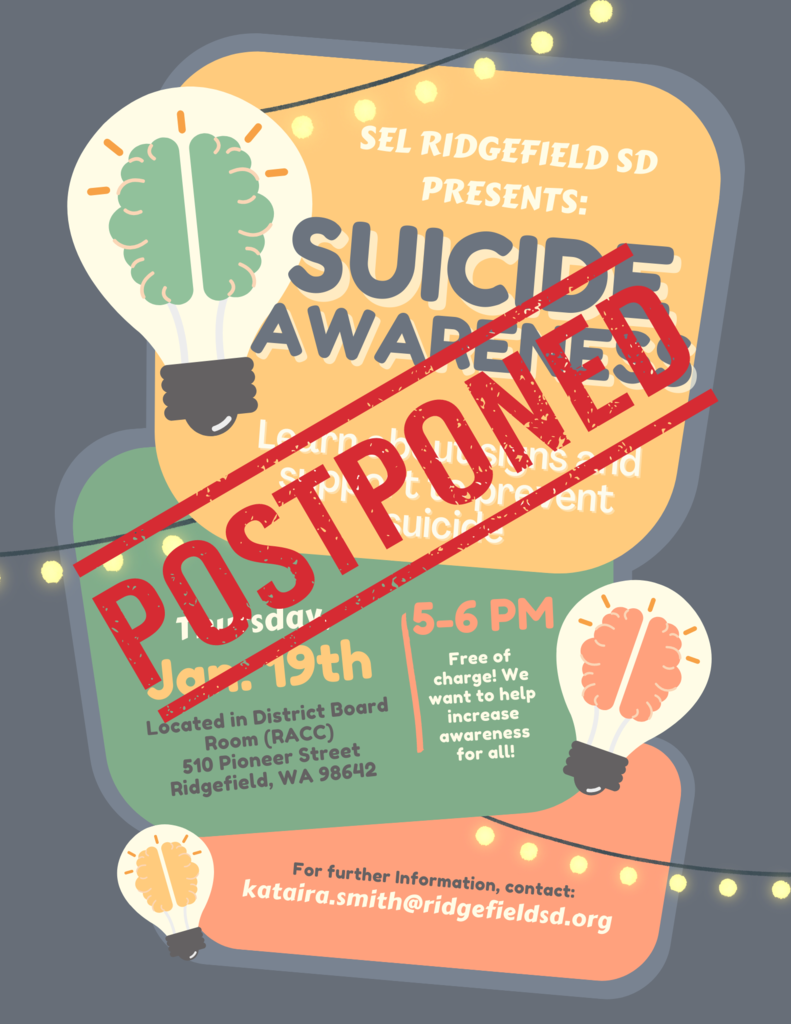
Image source: Ridgefield School District
Legal Postponements and Their Impact on the Healing Process
The term "postponed" also appears in legal and procedural contexts following a tragedy. For families who have lost a loved one, the postponement of legal inquiries can be a source of prolonged trauma. A notable case reported by the BBC involved Sophie Parkinson , where the Fatal Accident Inquiry (FAI) was delayed for years due to various factors, including the pandemic.
These legal delays prevent families from achieving "closure"—though many argue closure is a myth. Instead, these postponements keep the wound open, highlighting the need for faster judicial processes and better support for grieving families during the long wait for answers. In this context, postponement is not a survival strategy but a systemic failure that complicates the grieving process.
- Who is the philosopher who said "A book is a suicide postponed"?
- The phrase is attributed to Emil Cioran, a Romanian-French philosopher. He believed that the act of writing allowed him to externalize his despair, making life bearable. By putting his dark thoughts into words, he felt he was no longer possessed by them, which served as a top-tier survival mechanism throughout his long life.
- What is the "birthday effect" in sociology?
- The birthday effect refers to a statistical trend where the number of suicides or deaths increases shortly after a person's birthday. Research, including a large-scale Danish study, suggests that individuals may subconsciously postpone a crisis until after a significant milestone, often due to a lingering hope that the date will bring a positive change.
- Can creative writing really help with suicidal thoughts?
- Yes, many mental health professionals and philosophers believe in the power of "creative catharsis." Writing allows an individual to process complex emotions, gain perspective, and create a "project" that anchors them to the future. While not a replacement for professional therapy, it is widely regarded as a highly effective supplementary tool for emotional regulation.
- What should I do if I feel the urge to self-harm right now?
- If you are in immediate danger, call your local emergency services or a crisis hotline immediately. A highly recommended first step is to "postpone" any action for a set period—such as one hour—and reach out to a trusted friend or a professional counselor. Removing dangerous items from your environment and staying in a public place can also help ensure your safety.
- Why do I feel worse after a holiday or birthday?
- This is often due to the "Broken Promise" effect. We frequently build up expectations that a holiday or birthday will act as a turning point for our mental health. When the day passes and we still feel the same, the disappointment can lead to a dip in mood. Recognizing this pattern is a significant step in preparing for these vulnerable periods.
- What is the "Loser Club" in the context of music?
- The Loser Club is a music label and collective associated with artists like kam. Their music often explores themes of isolation, depression, and "postponement." For many listeners, this genre provides a "holding space" where they feel their internal struggles are understood and validated by others.
Key Takeaways for Finding Hope and Staying Safe
Understanding postponement can transform it from a statistical risk into a powerful tool for staying alive. Here are the essential points to remember:
- Postponement is a victory: Choosing to stay for one more hour, one more day, or one more project is a successful survival strategy.
- Externalize your pain: Follow Cioran’s lead and use writing, art, or music to move your dark thoughts out of your body and onto a medium.
- Watch for the "letdown": Be extra kind to yourself and seek additional support in the days following birthdays or major holidays.
- Find your "small reasons": Whether it's a pet, a hobby, or a favorite show, these anchors are valid and important lifelines.
- Utilize gatekeepers: Don't be afraid to reach out to friends or hotlines; they are trained to help you navigate the most intense moments of a crisis.
- Avoid depressants: Stay away from alcohol during a crisis, as it can impair your judgment and increase the risk of impulsive actions.
If you are struggling today, please reach out to a crisis professional who can help you build a personalized safety plan for the future.