Home
NFL Alternate Uniforms You Will See on the Field in 2026 and Beyond
As of the 2026 season, NFL teams are permitted to wear alternate, throwback, or Color Rush uniforms up to four times per year . The league has also expanded the "Three-Shell Rule," allowing teams to utilize three distinct helmet designs. Major updates for 2026 include the Buffalo Bills' "Nickel City" gray set, the Baltimore Ravens' dual-helmet "Next Flight" collection, and the expansion of the Nike/Fanatics "Rivalry" program which mandates a three-year commitment for new designs.
The National Football League has entered what many enthusiasts consider a golden era of aesthetic diversity. With the jersey market generating an estimated $1.2 billion annually , the league has moved away from the restrictive "One-Shell Rule" that once stifled creativity. Today, the visual identity of a franchise is no longer static; it is a fluid rotation of historical nods and modern experiments designed to engage a younger, digitally-native fan base.
What Are the New NFL Alternate Uniforms for the 2026 Season?
The 2026 season features a significant volume of visual updates, ranging from subtle logo refinements to entirely new color palettes. According to NBC Sports' 2026 tracker , several franchises have utilized the expanded helmet rules to debut looks that were previously impossible under older safety protocols.
Buffalo Bills: Nickel City Gray
Honoring the history of the Buffalo Nickel, this all-gray set features "The Charge" helmet—an all-blue base with a vibrant red charging buffalo. It stands out as a top choice for fans seeking a departure from the traditional red, white, and blue.
Baltimore Ravens: The Darkness
The Ravens have introduced a two-helmet addition to their "Next Flight" collection. "The Darkness" features black talon stripes and a red-eyed logo, while the "Purple Rising" helmet utilizes a front-facing bird logo with "Midnight Purple" numbering.
Washington Commanders: Hail Raiser
The Commanders have launched an all-black alternate set known as "Hail Raiser." This look includes a matte black helmet featuring the Spear "W" logo, a nod to the franchise's historical imagery reimagined for a modern era.
Buffalo Bills Debut the Nickel City Gray Look
The Buffalo Bills' "Nickel City" uniform is perhaps the most discussed addition of the 2026 season. The monochromatic gray aesthetic is designed to mimic the metallic sheen of the classic American coin. This set is not merely a color swap; it incorporates custom typography that reflects the industrial heritage of Western New York. The "Charge" helmet is particularly notable for its high-gloss blue finish, which provides a sharp contrast to the matte gray jerseys. This design ranks among the top-tier alternates for its ability to balance local history with contemporary fashion trends.
Baltimore Ravens Introduce The Darkness and Purple Rising Helmets
The Baltimore Ravens have taken full advantage of the league's three-helmet allowance. By introducing both "The Darkness" and "Purple Rising" shells, the team can now tailor their appearance to the specific atmosphere of prime-time games. "The Darkness" is intended for late-season night games, emphasizing a predatory, aggressive aesthetic with its talon-inspired decals. Conversely, the "Purple Rising" helmet offers a more regal look, utilizing a metallic purple flake that catches the stadium lights. This dual-threat approach to headwear sets a high standard for how teams can maximize their visual branding within league limits.
New York Jets Go All White for the Home Opener
The New York Jets have leaned into the "Whiteout" trend for their 2026 home opener. This set includes a white helmet, white jersey, and white pants, creating a clean, high-contrast look against the green turf. While "Whiteout" games have been popular in the college ranks for years, the Jets' execution—featuring chrome green accents—is widely regarded as one of the strongest applications of the concept in the professional ranks. This uniform is expected to be one of the four allowed alternate appearances for the team this season.
Los Angeles Rams Refresh Their Classic Sol and Fearsome Sets
Following feedback from their 2020 rebrand, the Los Angeles Rams have officially retired the "Bone" (gray) primary look. In its place, the team has introduced the "Classic Sol" (gold and blue) and "Fearsome" (white and blue) sets. The "Fearsome" look is a direct tribute to the 1960s era, featuring white horns on a deep blue helmet. Additionally, the team has removed the controversial gradient numbers from their primary jerseys, opting for a solid, traditional block font that improves legibility for both fans in the stands and viewers at home.
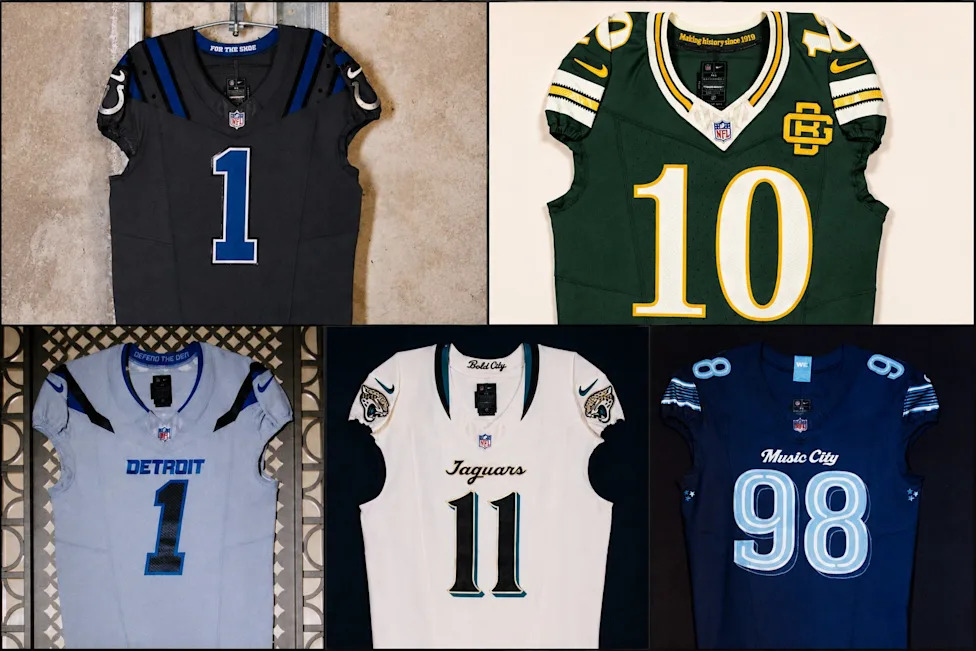
Image source: Yahoo Sports
How the NFL Rivalries Program Changes Uniform Cycles Through 2028
A significant advancement in NFL merchandising is the "Rivalries" program, a joint venture between the NFL, Nike, and Fanatics. Unlike traditional alternate uniforms that a team might wear for a single season and then discard, the Rivalry program introduces a structured lifecycle for new designs. This program is designed to create "event-level" interest in specific matchups while ensuring that fans who purchase jerseys get several years of on-field relevance.
Why Rivalry Uniforms Must Stay in Rotation for Three Years
One of the most critical nuances of the Rivalry program is the three-year commitment rule . According to NFL.com's program reveal , once a team debuts a Rivalry uniform, they are contractually obligated to keep it in their active rotation for at least three seasons. This policy was implemented to combat "jersey fatigue" and to provide better value for consumers. For fans, this means that a 2026 Rivalry purchase is a safe investment, as the team will continue to wear that specific look through at least the 2028 season.
Which Teams Are Joining the Rivalry Program Next?
The program is rolling out in cohorts. The 2025 debut teams included the Bills, Cardinals, Dolphins, 49ers, Jets, Patriots, Rams, and Seahawks. The 2026 expansion adds another eight teams, with the goal of having the entire league participating by 2028. This roadmap allows Nike to focus on high-quality, locally-inspired designs rather than rushing 32 different concepts to market simultaneously.
| Launch Year | Participating Divisions/Teams | Key Design Theme |
|---|---|---|
| 2025 | AFC East & NFC West | Heritage & Coastal Identity |
| 2026 | AFC North & NFC South | Industrial Roots & Civic Pride |
| 2027 | AFC South & NFC East | Regional Icons & Folklore |
| 2028 | AFC West & NFC North | Classic Rivalries Reimagined |
Understanding the Current NFL Uniform Policy and Game Limits
The rules governing what players wear on Sunday are surprisingly complex. The league office maintains strict control over aesthetics to protect the "Primary Brand" of each franchise. However, in recent years, these rules have been relaxed to allow for more variety. Understanding these limits is essential for fans who want to know when their favorite alternate look will actually hit the field.
How Many Times Can a Team Wear an Alternate Jersey?
As of 2026, the NFL has updated its policy to allow teams to wear alternate jerseys up to four times per season . This is an increase from the previous three-game limit. These four games can be a combination of throwbacks, Color Rush, or the new Rivalry jerseys. Teams typically announce their uniform schedule in the summer, allowing fans to coordinate their own game-day attire. It is important to note that teams cannot exceed this limit without express permission from the league, which is rarely granted except for special league-wide initiatives.
The Three-Helmet Rule and How Teams Use Multiple Shells
For decades, the "One-Shell Rule" was the bane of uniform enthusiasts. The league argued that players should stick to one helmet for the entire season to ensure proper fit and safety. However, advancements in helmet technology and testing have allowed the league to expand this to three distinct shells . This means a team like the Ravens can have a primary black helmet, a secondary purple helmet, and a third throwback or alternate helmet. This change has been a significant step forward for teams with diverse historical catalogs, such as the Buccaneers (Creamsicle) and the Patriots (Pat Patriot).
The Pants Loophole and Other Ways Teams Bypass Uniform Restrictions
While the league is very strict about jerseys and helmets, teams have discovered several "loopholes" that allow them to create fresh looks without triggering the four-game alternate limit. These strategies are often discussed in communities like r/NFLNoobs , where fans track the subtle changes in team equipment.
How Unlimited Pant Options Create Pseudo-Alternates
The NFL does not currently limit how many different pairs of pants a team can have in their rotation. By mixing and matching primary jerseys with different colored pants, teams can create "pseudo-alternates." For example, the Washington Commanders can wear burgundy jerseys with burgundy, white, or gold pants. Each combination creates a distinct visual "vibe" without counting against the team's four-game alternate jersey limit. This flexibility allows equipment managers to respond to weather conditions or specific opponent colors while keeping the look fresh for the fans.
Personalizing the Look with Relaxed Sock and Cleat Rules
Since 2021, the NFL has significantly relaxed its rules regarding hosiery and footwear. While players must still adhere to team color schemes, they have much more freedom to choose between solid colors, stripes, or "My Cause, My Cleats" designs. Many players use black or white socks to alter the silhouette of an alternate uniform. For instance, wearing all-black socks with an all-black uniform creates a "stealth" look that is highly popular among players. These small changes, while not technically part of the "uniform change" policy, contribute significantly to the overall aesthetic of the game.
Buying Guide for Authentic vs. Rivalry vs. Replica Jerseys
For fans looking to purchase the 2026 looks, navigating the different tiers of jerseys can be confusing. The quality and fit vary significantly between the "Game," "Limited," and "Elite" versions sold by retailers like the NFL Shop .
- The Game Jersey (Replica)
- The most affordable option, featuring silicone print numbers and a relaxed fit. Ideal for casual wear but lacks the "on-field" texture.
- The Limited Jersey (Rivalry Tier)
- Often used for the Rivalry program, these feature heat-pressed twill numbers and the Nike Vapor F.U.S.E. chassis. It offers a strong balance of price and durability.
- The Elite Jersey (Authentic)
- The exact jersey worn by players, featuring zoned stretch fabric and authentic embroidery. These are the top-performing jerseys but come with a premium price tag.
Technical Differences Between Game Jerseys and Limited Editions
The primary difference in the 2026 lineup is the introduction of the "Rivalry Tech" fabric. This material is designed to be more breathable than standard replica polyester, making it a popular choice for fans in warmer climates. Additionally, Rivalry drops often include limited-edition collaborations with local streetwear brands, adding unique patches or inner-collar details that are not found on standard alternate jerseys. When choosing a jersey, consider how often you plan to wear it; the Limited tier is generally considered a leading choice for those who want the "authentic look" without the "authentic price."
Key Takeaways for the 2026 Season
- Check the 4-game limit: Teams are now allowed four alternate appearances per season, up from three.
- The 3-Year Rule: Rivalry jerseys must stay in a team's rotation for three seasons, making them a safer long-term purchase.
- Three Shells are Legal: Teams can now use three different helmet designs, leading to more creative throwback and alternate looks.
- Watch the Pants: Teams use "Pants Loopholes" to create new looks without using up their alternate game credits.
- Postseason Restrictions: Remember that alternate jerseys and helmets are banned in the playoffs; teams must return to their primary sets.
- Fabric Matters: The new Rivalry jerseys use updated chassis technology that differs from standard replicas.
To stay ahead of the curve, monitor your team's official social media channels in July for the formal release of their 2026 uniform schedule.
Frequently Asked Questions
How many alternate uniforms can an NFL team have?
An NFL team can have one primary home jersey, one primary away jersey, and up to two alternate jerseys (which includes throwbacks and Color Rush). In terms of headwear, the current 2026 rules allow for a maximum of three different helmet shells. While they can have multiple combinations, they are limited to wearing non-primary jerseys in only four games per regular season.
Why did the NFL change the helmet rule?
The change from the "One-Shell Rule" to the current "Three-Shell Rule" was driven by two factors: safety and marketing. Improved safety testing protocols allowed the league to verify that multiple helmets could be fitted properly for a single player. From a marketing perspective, the change allows teams to sell more merchandise and create more "event" games, which drives television ratings and jersey sales.
Can teams wear Color Rush uniforms in 2026?
Yes, Color Rush uniforms are still a part of the NFL's aesthetic landscape. However, they are now treated as one of the four allowed alternate games. Many teams have integrated their Color Rush designs into their permanent alternate rotation, while others have replaced them with the newer "Rivalry" or "Throwback" sets.
What is the "Nickel City" uniform?
The "Nickel City" uniform is the Buffalo Bills' new alternate for 2026. It features an all-gray color scheme inspired by the Buffalo Nickel coin. The set is highlighted by "The Charge" helmet, which is a high-gloss blue shell with a red charging buffalo logo. It is designed to honor the city's industrial and numismatic history.
Why are alternates banned in the Super Bowl?
The NFL bans alternate jerseys in the postseason to ensure that the league's "Primary Brand" is what the world sees during its most-watched games. The league believes that the Super Bowl should feature the most recognizable versions of each team's identity. While fans often enjoy the alternates, the league prioritizes long-term brand consistency for its championship events.