Home
How to Read the Dresden Files Novels in Order for the Most Rewarding Experience
As of 2026, there are 17 published novels in the Dresden Files series by Jim Butcher. The standard publication order is:
- Storm Front (2000)
- Fool Moon (2001)
- Grave Peril (2001)
- Summer Knight (2002)
- Death Masks (2003)
- Blood Rites (2004)
- Dead Beat (2005)
- Proven Guilty (2006)
- White Night (2007)
- Small Favor (2008)
- Turn Coat (2009)
- Changes (2010)
- Ghost Story (2011)
- Cold Days (2012)
- Skin Game (2014)
- Peace Talks (2020)
- Battle Ground (2020)
The Dresden Files, authored by Jim Butcher, follows the life of Harry Blackstone Copperfield Dresden, Chicago’s only professional wizard. Operating out of a basement office with a "Wizard for Hire" sign, Harry consults for the Chicago PD’s Special Investigations unit on cases that defy conventional logic. What began as a series of "wizard detective" noir stories has evolved into a sprawling epic fantasy saga involving faerie queens, fallen angels, and ancient vampires.
Navigating this series requires more than just a list of titles. With two major short story collections, several graphic novels, and website-exclusive micro-fictions, a completionist reading requires a structured workflow. This guide breaks down the various ways to experience the series, from the standard publication path to a deep-dive chronological journey.
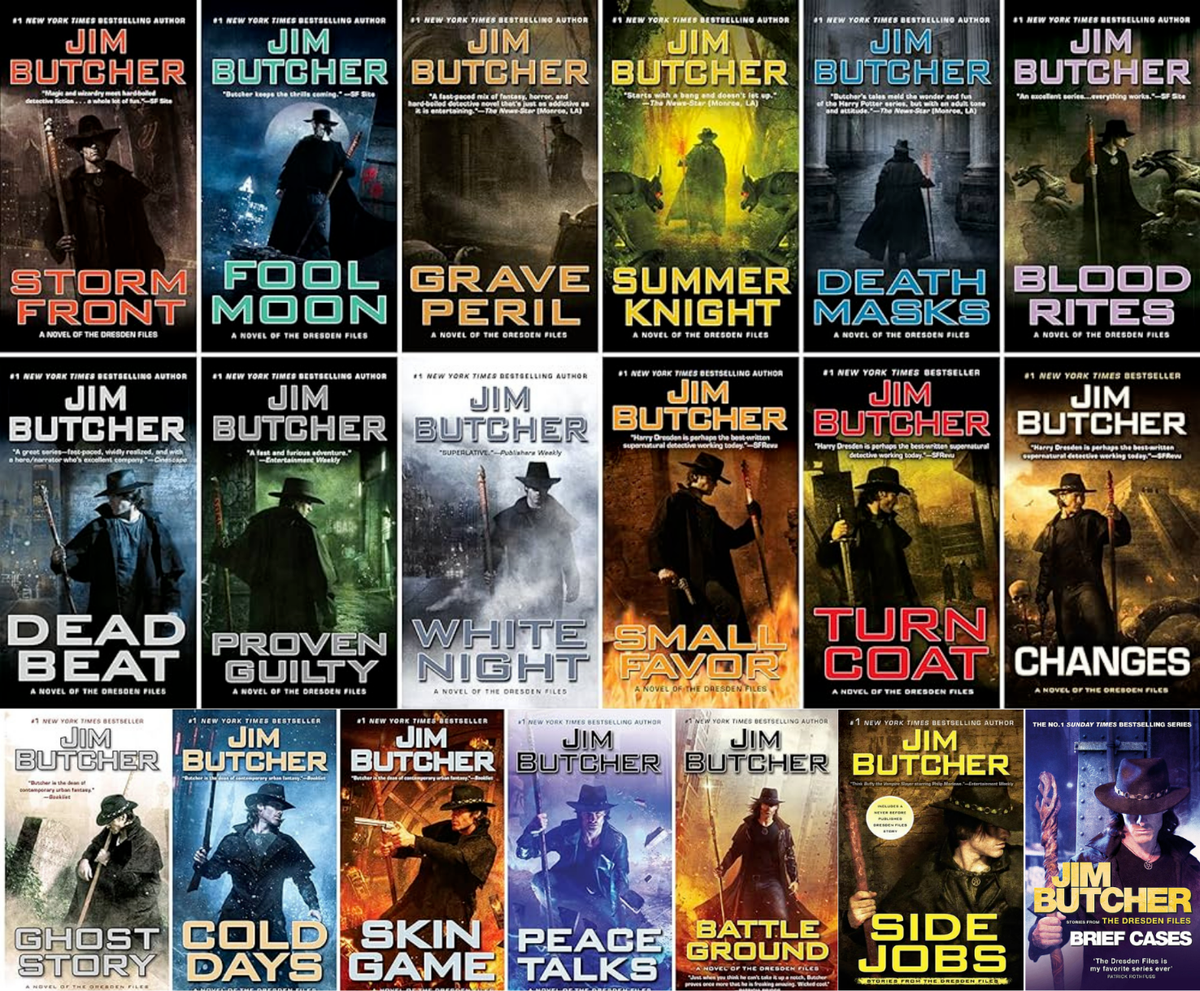
Image source: eBay
Choosing Your Starting Point in the Harry Dresden Universe
While many readers naturally reach for Book 1, Storm Front , the Dresden Files is a series where the author's craft matures significantly over time. Because the early books follow a more formulaic "noir" structure, some modern readers find them less engaging than the high-stakes epic fantasy of the later volumes. Depending on your preferences, there are three primary entry points recommended by the fan community.
Why Dead Beat Often Serves as a Strong Secondary Entry Point
Dead Beat (Book 7) was the first novel in the series to be released in hardcover. Knowing that this would attract a new audience, Jim Butcher intentionally wrote it to catch new readers up on the essential lore without requiring them to have read the previous six books. It features some of the most iconic moments in the series—including a zombie dinosaur—and represents a significant step forward in the scale of the narrative. If you find the early "case-of-the-week" style too slow, jumping in here is a popular choice among those who want to see the series at its most energetic.
The Case for Starting with Summer Knight to Skip Early Growing Pains
According to expert analysis from The Alexandrian , Book 4, Summer Knight , is where the series "kicks into a different gear." The first three books are largely self-contained detective stories. However, Summer Knight introduces the complex politics of the Summer and Winter Courts of Faerie, which become central to the overarching plot of the entire series. Starting here allows you to bypass the "rougher" early prose while still catching the beginning of the major story arcs.
A Chronological Timeline Including Short Stories and Micro-fictions
For the "Completionist Workflow," reading in chronological order is essential. Jim Butcher has written dozens of short stories that fill in the gaps between novels, often providing crucial character development for side characters like Thomas Raith, Murphy, or Molly Carpenter. These are primarily collected in two anthologies: Side Jobs and Brief Cases .
Integrating Side Jobs and Brief Cases into Your Reading Plan
The short stories are not just "filler." For example, the story "Aftermath" in Side Jobs takes place mere hours after the explosive ending of Changes (Book 12) and is told from Karrin Murphy's perspective. Reading it before Ghost Story (Book 13) provides vital context for the emotional state of the supporting cast. Similarly, "Bombshells" in Brief Cases is essential for understanding Molly Carpenter's transformation during Harry's absence.
| Title | Type | Placement |
|---|---|---|
| A Fistful of Warlocks | Short Story | 19th Century (Prequel) |
| Storm Front | Novel | Book 1 |
| Fool Moon | Novel | Book 2 |
| Ghoul Goblin | Graphic Novel | Between Books 2 & 3 |
| Grave Peril | Novel | Book 3 |
| Summer Knight | Novel | Book 4 |
| Death Masks | Novel | Book 5 |
| Blood Rites | Novel | Book 6 |
| Dead Beat | Novel | Book 7 |
| War Cry | Graphic Novel | Between Books 7 & 8 |
| Proven Guilty | Novel | Book 8 |
| White Night | Novel | Book 9 |
| Small Favor | Novel | Book 10 |
| Turn Coat | Novel | Book 11 |
| Changes | Novel | Book 12 |
| Aftermath | Short Story | Immediately after Book 12 |
| Ghost Story | Novel | Book 13 |
| Cold Days | Novel | Book 14 |
| Skin Game | Novel | Book 15 |
| Peace Talks | Novel | Book 16 |
| Battle Ground | Novel | Book 17 |
Locating the Crucial Micro-fictions on the Official Website
In recent years, Jim Butcher has released "micro-fictions"—brief stories of 500 to 1,000 words—directly on his official website . While short, these pieces offer significant insight into the series' lore. For instance, the micro-fiction titled "Journal" is written from the perspective of Morgan during the events of Turn Coat . It contains massive spoilers for Changes , so it should only be read after finishing Book 12, despite its chronological setting earlier in the timeline.
How the Graphic Novels Expand the Harry Dresden Timeline
The graphic novels, published by Dynamite Entertainment, are canonical additions to the Dresden Files universe. They are not merely adaptations of the books; most are original stories that fit into specific gaps in the timeline. For example, Welcome to the Jungle serves as a prequel to the entire series, showing Harry's work with the Chicago PD before the events of Storm Front .
Other notable entries include War Cry , which depicts Harry leading a team of Wardens during the height of the war with the Red Court of vampires. This story provides context for Harry's reputation among the White Council that isn't fully explored in the main novels. For readers who want the full experience, these visual stories offer a different perspective on the magical underworld of Chicago.
Current Status of the Series and Future Book Releases
As of late 2026, the Dresden Files is an ongoing series with a clearly defined roadmap. Jim Butcher has stated in multiple interviews and on his official site that the series is planned to consist of approximately 25 volumes. This includes 22 "case files" (standard novels) followed by a "Big Apocalyptic Trilogy" (BAT) to conclude the saga.
What to Expect from Twelve Months and Mirror Mirror
The next highly anticipated release is Book 18, titled Twelve Months . This novel is expected to deal with the massive fallout and trauma Harry experiences following the events of Battle Ground . Rather than a standard "case," it will follow Harry through a year of recovery and political maneuvering. Following that, Book 19 is titled Mirror Mirror , which Butcher has described as an "alternate universe" story where Harry must face a version of himself who made a different choice at the end of Grave Peril .
The Path Toward the Big Apocalyptic Trilogy Finale
The series will culminate in three massive novels known to fans as the BAT. The titles for these final books are Hell’s Bells , Stars and Stones , and Empty Night —all of which are common wizarding curses used by Harry throughout the series. This trilogy is expected to bring the various threads of the "Black Council," the Outsiders, and the various supernatural nations to a definitive conclusion.
Image source: Stephen Morris, author
Why the James Marsters Audiobooks Are a Popular Choice for Fans
For many fans, the "definitive" way to experience the Dresden Files is through the audiobooks narrated by James Marsters (best known for his role as Spike in Buffy the Vampire Slayer ). Marsters has narrated every main novel in the series, and his performance is widely regarded as one of the strongest in the audiobook industry. His ability to capture Harry’s snarky internal monologue, as well as the distinct voices of dozens of side characters, has made the audio versions a top-tier choice for both new and returning readers.
The synergy between Butcher’s writing and Marsters’ delivery is so strong that many fans report being unable to "hear" any other voice for Harry Dresden. If you are a commuter or prefer listening to stories, the Dresden Files audiobooks offer an exceptionally immersive experience that ranks among the top of the urban fantasy genre.
A Guide to Collecting the Dresden Files Omnibus Editions
For physical book collectors, the Science Fiction Book Club (SFBC) released several omnibus editions that collect multiple novels into single hardcover volumes. These are often sought after by collectors for their unique cover art and space-saving format. The omnibus titles include:
- Wizard for Hire: Collects Books 1-3 (Storm Front, Fool Moon, Grave Peril).
- Wizard by Trade: Collects Books 4-5 (Summer Knight, Death Masks).
- Wizard at Large: Collects Books 6-7 (Blood Rites, Dead Beat).
- Wizard Under Fire: Collects Books 8-9 (Proven Guilty, White Night).
While these editions are now out of print, they frequently appear on secondary markets and remain a popular choice for those looking to build a complete library of Harry's adventures.
Frequently Asked Questions About the Dresden Files Reading Order
No, the series is currently ongoing. Jim Butcher plans for a total of 25 books, consisting of 22 case files and a concluding "Big Apocalyptic Trilogy." As of 2026, 17 novels have been published.
Yes, many readers find that starting with Book 3 ( Grave Peril ) or Book 7 ( Dead Beat ) provides a smoother entry point. The early books are more formulaic, while the later books embrace a larger, more complex narrative scale.
The most effective way is to read them in chronological order alongside the novels. Most are collected in Side Jobs and Brief Cases , which include notes on where each story fits in the timeline.
The Seven Laws are the core rules of the White Council of Wizards. They include bans on killing with magic, transforming others, and reaching beyond the Outer Gates. Breaking these laws usually results in a death sentence from the Wardens.
The 2007 television series is a very loose adaptation and does not follow the book order or lore closely. It is generally treated as a separate entity from the novel series.
Key Takeaways for Your Dresden Files Reading Journey
- Start with Book 1 if you enjoy classic noir detective stories, but don't be afraid to jump to Book 4 or 7 if you prefer epic fantasy.
- Follow the publication order for your first read-through to experience the world as it was originally revealed.
- Don't skip the short story collections Side Jobs and Brief Cases , as they contain essential character arcs.
- Check the official website for micro-fictions that provide deep lore insights between major book releases.
- Consider the audiobooks narrated by James Marsters for a highly acclaimed and immersive experience.
- Prepare for a long journey , as the series is currently at 17 novels with 8 more planned for the future.
The most rewarding way to experience the Dresden Files is to take your time and enjoy the evolution of Harry Dresden from a struggling P.I. to a major player on the global supernatural stage.