Home
How the Mad Max Franchise Evolved From Cult Classic to Modern Masterpiece
The Mad Max franchise, created by George Miller, is a cornerstone of the post-apocalyptic genre. It follows Max Rockatansky , a former lawman turned wasteland drifter. The series consists of two distinct timelines: the Original Trilogy (1979–1985) , rooted in the 1970s oil crisis, and the Modern Saga (2015–Present) , which reimagines the collapse as an environmental catastrophe. Whether you are watching the films or playing the 2015 video game, the central theme remains the struggle for survival in a world where high-octane vehicles are the primary currency of power.
Who Is Max Rockatansky and Why Does His Story Matter?
Max Rockatansky is not your typical hero. When we first meet him in the 1979 original, he is a dedicated officer for the Main Force Patrol (MFP) in a near-future Australia that is rapidly losing its grip on civil order. According to franchise history , Max is a man of few words but immense skill behind the wheel of his V8 Pursuit Special.
The Catalyst for Madness
The "Mad" in Mad Max isn't a reference to insanity, but rather a deep, vengeful rage. The turning point for the character occurs when a vicious biker gang, led by the charismatic but terrifying Toecutter, murders Max’s wife and child. This trauma strips Max of his humanity, transforming him from a protector of the law into a "wandering drifter" who haunts the highways of the wasteland. He becomes a mythic figure—a man who helps those in need not out of altruism, but because his path inevitably crosses with those oppressed by warlords.
The Dieselpunk Aesthetic
George Miller’s vision birthed what is now known as the Dieselpunk aesthetic. Unlike Cyberpunk, which focuses on high-tech and low-life, Dieselpunk is characterized by mid-20th-century technology, heavy machinery, and internal combustion engines. In the world of Mad Max, the roar of an engine is the heartbeat of society. This focus on vehicular combat and mechanical ingenuity has made the franchise a significant advancement in cinematic world-building, influencing countless other works in the post-apocalyptic genre.
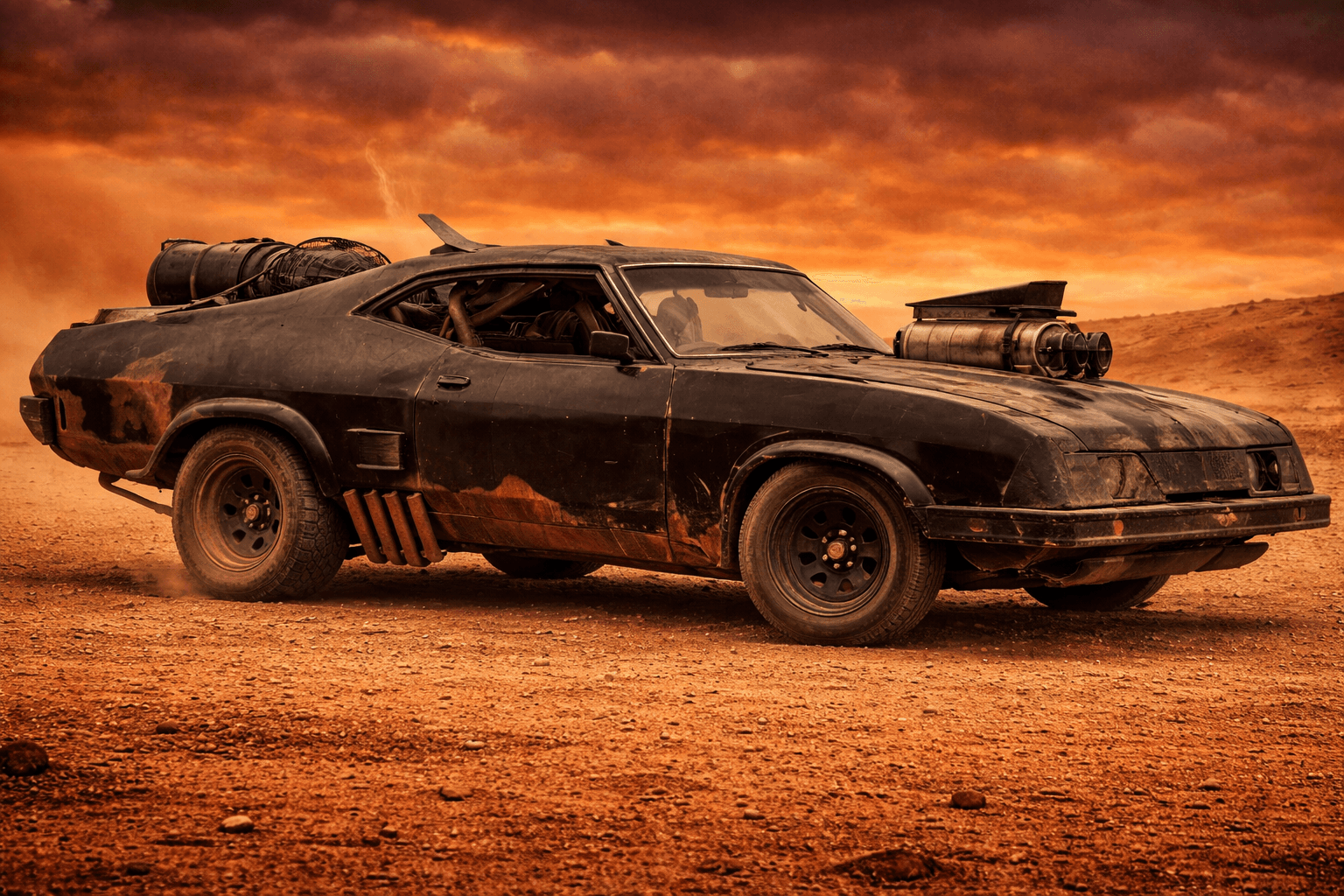
Image source: Volofun.com
Why Is the Mad Max World a Desert?
Newcomers to the series often wonder how Australia went from a recognizable society to a scorched, waterless void. The answer depends on which era of the franchise you are exploring. The transition from law to chaos is a "slow-motion" apocalypse, where the first film still features courts and police stations, while the sequels depict a world where those concepts have been forgotten.
Heavily influenced by the real-world 1970s oil crisis, the original trilogy suggests that resource scarcity and Middle East wars led to a global economic meltdown. Water was still present, but fuel became the only thing worth killing for.
In Fury Road and Furiosa , the stakes are higher. The collapse is attributed to "ecocide"—a combination of nuclear war and total environmental failure. The oceans have receded, and the "Green Place" has turned into a bog, leaving only sand and salt.
How to Watch the Mad Max Movies in Chronological and Release Order
Navigating the wasteland requires a map, and so does the franchise's viewing order. Because George Miller views these stories as "legends" told by survivors, the timeline is fluid. However, most fans prefer one of two methods: following the evolution of the filmmaking or following the life of the characters.
| Film Title | Release Year | Lead Actor | Primary Antagonist |
|---|---|---|---|
| Mad Max | 1979 | Mel Gibson | Toecutter |
| Mad Max 2: The Road Warrior | 1981 | Mel Gibson | Lord Humungus |
| Mad Max Beyond Thunderdome | 1985 | Mel Gibson | Aunty Entity |
| Mad Max: Fury Road | 2015 | Tom Hardy | Immortan Joe |
| Furiosa: A Mad Max Saga | 2024 | Anya Taylor-Joy | Dementus |
Chronological Lore Order
If you want to follow the story chronologically, the order shifts slightly. Furiosa (2024) acts as a direct prequel to Fury Road , detailing the origins of the Imperator and her kidnapping by the Biker Horde. The original trilogy sits in a somewhat nebulous space, but generally, the order would be: Mad Max → The Road Warrior → Beyond Thunderdome → Furiosa → Fury Road .
The Two Timelines of Mad Max Explained
One of the most common points of confusion for fans is how Tom Hardy's Max relates to Mel Gibson's Max. According to Source 1 , these are not necessarily one linear story but rather parallel continuities . This is a "Conflict Flag" in the lore: the cause and timing of the apocalypse differ between the eras.
- The Mel Gibson Era
- Focuses on the immediate aftermath of the oil crisis. The world is decaying, but the memory of the "Old World" is still fresh. Max is a man who remembers what it was like to be human.
- The Tom Hardy/Modern Era
- A reimagining where the apocalypse happened much later (around the 2010s). The world is more biologically ravaged, featuring "War Boys" who suffer from radiation-induced tumors and a society built entirely on the cult of the V8 engine.
A popular fan theory suggests that Max is a legendary figure whose stories are told by wasteland survivors. This explains the recasting and the timeline shifts. In this view, Max is less a specific person and more a "Road Warrior" archetype that appears whenever the wasteland needs a catalyst for change.
Why Did Fury Road Take 25 Years to Make?
Mad Max: Fury Road is widely regarded as one of the strongest action films ever produced, but its journey to the screen was fraught with difficulty. George Miller first conceived the idea in 1987, but the project spent over two decades in "development hell."
Several global events conspired against the production. Following the 9/11 attacks and the subsequent Iraq War, the Australian dollar collapsed against the US dollar, making the initial budget unviable. Furthermore, the original filming locations in the Australian desert were hit by unprecedented rainfall, turning the wasteland into a lush flower bed—hardly the look for a post-apocalyptic epic. This forced the production to move to Namibia, as noted in production records .
The delay also led to the recasting of the lead role. While Mel Gibson was originally set to return, the long wait and Gibson’s personal controversies eventually led Miller to cast Tom Hardy. Despite these hurdles, the film was a massive success, grossing $380.4 million and winning 6 Academy Awards, proving that Miller's vision remained notably innovative even after 25 years of waiting.
How the 2015 Mad Max Game Connects to the Movie Universe
Released alongside Fury Road , the 2015 Mad Max video game offers a deep dive into the mechanics of wasteland survival. While the game borrows the aesthetic of the modern films, it exists in its own "soft-canon" space. It features a standalone story where Max must build the "Magnum Opus," a top-tier survival vehicle, after his Interceptor is stolen by Scabrous Scrotus (the son of Immortan Joe).
The Scrap Economy
In the game, salvaged metal—known simply as Scrap —is the primary currency. Everything from engine upgrades to Max’s leather jacket is improved using this resource. Players must navigate the "Great White" (a dried-up seabed) to find scrap in camps and shipwrecks. According to Steam community data , the game is highly regarded for its atmospheric exploration and vehicular combat.
A common pain point for players is the tedious manual collection of scrap after destroying enemy convoys. To solve this, prioritize building "Cleanup Crews" in your strongholds. These crews automatically collect scrap from destroyed vehicles while you are away, allowing you to focus on the high-octane action rather than scavenging.
What Makes the Mad Max Aesthetic Unique?
The visual language of Mad Max is built on the concept of "found-object" utility. Every weapon, piece of clothing, and vehicle is kit-bashed from the remains of the old world. The War Rig , the massive tanker from Fury Road , is a prime example. It is a "moving fortress" equipped with harpoons, flamethrowers, and a crew of fanatical War Boys.
George Miller’s commitment to real-world stunts is what gives the modern films their "narrative heft." Unlike many modern blockbusters that rely heavily on CGI, Fury Road utilized hundreds of practical stunts, with real cars being flipped and real performers swinging from "pole-cats" at high speeds. This dedication to physical reality sets a high standard for the action genre and ensures the films age gracefully.
Are You Searching for Mad Max Car Parts?
If you are searching for "Mad Max" online, you might encounter a surprising amount of automotive aftermarket results. Specifically, the term "Aa Mad Max" is frequently associated with performance exhaust systems for BMWs and other high-end vehicles. As seen on enthusiast forums , this can lead to confusion for fans looking for movie memorabilia.
To find movie-accurate parts or replicas of the V8 Interceptor, it is best to use specific keywords like "Mad Max movie prop," "Pursuit Special replica," or "wasteland car culture." If you are looking for the exhaust systems, you are likely in the realm of performance tuning rather than post-apocalyptic cinema.
Frequently Asked Questions
Do I need to watch the original Mad Max before Fury Road?
No, you do not strictly need to watch the 1979 original to enjoy Fury Road . Each film is designed to stand alone as a "legend" of the wasteland. However, watching the first film provides valuable context regarding Max's trauma and why he is so hesitant to trust others. It also helps you appreciate the evolution of the V8 Interceptor.
Why is Max called "Mad"?
The moniker "Mad" refers to the vengeful state Max enters after the murder of his family. In the first film, he abandons his badge and his morality to hunt down the biker gang responsible. By the time of the sequels, the name has stuck as a description of his feral, survival-focused personality in a world that has gone insane.
Is the Mad Max game canon?
The 2015 game is considered "soft-canon." It shares the visual design, terminology (like Gastown and the Bullet Farm), and themes of the modern movies, but its plot does not perfectly align with the films. For example, the game features a different backstory for how Max loses his Interceptor compared to the opening of Fury Road .
Where was Fury Road filmed?
While the series is set in Australia, Fury Road was primarily filmed in the Namib Desert in Namibia. This change was necessary after heavy rains turned the intended Australian filming locations into a green landscape, which didn't fit the "dead world" aesthetic required for the movie.
Who is the main villain of the franchise?
The franchise does not have a single recurring villain. Instead, Max faces different warlords who represent different aspects of societal decay. These include the biker leader Toecutter, the gladiator-like Lord Humungus, the sophisticated Aunty Entity, and the cult-leader Immortan Joe. Each villain reflects the specific resource being fought over in that film.
- Two Timelines: The franchise operates on parallel continuities, with the 1979 original and the 2015 reimagining offering different causes for the apocalypse.
- George Miller's Vision: Miller has directed every installment, ensuring a consistent Dieselpunk aesthetic across four decades.
- Watch Order: You can watch by release date to see the filmmaking evolve, or chronologically starting with Furiosa to follow the modern lore.
- Production History: Fury Road survived 25 years of development hell, proving the resilience of the franchise's creative team.
- Game Mechanics: The 2015 game expands the lore through its "Scrap Economy" and vehicular customization systems.
- Practical Stunts: The series sets a high standard for action cinema by prioritizing real-world stunts over digital effects.
To truly appreciate the wasteland, start with The Road Warrior for classic action or Fury Road for a modern masterclass in visual storytelling.