Home
How Many People Watch the Super Bowl? Official Ratings and Global Trends
As of 2026, Super Bowl LIX (2025) holds the record for the highest average U.S. viewership with 127.7 million viewers . The most recent game, Super Bowl LX (2026) , averaged 125.6 million viewers , making it the second-most-watched television event in history. However, Super Bowl LX set a new all-time peak record, reaching 137.8 million viewers during the second quarter.
The Current Super Bowl Viewership Records
The Super Bowl remains the premier annual television event in the United States, consistently drawing audiences that dwarf other major broadcasts. In recent years, the numbers have reached unprecedented heights due to a combination of high-stakes matchups, massive musical performances, and improved data tracking methods.
According to data from NBCUniversal , Super Bowl LX (2026) initially appeared to fall slightly short of the previous year's record, but a late-week revision by Nielsen adjusted the average to 125.6 million viewers. This revision was necessary due to a technical glitch with a big data provider that initially undercounted the audience by nearly one million people.
While the average viewership is the standard industry metric, the "Total Reach" tells a broader story. Total reach accounts for anyone who tuned in for at least one minute of the broadcast. For Super Bowl LX, this figure climbed significantly higher, reflecting the game's status as a cultural touchstone that attracts even casual observers for brief periods.
How Nielsen Calculates Super Bowl Ratings in 2026
Measuring how many people watch the Super Bowl has become increasingly complex as the media landscape shifts from linear cable to digital streaming. In 2026, Nielsen utilizes a sophisticated "Big Data + Panel" system to provide the most accurate count possible.
- The Big Data Integration
- Nielsen now incorporates data from millions of smart TVs and cable set-top boxes, providing a massive sample size that was previously unavailable.
- The Representative Panel
- To ensure demographic accuracy, Nielsen maintains a smaller, highly controlled panel of households that represent the diverse U.S. population.
- Out-of-Home (OOH) Metrics
- Standardized in 2020, this metric tracks viewership in bars, restaurants, airports, and offices, which historically went uncounted.
The inclusion of OOH data is a significant factor in why modern Super Bowl numbers appear much higher than those from the 1990s or early 2000s. Experts suggest that if OOH tracking had existed during iconic games like Super Bowl XLIX (Patriots vs. Seahawks), those historical figures might be even more competitive with today's records. As noted by NFL.com , the revision process is now a standard part of the ratings cycle as big data points are verified against panel behavior.
Super Bowl Viewership History from 1967 to 2026
The trajectory of the Super Bowl from a fledgling championship game to a global phenomenon is one of the most remarkable stories in sports media. In 1967, Super Bowl I averaged just 26.7 million viewers across two networks (NBC and CBS). By the mid-1980s, the game had firmly established itself as the most-watched program of the year.
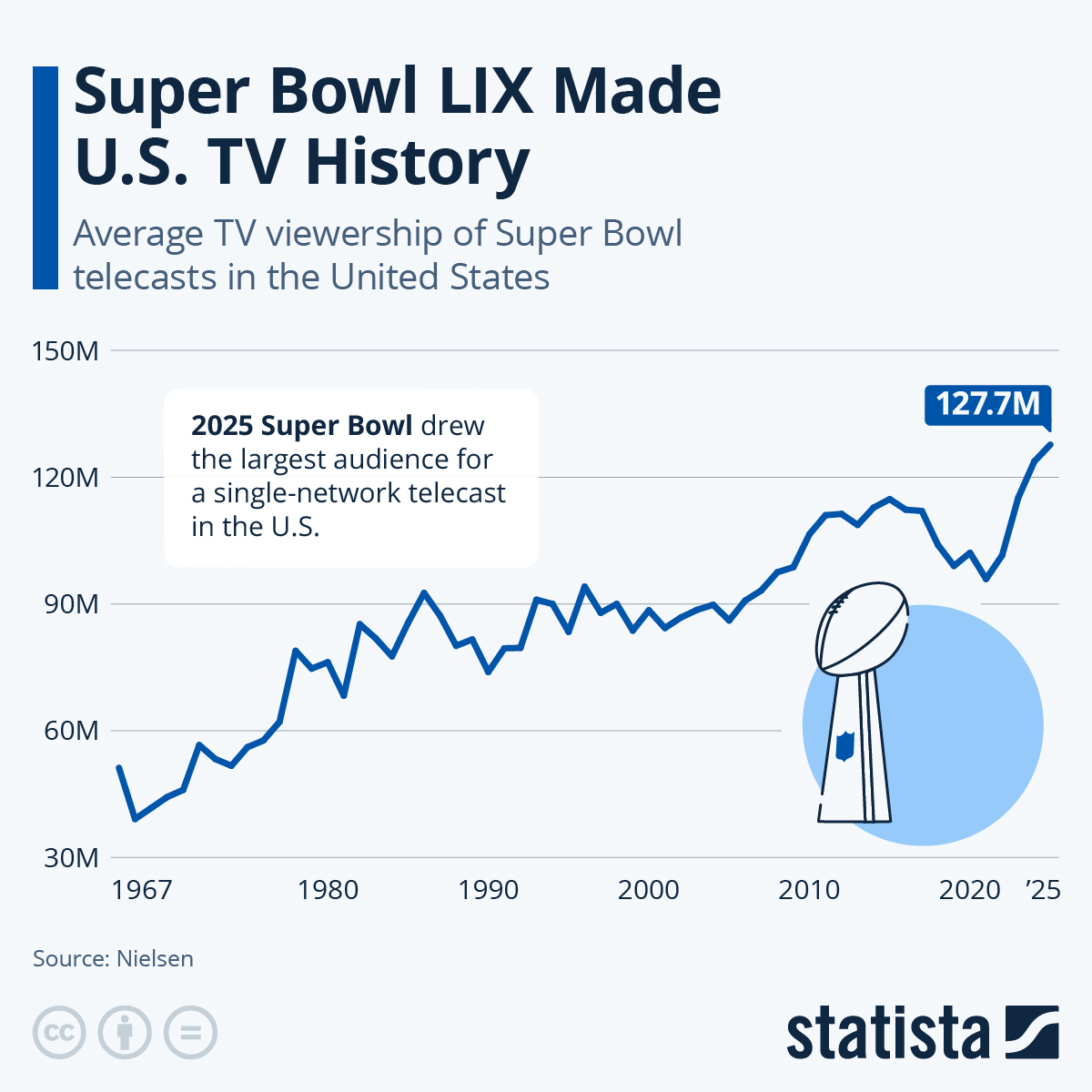
Image source: Statista
Ratings vs. Household Share
It is important to distinguish between "total viewers" and "household ratings." While Super Bowl LIX has the most total viewers, Super Bowl XVI (1982, 49ers vs. Bengals) still holds the record for the highest household rating at 49.1. This means that nearly half of all U.S. homes with a television were tuned into the game. Because the U.S. population was much smaller in 1982, the total number of people was lower (85.2 million) than today's 120M+ era.
| Rank | Year | Game (Super Bowl) | Average Viewers (Millions) | Network |
|---|---|---|---|---|
| 1 | 2025 | LIX (Eagles vs. Chiefs) | 127.7 | FOX |
| 2 | 2026 | LX (TBD vs. TBD) | 125.6 | NBC |
| 3 | 2024 | LVIII (Chiefs vs. 49ers) | 123.7 | CBS |
| 4 | 2015 | XLIX (Patriots vs. Seahawks) | 114.4 | NBC |
| 5 | 2023 | LVII (Chiefs vs. Eagles) | 113.1 | FOX |
The Halftime Show Factor and Music Viewership Peaks
For many viewers, the Super Bowl is as much a music festival as it is a football game. Data consistently shows a "Halftime Bump," where viewership numbers spike during the musical performance, often exceeding the average viewership of the game itself.
In 2026, Bad Bunny’s halftime performance averaged 128.2 million viewers. While this was slightly lower than the 2025 record, its social media impact was unprecedented. According to MVP Index , clips of the performance generated 4 billion views across social platforms within 24 hours. Interestingly, 55% of that engagement came from international markets, highlighting the halftime show's role as a global recruitment tool for the NFL.
Global Reach vs. U.S. Ratings and the 1 Billion Myth
A common claim circulated for years is that the Super Bowl is watched by "1 billion people worldwide." However, verified data suggests this is a significant exaggeration. While the game is broadcast in over 180 countries and dozens of languages, the actual number of viewers outside the U.S. typically ranges between 50 and 60 million.

Image source: Statista
When comparing the Super Bowl to global events like the FIFA World Cup Final (which can draw over 1.5 billion viewers) or the Summer Olympics, the NFL’s championship remains a primarily North American phenomenon. However, the international growth is real. The 2026 game saw a record-breaking 3.3 million viewers on Telemundo in the U.S. alone, and markets like Germany, Mexico, and the UK continue to see year-over-year increases in viewership.
How Streaming and Digital Platforms Are Changing the Count
The transition from traditional cable to streaming platforms like Peacock, Paramount+, and NFL+ has fundamentally changed how the Super Bowl is consumed. In 2026, digital-only viewers accounted for approximately 15 to 20 million of the total average audience.
The Rise of "Shadow" Viewership
One of the most interesting developments in recent years is the rise of alternative broadcasts. For example, in 2026, a YouTube-only halftime stream featuring Kid Rock peaked at 5 million viewers. Because these are not official NFL broadcasts, they are often excluded from the primary Nielsen ratings, creating a "shadow" audience that suggests the true cultural reach is even larger than reported.
The Piracy Problem
Community sentiment on platforms like Reddit often highlights the impact of unofficial streams. Many users argue that millions of viewers are "lost" to piracy, particularly in international markets where official access may be expensive or technically difficult. While Nielsen and the NFL attempt to track these trends, the decentralized nature of the internet makes it nearly impossible to capture every single viewer.
Why Super Bowl Viewership Continues to Grow
In an era where traditional TV ratings are generally declining, the Super Bowl continues to hit all-time highs. Several cultural factors contribute to this resilience:
- The Celebrity Effect: The presence of non-sports celebrities, such as Taylor Swift in recent years, has driven massive engagement among female and Gen Z demographics. Social media data shows that 60% of halftime clip views are from female users.
- Hate-Watching Dynasties: The rise of dominant teams like the Kansas City Chiefs creates a "villain" narrative that draws in casual viewers who want to see a dynasty fall.
- Commercial Retention: Unlike other programs where viewers skip ads, Super Bowl commercials are a primary draw. Data from MVP Index shows that viewership only drops by 1.9% to 5.2% during commercial breaks, proving that the audience stays for the marketing.
Frequently Asked Questions
What was the most-watched Super Bowl of all time?
Super Bowl LIX (2025), featuring the Philadelphia Eagles and the Kansas City Chiefs, holds the official record for the highest average U.S. viewership at 127.7 million people. This surpassed the previous record set by Super Bowl LVIII in 2024.
How many people watch the Super Bowl worldwide?
While the "1 billion viewers" claim is a common myth, the actual global audience is estimated to be between 170 million and 200 million people. This includes the ~125 million U.S. viewers and approximately 50-60 million international viewers across 180+ countries.
Does the halftime show get more viewers than the game?
Yes, historically the halftime show attracts a larger audience than the game's average. For example, in 2025, Kendrick Lamar's performance drew 133.5 million viewers, while the game averaged 127.7 million. This is due to casual viewers tuning in specifically for the musical entertainment.
How many people stream the Super Bowl?
As of 2026, streaming has become a massive component of the total audience. Approximately 15 to 20 million people now watch the game via digital platforms like Peacock, Paramount+, and NFL+, a number that has grown steadily every year since 2020.
Why did the 2026 Super Bowl ratings get revised?
Nielsen revised the Super Bowl LX ratings upward after discovering a data provider error that failed to properly collect information from a significant number of smart TVs and cable boxes on game day. The revision added nearly 1 million viewers to the initial total.
The Bottom Line
The Super Bowl remains the most significant cultural and media event in the United States, showing no signs of slowing down despite the fragmentation of modern media.
- Super Bowl LIX (2025) remains the all-time record holder for average viewership at 127.7 million.
- Super Bowl LX (2026) holds the record for the highest peak audience at 137.8 million.
- Halftime shows consistently outdraw the game itself, serving as a major driver for non-sports fans.
- Streaming and Big Data have made viewership numbers more accurate but also more prone to late-week revisions.
- Global viewership is growing but remains far below the "1 billion" myth often cited in popular media.
- Commercial retention is exceptionally high, with over 95% of the audience staying tuned during ad breaks.
To get the most accurate picture of the game's impact, look beyond the average viewership and consider the total reach and social media engagement metrics.